English
 Español
 中文简体
中文简体
Home / News / Industry News / Amplifier Class of Subwoofer: Class D vs Class AB and Class H Explained
Short answer: the amplifier class used for subwoofers is Class D in nearly every powered design built today between roughly 200 W and 3 kW. Class AB still makes sense below about 150 W and in some hi-fi and automotive subwoofers, while Class H holds a place in high-power professional subwoofer channels. The class is a heat, size and cost decision before it is a sound-quality label.
Sourcing a powered subwoofer, a plate amplifier or an OEM amplifier module usually starts with a power target and a cabinet drawing. The class decision then shows up in the heatsink, the power supply, the chassis depth and the bill of materials — and only later in the marketing copy.
The sections below explain why Class D took over the low-frequency channel, where the linear classes still win, and which measurements actually tell you whether a subwoofer amplifier module will survive production.
Content
- 1 Why Class D Became the Default Amplifier Class for Subwoofers
- 2 Class AB, Class D and Class H Compared for Subwoofer Duty
- 3 The Specs That Decide the Class in a Real Project
- 4 Inside a Powered Subwoofer Amplifier Module
- 5 How DSP and the Power Supply Shape the Class Result
- 6 Where Class AB and Class H Still Earn Their Place
- 7 Frequently Asked Questions
- 7.1 What amplifier class is best for a subwoofer?
- 7.2 Is Class D good for subwoofers, or does it sound worse?
- 7.3 Why do subwoofer amplifiers use Class D instead of Class AB?
- 7.4 What is the difference between Class D and Class H subwoofer amplifiers?
- 7.5 How much power does a subwoofer amplifier module need?
- 7.6 Do Class D subwoofer amplifiers need a special power supply?
Why Class D Became the Default Amplifier Class for Subwoofers
A 1,000 W subwoofer channel is unremarkable today, so the useful question is what the amplifier does with the power it never delivers to the driver. At about 60% efficiency — realistic for a Class AB stage driven hard — roughly 670 W of every 1,000 W leaves as heat. A Class D stage running at 90% leaves about 110 W. That ratio decides heatsink mass, fan noise, chassis depth, and whether the rear of the cabinet has to be vented at all.
The frequency band suits the topology as well. A subwoofer crossed over at 80–120 Hz never asks the amplifier to reproduce switching residue in the audible midrange, and modern modulator designs close a feedback loop around the output filter, so the low-frequency distortion penalty that early Class D modules carried is now largely a historical problem.
Typical ranges quoted in amplifier design literature and manufacturers' datasheets; real values depend on load impedance and drive level.
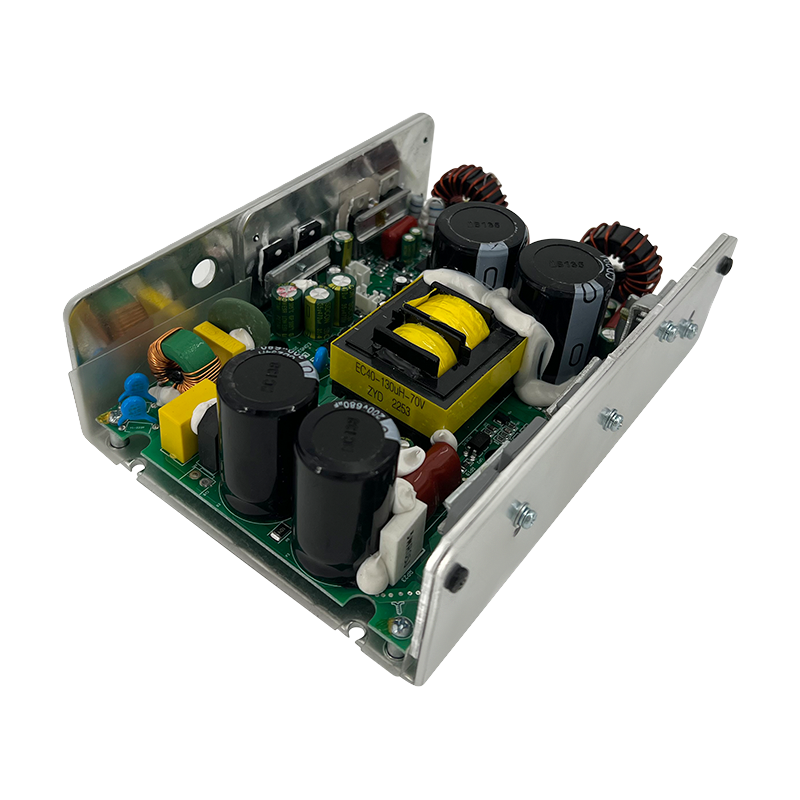
This is why a Class D subwoofer power amplifier module rated 650 W into 8Ω can sit on a rear plate without forced cooling, while a comparable linear design needs a heatsink several times larger and a heavier transformer behind it.
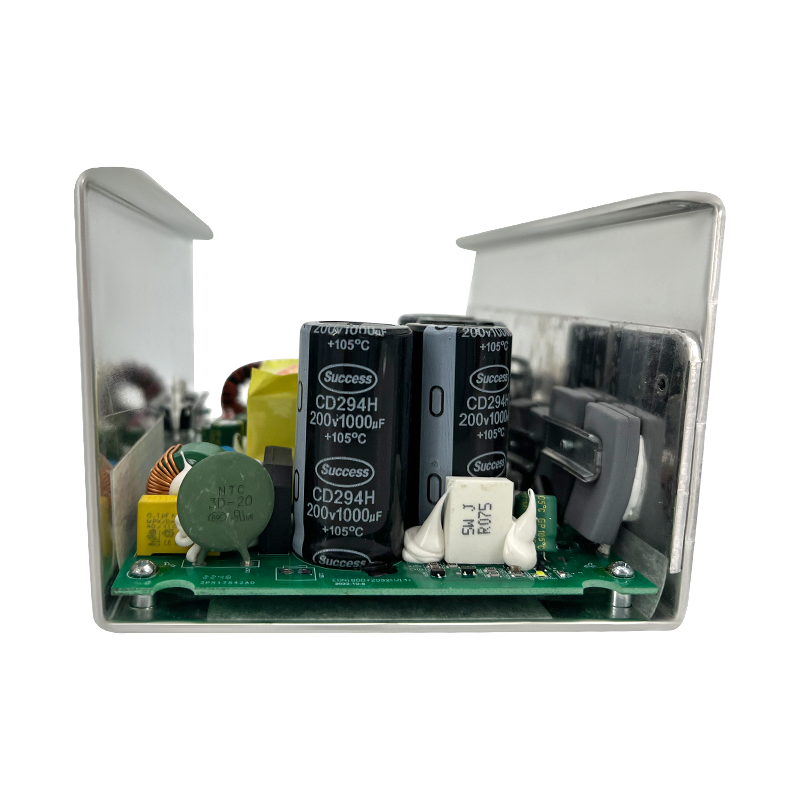 EON180S+2092: LP 650W/8Ohm Pro Audio BTL Subwoofer Power Amplifier ModuleWe have a strong R & D team that can develop and produce products according to drawings or samples provided by customers.View Product →
Class AB, Class D and Class H Compared for Subwoofer Duty
The table compares the four classes that genuinely reach subwoofer products. Efficiency ranges are typical figures quoted in amplifier design literature and manufacturers' datasheets; real values move with load impedance, rail voltage and how hard the amplifier is driven.
| Class | Typical efficiency | Heat per 1,000 W out | Where it still appears | Main trade-off |
|---|---|---|---|---|
| Class A | 20–30% | 2,300–4,000 W | Niche hi-fi and studio subwoofers | Very low distortion, very large heatsink |
| Class AB | 50–70% | 430–1,000 W | Sub-150 W systems, automotive, some studio subs | Simple and EMI-quiet, but heavy and warm |
| Class H | 70–80% | 250–430 W | High-power professional subwoofer channels | Cooler than AB, still needs a large transformer |
| Class D | 80–95% | 50–250 W | Default for powered subs, line array subs, portable | Highest efficiency, layout and EMI care needed |
Derived from the efficiency ranges above: heat = (100 / efficiency − 1) × output power.
The Specs That Decide the Class in a Real Project
Class is only the first filter. These are the numbers that separate a workable module from a datasheet that falls apart in production.
- Power at the real load. A module rated 650 W into 8Ω and one rated 650 W into 4Ω are different products. Ask for continuous power at the impedance the driver actually presents, not a peak figure.
- Damping factor at low frequency. Output impedance at 50 Hz controls how tightly a subwoofer cone starts and stops. It matters more below 100 Hz than any number measured above 1 kHz.
- THD+N below 100 Hz. Request the curve, not a single value at 1 kHz. The subwoofer band is where a class claim is genuinely tested.
- Thermal behaviour at continuous output. Heat is the reason Class D won. A module that meets its rating for a few seconds is not the same product as one rated for continuous use.
- Protection that matches real faults. Over-current, over-temperature, DC offset and short-circuit behaviour at the output should be defined, not implied by the word "protected".
- Idle and standby consumption. Retail channels in Europe and North America increasingly ask for standby figures, and they are cheapest to design in from the start.
Inside a Powered Subwoofer Amplifier Module
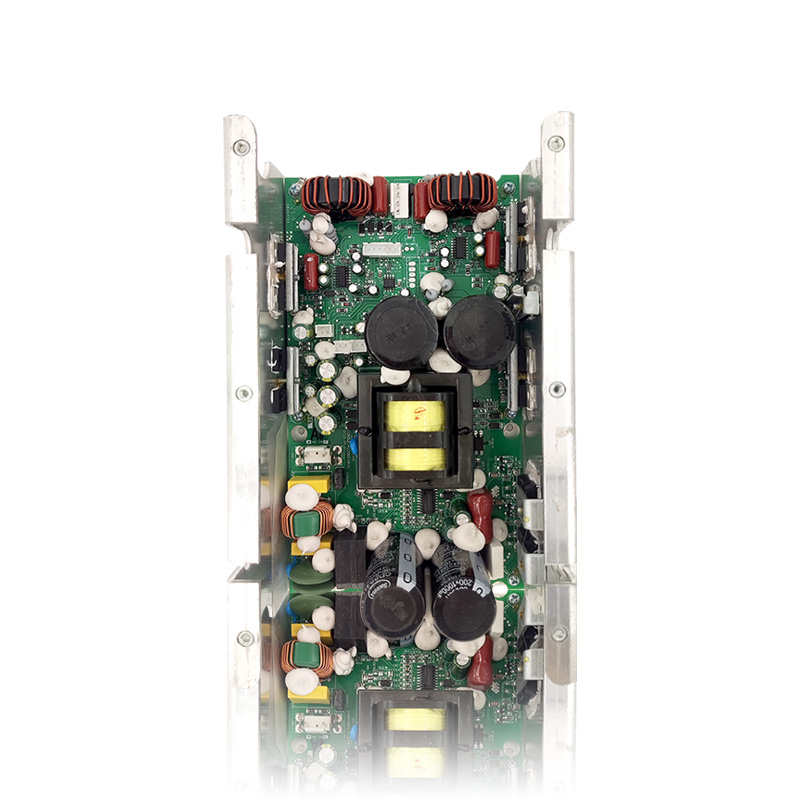
A subwoofer amplifier module is usually two or three boards stacked on standoffs: a power stage on an aluminium base, an output PCB carrying the devices, and a control or DSP board on top. That stack explains most of the thermal and layout constraints an integrator will face.
Layer stack of a typical powered subwoofer amplifier: heatsink base, output PCB on standoffs, and a control or DSP board on top.
Where the heatsink sits, how much air the chassis allows and how far the DSP board is from the switching stage all change with the class. A linear Class AB stage usually needs vertical fins and an aluminium rear panel; a Class D module can often use the rear plate itself as the heatsink. Integrators who need a specific board outline, connector set or rail voltage can frequently adapt a standard module instead of starting from a blank PCB — that is what a customization service is for.
How DSP and the Power Supply Shape the Class Result
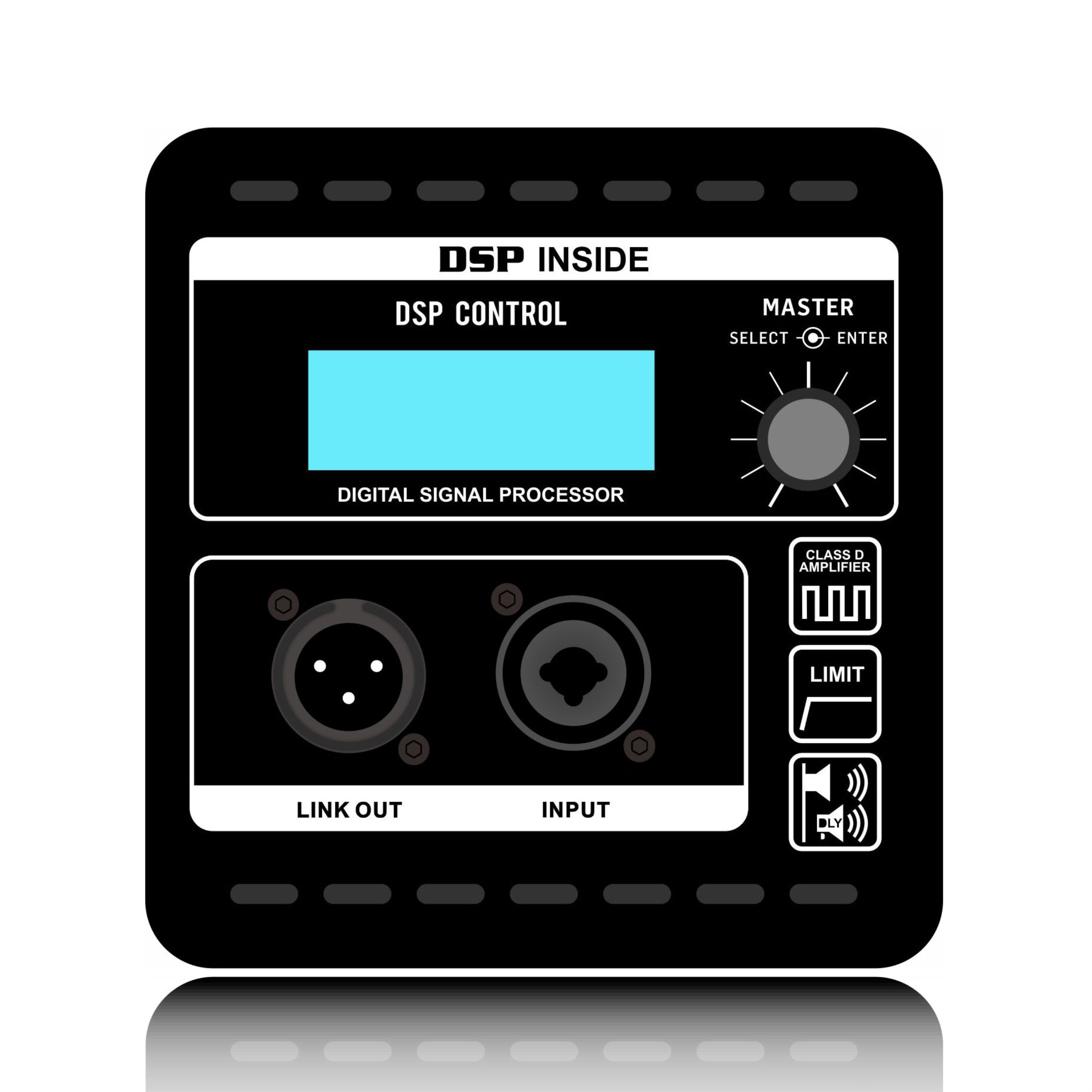
The amplifier class decides how much heat the output stage makes; the DSP and the power supply decide how well that output can be used. A limiter, crossover and EQ implemented in DSP let the power stage run closer to its ceiling without clipping the driver, which is why so many subwoofer modules pair a Class D stage with an ADAU1701-based DSP board and preset EQ modes.
The supply matters just as much. A resonant LLC stage with power factor correction keeps efficiency high and holds the rails steady when heavy bass demands current in short bursts — the behaviour behind LLC resonant supplies in subwoofer systems that OEM buyers now treat as standard.
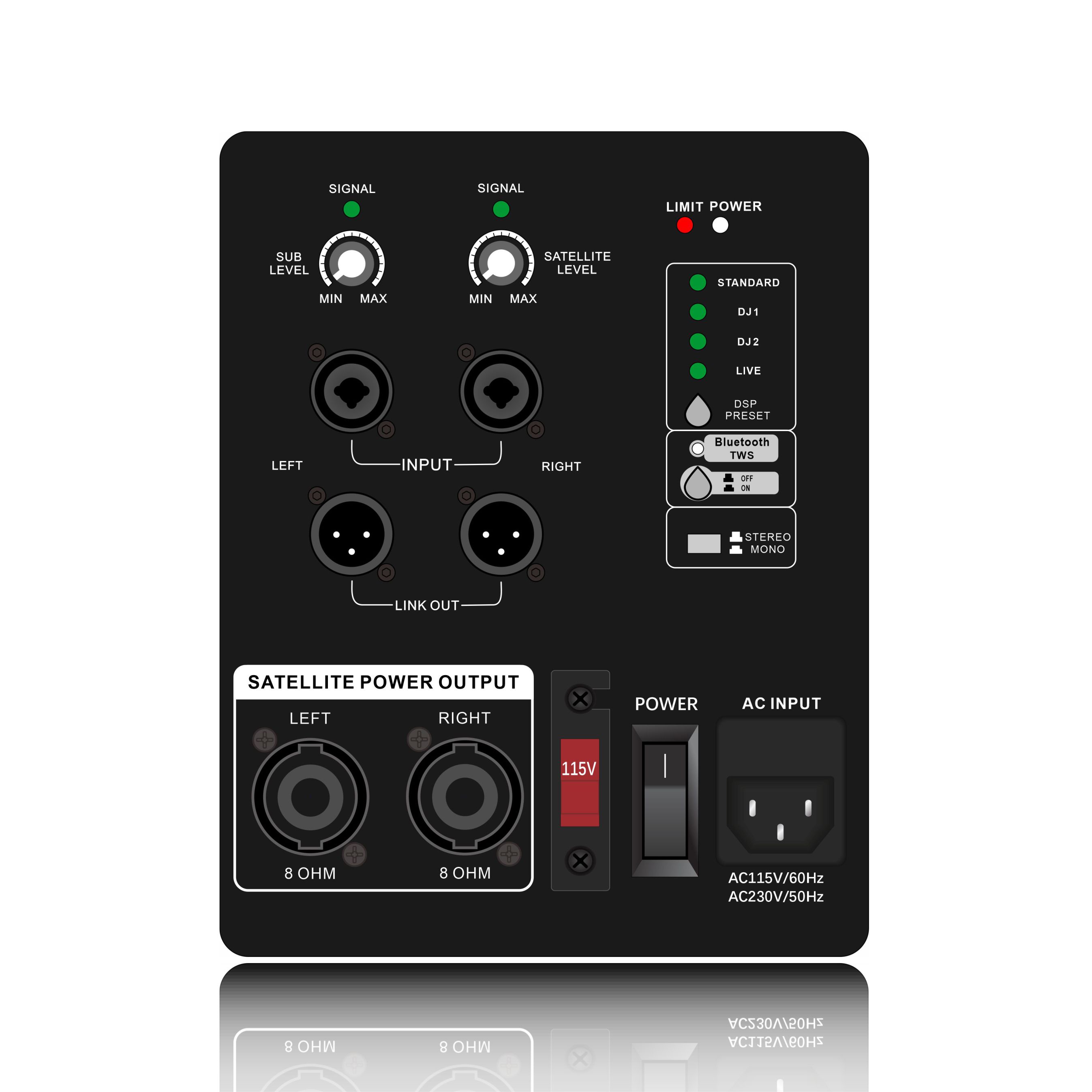
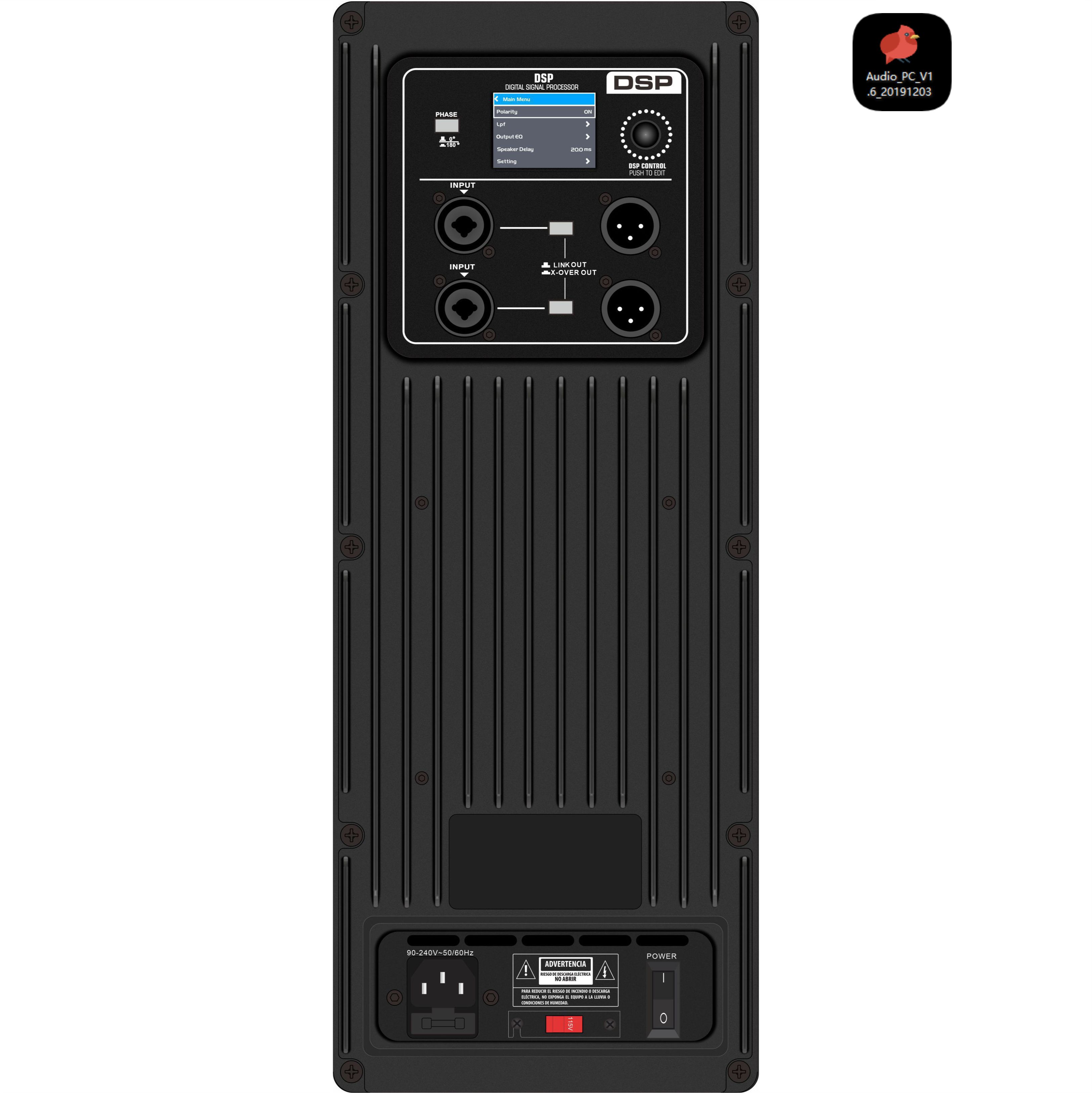 DSP2405SUB Powered Subwoofer Amplifier with LLC Supply and BluetoothFor high-power subwoofer builds, this 1200W Class D amplifier pairs LLC resonant supply with DSP, Bluetooth TWS, and 1000W 8-ohm sub output.View Product →
Where Class AB and Class H Still Earn Their Place
Class D is not universal, and pretending otherwise leads to over-engineered products. Below roughly 150 W, a small Class AB design is often cheaper to build, needs no output filter and produces no switching EMI — which matters in compact enclosures with sensitive wireless circuitry nearby.
Class H sits between the two. It keeps a linear output stage but steps the supply rails with the signal, so it wastes far less heat than Class AB at high power while avoiding switching noise altogether. In professional subwoofer channels where the platform is already linear, a Class H module such as an 800 W linear-transformer design remains a sensible choice.
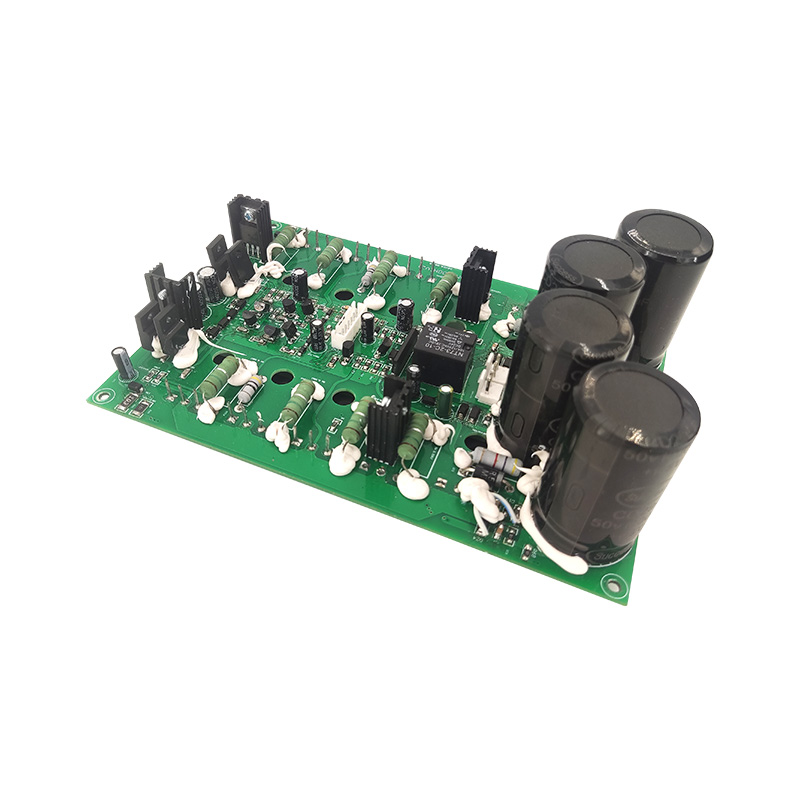 AMP800H Class H Subwoofer Amplifier Module with Linear TransformerFor linear subwoofer systems needing lower heat without switching noise, this 800W-transformer Class H module delivers 600W into 4-ohm loads.View Product →
Frequently Asked Questions
What amplifier class is best for a subwoofer?
Class D above roughly 200 W — it runs cooler, weighs less and costs less per watt than Class AB at the same output. Below about 150 W, a small Class AB build can still be the cheaper option.
Is Class D good for subwoofers, or does it sound worse?
In the subwoofer band, a correctly designed Class D module is not audibly worse. What decides the result is damping factor at low frequency, THD+N below 100 Hz and how the supply behaves under load.
Why do subwoofer amplifiers use Class D instead of Class AB?
Heat. A 1,000 W channel at 60% efficiency wastes about 670 W as heat, while a 90% Class D stage wastes roughly 110 W. That gap sets heatsink size, chassis depth and fan requirements.
What is the difference between Class D and Class H subwoofer amplifiers?
Class D switches the output devices on and off; Class H keeps a linear output stage but steps the supply rails with the signal. Class H runs cooler than Class AB but still needs a larger transformer.
How much power does a subwoofer amplifier module need?
Match continuous power to the driver's RMS rating at its real impedance — 8Ω or 4Ω, not the peak figure on the carton. For a 15-inch to 18-inch professional sub, 600–1,500 W RMS is a common range.
Do Class D subwoofer amplifiers need a special power supply?
Not special, but well matched. Most designs pair the Class D stage with a switching supply using PFC and LLC resonance, which keeps efficiency high and output steady when heavy bass pulls the rails down.
Choosing the amplifier class of a subwoofer comes down to three numbers: how much continuous power the design needs, how much heat the enclosure can shed, and how much the bill of materials allows. Class D answers all three for most modern subwoofers, while Class AB and Class H stay relevant at the low-power and professional ends of the market, where their specific strengths still pay for themselves.