English
 Español
 中文简体
中文简体
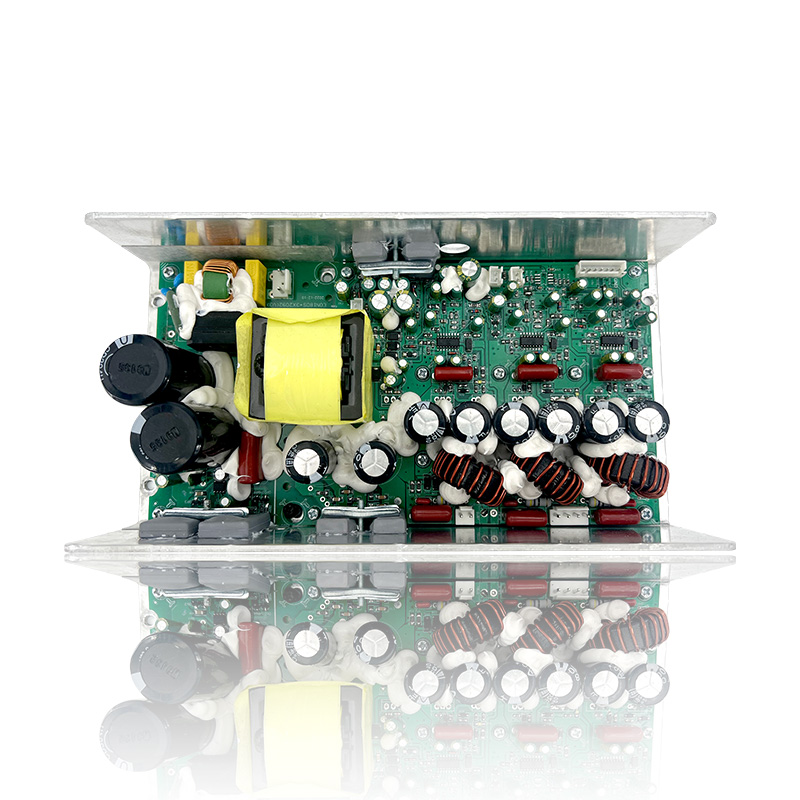
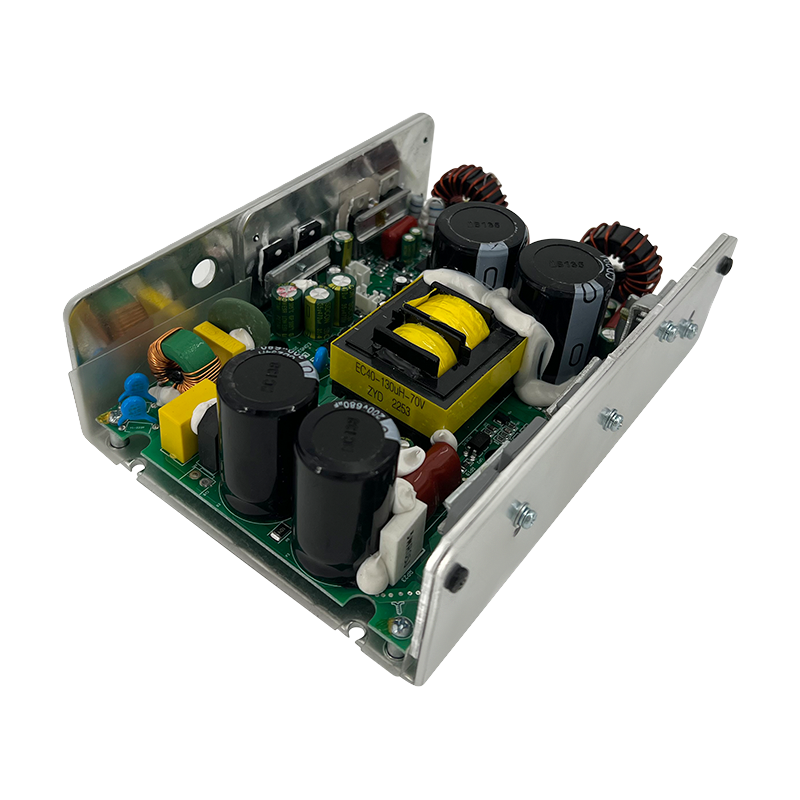
A Class H loudspeaker amplifier is an advanced type of power amplifier that dynamically adjusts its supply voltage in real time to match the needs of the audio signal. Unlike traditional Class AB amplifiers that run at a fixed supply rail, a Class H amplifier uses multiple voltage rails and switches between them depending on signal demand — dramatically reducing wasted heat energy and improving overall power efficiency. The result is a professional audio amplifier that can deliver high output power with significantly less thermal dissipation, making it ideal for demanding commercial and live sound applications.
In practical terms, when the audio signal is low, the amplifier operates on a lower voltage rail. When peaks demand more headroom, it briefly steps up to a higher rail. This "tracking" behavior means the output transistors are never dissipating far more power than the signal actually needs. Efficiency ratings for Class H designs typically fall in the 70–80% range, compared to 50–65% for conventional Class AB topologies — a meaningful advantage when running large-scale sound systems for hours at a time.
Ningbo Zhenhai Huage Electronics Co., Ltd. is a professional Class H Loudspeaker Amplifier Manufacturer and factory with deep expertise in designing and producing these amplifiers for commercial audio markets worldwide. This guide explains how Class H technology works, where it excels, how to select the right amplifier, and why it has become the preferred topology for professional sound reinforcement.
Content
- 1 How Class H Amplifier Technology Works
- 2 Class H vs. Other Amplifier Classes: A Detailed Comparison
- 3 Top Applications: Where Class H Amplifiers Deliver the Most Value
- 4 Key Technical Specifications to Evaluate in a Class H Amplifier
- 5 Commercial Sound System Design with Class H Amplifiers
- 6 OEM and Custom Class H Amplifier Manufacturing
- 7 PA Amplifier Class H: Selection Checklist for System Designers
- 8 About Ningbo Zhenhai Huage Electronics Co., Ltd.
- 9 Frequently Asked Questions
How Class H Amplifier Technology Works
At the heart of Class H amplifier design is the concept of supply rail modulation. A conventional amplifier maintains a fixed DC supply voltage at all times. Even when the audio signal is quiet, the output stage must work against the full rail — burning the excess energy as heat. A Power Amplifier Class H architecture solves this by introducing two or more supply rails (for example, ±40 V and ±80 V) and a fast-acting switching circuit that selects the appropriate rail based on instantaneous signal level.
This switching typically uses dedicated comparators or envelope followers that monitor the audio signal continuously. When the signal envelope exceeds a defined threshold — usually around 60–70% of the lower rail's maximum — the circuit transitions to the higher rail with minimal audible artifacts, typically within microseconds. The transition must be carefully engineered to avoid switching noise or distortion being introduced into the audio path, which is why professional amplifier suppliers invest heavily in rail-transition circuit design.
Rail Switching vs. Envelope Tracking
There are two common implementations within the Class H family. The first — and more common in commercial audio — uses discrete supply rails (two or three fixed voltage levels). The second, sometimes called "envelope tracking," continuously varies the supply voltage in near-perfect lockstep with the signal envelope. Discrete-rail designs are simpler, more cost-effective, and more suitable for high-power PA applications. Envelope tracking is more complex but theoretically achieves even higher efficiency, making it popular in battery-powered or portable designs.
For commercial sound systems — stadiums, churches, event venues, and corporate AV — the two-rail or three-rail discrete approach is the standard because it balances excellent efficiency with robust reliability in high-power scenarios. This is the core of what makes a Class H Amplifier for PA System use cases so compelling.
Amplifier Class Efficiency Comparison (%)
This chart illustrates how Class H sits between traditional linear topologies (Class A, AB) and fully switching designs (Class D) in terms of power efficiency. With efficiency typically reaching 75–80%, a Class H loudspeaker amplifier delivers substantial energy savings over Class AB designs while retaining the low distortion and analog character that professional audio engineers rely on. For large venues running systems for extended periods, this efficiency gap translates directly into reduced operating costs and smaller heat management requirements.
Class H vs. Other Amplifier Classes: A Detailed Comparison
Understanding where Class H fits in the amplifier landscape helps engineers and system designers make better purchasing decisions. Each amplifier class has a distinct operating principle, efficiency profile, distortion characteristic, and ideal application domain.
| Class | Efficiency | THD | Heat Output | Typical Use | Weight |
|---|---|---|---|---|---|
| Class A | 10–20% | Very Low | Very High | Hi-Fi, Studio | Heavy |
| Class AB | 50–65% | Low | Moderate | General PA | Moderate |
| Class H | 70–82% | Very Low | Low | PA, Stadium, Church | Moderate |
| Class D | 85–95% | Moderate | Very Low | Installation, DSP | Light |
The table highlights a key insight: Class H uniquely combines the analog audio fidelity of Class AB with efficiency levels approaching Class D. This makes it the preferred topology for scenarios where audio quality cannot be compromised but power management is also critical — such as a Class H Amplifier for Church sound systems, conference centers, and outdoor event production.
Class D amplifiers, while more efficient, use pulse-width modulation switching that can introduce EMI and require sophisticated output filters to achieve clean audio. Class H avoids this complexity entirely, maintaining a linear output stage that naturally produces lower noise floors and better sonic transparency — important for speech intelligibility and critical listening environments.
Top Applications: Where Class H Amplifiers Deliver the Most Value
Class H amplifiers are not universally superior for every scenario — they are specifically optimized for professional, high-power, extended-duration audio applications where efficiency and audio quality must coexist. Below are the primary deployment environments where these amplifiers are most widely specified.
Class H Amplifier for PA System
Public address systems in airports, train stations, shopping malls, and corporate campuses often operate around the clock. A Class H Amplifier for PA System use cases offers two decisive benefits here: reduced electricity consumption (which matters when systems run 16+ hours per day) and lower heat generation (which reduces cooling infrastructure costs and improves equipment longevity). In a typical 4-zone commercial PA system delivering 2,000 W continuous, switching from Class AB to Class H can reduce power draw by 400–600 W — adding up to meaningful savings over months of operation.
Class H Amplifier for Stadium
Stadium sound reinforcement is among the most demanding professional audio applications. Systems must cover vast areas with consistent SPL, handle rapid transient peaks from crowd noise and music simultaneously, and operate reliably for multi-hour events. A Class H Amplifier for Stadium deployment benefits from the topology's ability to handle dynamic peaks efficiently — the rail switching means the amplifier can momentarily deliver full headroom for transients without sustaining the thermal cost of a fixed high-rail Class AB design. Stadiums with 50,000+ seating capacity commonly deploy arrays of high-power Class H amplifiers in distributed rack systems, each handling multiple speaker zones.
Class H Amplifier for Church
Houses of worship present a unique audio challenge: they need systems capable of handling the dynamic range of live music performances while also providing exceptional clarity for spoken word. Background noise floors in churches are extremely low, which means any amplifier noise becomes audible. A Class H Amplifier for Church installation is well-suited because its linear output stage maintains a low noise floor (typically better than -100 dB SNR) while still operating efficiently during quieter passages. The reduced heat output is also valuable in historic buildings where HVAC constraints may limit cooling options.
Class H Suitability Radar: Application Performance Profile
The radar chart above illustrates the overall suitability of Class H amplifier technology across five major professional audio application segments. PA systems and church installations score highest due to the combination of efficiency demands and audio fidelity requirements. Stadium and large live-event deployments also score very strongly, reflecting the technology's ability to manage high peak-power demands without excessive thermal output. Commercial sound system applications round out the profile, confirming that Class H is a well-rounded choice across the commercial audio spectrum.
Key Technical Specifications to Evaluate in a Class H Amplifier
When specifying a Professional Audio Amplifier based on Class H topology, several technical parameters must be carefully evaluated to ensure system compatibility and performance reliability. Not all Class H amplifiers are engineered equally — the quality of the rail-switching circuit, power supply design, and output stage directly affect both audio performance and long-term reliability.
- Continuous RMS Power Output (per channel): Measured at 4 Ω and 8 Ω loads. For large PA applications, look for amplifiers offering 500 W to 2,000 W per channel. Verify that rated power is achievable at typical operating temperatures, not just cold-start conditions.
- Total Harmonic Distortion + Noise (THD+N): Class H amplifiers should achieve THD+N below 0.05% at rated power, and below 0.01% at moderate drive levels. Higher figures indicate suboptimal output stage or rail-transition design.
- Signal-to-Noise Ratio (SNR): For commercial sound system amplifiers targeting speech applications, SNR should exceed 100 dB (A-weighted). Music reproduction benefits from SNR above 105 dB.
- Damping Factor: A damping factor of 200 or higher (at 8 Ω, 1 kHz) ensures the amplifier maintains control over woofer cone excursion, which is critical in large-format speaker systems used in stadiums and arenas.
- Frequency Response: Professional amplifiers should maintain ±0.5 dB from 20 Hz to 20 kHz. Significant deviations outside this window suggest compromised output stage or feedback network design.
- Protection Circuits: Look for DC offset protection, short-circuit protection, thermal limiting, and clip limiting — especially important in unattended commercial deployments.
- Input Sensitivity and Impedance: Balanced XLR inputs with input impedance of 10–20 kΩ are standard for professional rack integration. Sensitivity settings (typically 0.775 V / 1.0 V / 1.4 V) allow flexible gain staging.
SNR Comparison: Class H vs. Class AB vs. Class D (dB, A-weighted)
Signal-to-noise ratio is a critical metric for professional amplifiers, particularly in applications requiring high speech intelligibility or critical music reproduction. Class H amplifiers typically achieve SNR values around 105–110 dB (A-weighted), outperforming both Class AB and switching Class D designs in this key metric. This advantage is particularly noticeable in quiet environments such as houses of worship, conference rooms, and broadcast studios, where background noise from amplifier electronics can otherwise become audible during low-level passages.
Commercial Sound System Design with Class H Amplifiers
Designing a Commercial Sound System Amplifier specification requires more than simply selecting the right amplifier topology. System-level decisions around amplifier quantity, power distribution, speaker load management, and thermal planning are all interconnected. Class H amplifiers influence each of these design dimensions.
Power Zoning and Distribution
In multi-zone commercial audio systems, the standard approach is to assign discrete amplifier channels to speaker zones based on power requirements and coverage area. A Commercial Audio Amplifier based on Class H technology is particularly well-suited to this configuration because multiple channels can be packed into standard 2U or 3U rack units without overheating adjacent equipment. The reduced thermal footprint allows higher channel density per rack — often 8 to 16 channels in a single enclosure — which reduces cabling complexity and simplifies rack design.
Speaker Load Compatibility
Most commercial installations use 8 Ω nominal drivers, but parallel wiring of multiple ceiling speakers commonly results in 4 Ω or even 2 Ω effective loads. Quality Class H amplifiers are designed to drive loads down to 2 Ω while maintaining stable operation and protection circuit coverage. This flexibility is valuable when expanding existing systems without replacing speaker wiring infrastructure. For 70 V / 100 V distributed systems (common in large-area commercial installations), Class H amplifiers with integrated line-matching transformers provide an efficient solution.
Thermal Management in Equipment Racks
Equipment racks in commercial AV installations are often located in mechanical rooms, server closets, or built-in cabinetry with limited ventilation. Class H's reduced heat output — typically 20–30% less heat dissipation than equivalent-power Class AB designs — means fewer forced-air cooling requirements, reduced fan noise, and longer equipment lifespan. In rack installations where temperatures can climb during sustained operation, this thermal advantage is not academic: it directly affects uptime and maintenance intervals.
Thermal Dissipation Over Time: Class H vs. Class AB (1000W Amplifier, Sustained Drive)
This line chart models thermal dissipation over a typical four-hour event at sustained moderate drive levels for a 1,000 W amplifier. Class H designs stabilize at roughly 35–40% lower heat output than equivalent-power Class AB amplifiers, reducing rack temperature rises considerably over extended operation. This directly translates to reduced wear on capacitors, output transistors, and fan bearings — components that are statistically the most common sources of amplifier failure in commercial installations. For venues running daily events, this thermal advantage contributes meaningfully to multi-year total cost of ownership calculations.
OEM and Custom Class H Amplifier Manufacturing
For audio brands, system integrators, and distributors seeking to offer Class H amplifiers under their own label, working with a capable Class H Amplifier Manufacturer or factory is the foundation of a competitive product lineup. OEM partnerships allow companies to leverage existing engineering excellence while focusing their own resources on sales, marketing, and customer relationships.
Ningbo Zhenhai Huage Electronics Co., Ltd. functions as both a Class H Amplifier Factory and a full-service OEM partner. The company's capabilities span the entire product lifecycle — from initial circuit design consultation and PCB layout through production, aging testing, and quality control inspection. Custom product configurations supported include output power levels, channel count, input/output connector layout, front panel design, firmware customization for DSP-integrated models, and packaging.
What to Evaluate in an OEM Audio Amplifier Partner
- Engineering Depth: Does the factory employ in-house circuit designers with Class H-specific expertise, or do they only assemble reference designs? Original engineering capability leads to better customization outcomes.
- Production Testing: Every unit should undergo individual power-on testing, frequency response measurement, distortion measurement, and protection circuit verification before shipping. Batch sampling alone is insufficient for amplifiers.
- Certifications: CE, FCC, RoHS, and UL certifications are expected for products entering major markets. Confirm the factory can provide documentation or support the certification process for customized models.
- Minimum Order Flexibility: Established factories can accommodate both trial orders (50–200 units) and high-volume production without quality trade-offs.
- Longevity and References: A factory with multi-year OEM relationships with recognized audio brands provides strong evidence of consistent quality and reliability.
As a Professional Amplifier Supplier with long-term OEM partnerships across multiple continents, Huage Electronics has developed standardized quality control workflows specifically calibrated for Class H amplifier production — an area where the precision of rail-switching circuits requires particularly careful inspection protocols. Customers are welcome to visit the facility, review production processes, and discuss custom specifications directly with the engineering team.
PA Amplifier Class H: Selection Checklist for System Designers
Selecting the right PA Amplifier Class H configuration for a specific project involves matching amplifier specifications to acoustic system requirements. The following checklist provides a practical framework for system designers and integrators.
- Define total acoustic power requirements: Calculate required SPL at listener distance, factor in room gain or loss, and determine total wattage needed across all speaker clusters and fill zones.
- Determine speaker load impedances: Confirm nominal impedance, account for parallel wiring configurations, and verify the amplifier's rated power at the actual load impedance you will be driving.
- Assess peak-to-average ratio of program material: Live music has crest factors of 12–20 dB; speech typically 10–15 dB. Ensure the amplifier's peak power headroom comfortably covers the crest factor of the intended program type.
- Review thermal and rack density requirements: Calculate total heat load per rack and verify that cooling infrastructure (fans, rack ventilation, room HVAC) can handle sustained operation.
- Confirm connectivity requirements: Verify balanced XLR input, output connector type (Speakon, binding posts, terminal block), and remote monitoring/control interface requirements (Ethernet, RS-485, GPIO).
- Evaluate protection features: Ensure the amplifier includes all required protection modes for the deployment environment — particularly important in unattended or remote installations.
- Request verified test data: Ask the supplier for third-party or in-house measured THD+N, SNR, frequency response, and power output curves — not just datasheet specifications.
Typical Class H Amplifier: Output Power vs. Load Impedance
A well-designed Class H loudspeaker amplifier delivers proportionally more power as load impedance decreases — a behavior that confirms a robust power supply and output stage. In this representative example, output scales from 800 W at 8 Ω to approximately 1,900 W at 2 Ω, demonstrating the current-delivery capability expected in professional-grade designs. Specifying amplifiers with verified multi-impedance power curves, rather than relying solely on peak or "music power" figures, is essential for accurate system design and avoids under- or over-specifying amplifier channel counts.
About Ningbo Zhenhai Huage Electronics Co., Ltd.
Ningbo Zhenhai Huage Electronics Co., Ltd. is a professional audio enterprise that integrates research and development, production, and sales under one operation. As a dedicated Class H Loudspeaker Amplifier Manufacturer and factory, the company has spent many years focused on the design and production of sound mixers, active power amplifiers, microphones, and related electronic components and equipment.
The company specializes in custom Class H Loudspeaker Amplifier production, offering OEM services to many well-known audio brands both domestically and internationally. Long-term, stable cooperative relationships with clients across multiple industries reflect the company's consistent adherence to its core business policy: good products, good service, and good reputation. The company maintains professional design, production, and testing teams capable of developing custom products to exact customer specifications.
Customers from all sectors are welcome to visit the facility, exchange technical insights, and discuss OEM, ODM, or standard product procurement. Whether the requirement is a single-channel studio reference amplifier or a multichannel rack system for a major venue deployment, Huage Electronics has the engineering depth and production capacity to deliver.
Frequently Asked Questions
Q1: What is the main difference between Class H and Class D amplifiers?
Class H amplifiers use a linear analog output stage with dynamic supply rail switching, preserving low distortion and a low noise floor. Class D amplifiers use pulse-width modulation (digital switching), which achieves higher efficiency but can introduce switching noise and EMI. For applications demanding high audio fidelity — such as live music or speech in quiet environments — Class H is generally preferred.
Q2: Is a Class H amplifier suitable for outdoor stadiums?
Yes. A Class H Amplifier for Stadium use is well-suited to outdoor deployments because it handles dynamic transients efficiently, reduces the heat load in equipment racks (which is important in warm outdoor environments), and delivers sustained high power over multi-hour events. It is a common specification choice for stadium PA and distributed speaker arrays.
Q3: Can Class H amplifiers be used in 70V distributed audio systems?
Yes. Many Class H commercial audio amplifiers are available with built-in 70 V and 100 V transformer outputs or are designed to drive external transformer interfaces. Distributed systems using 70 V wiring are common in large-area commercial installations such as offices, retail spaces, and airports, and Class H is a suitable and efficient amplifier topology for these systems.
Q4: How do I verify the actual rated power of a Class H amplifier?
Request measurements taken at continuous RMS output with less than 1% THD+N, at both 4 Ω and 8 Ω loads, and at full operating temperature (not cold-start). Reputable manufacturers provide these as either factory test reports or third-party certification data. Avoid relying solely on "peak" or "PMPO" figures, which do not reflect real-world sustained performance.
Q5: Does Huage Electronics offer OEM services for Class H amplifiers?
Yes. Ningbo Zhenhai Huage Electronics Co., Ltd. has provided OEM Audio Amplifier services to multiple recognized audio brands. Custom configurations including power output, channel count, front panel design, branding, and connectivity can be accommodated. The company welcomes inquiries from distributors, system integrators, and audio brands seeking a reliable OEM partner.
Q6: How long do Class H amplifiers typically last in commercial installations?
With proper thermal management and quality components, a well-designed Class H amplifier can operate reliably for 10–15 years or more in commercial installations. The reduced heat dissipation compared to Class AB designs directly extends the lifespan of electrolytic capacitors and output transistors — the most common points of failure over time. Regular maintenance including filter cleaning and annual electrical checks supports longevity.