English
 Español
 中文简体
中文简体
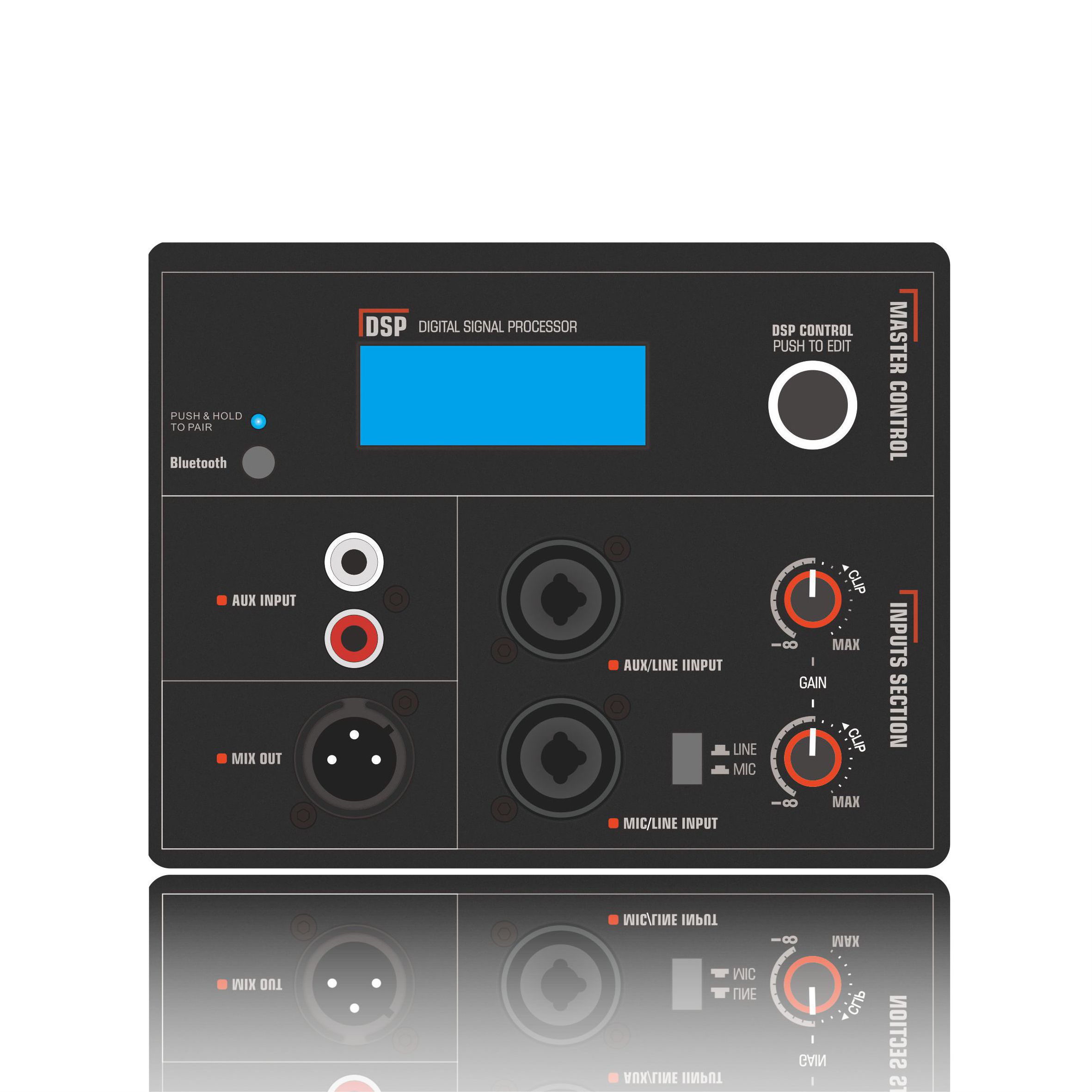
A pro line array amplifier is a high-power, professional-grade audio amplifier specifically engineered to drive line array speaker systems used in large-scale live sound reinforcement, touring concerts, houses of worship, stadiums, and broadcast environments. Unlike general-purpose amplifiers, a professional power amplifier for line array applications is optimized for high continuous output power, stable impedance handling across multiple drivers wired in series or parallel, and often incorporates onboard DSP (Digital Signal Processing) for precise system alignment, crossover, delay, and protection management. The result is a tightly controlled, high-fidelity sound delivery system capable of projecting consistent audio over long throw distances with minimal distortion.
In practical terms, a line array amplifier is not simply a powerful amplifier — it is a purpose-built signal processing and power delivery platform. Modern units based on Class D amplifier topology can deliver 2,000 W to 20,000 W of total output power from a single 2U or 3U rackmount chassis, with efficiency ratings above 90%, making them the backbone of professional touring and installed sound systems worldwide.
This article covers how these amplifiers work, what sets them apart from conventional audio amplifiers, key specifications to evaluate, and what to look for when sourcing from a pro audio amplifier manufacturer or evaluating OEM options.
Content
- 1 How a Pro Line Array Amplifier Works: Signal Chain and Power Delivery
- 2 Why Line Array Systems Require Dedicated Amplifiers
- 3 Class D Amplifier Technology: Efficiency That Powers the Modern Stage
- 4 What DSP Does in a Professional Line Array Amplifier
- 5 Key Specifications to Evaluate When Selecting a Line Array Amplifier
- 6 Touring vs. Installed Sound: How Application Shapes Amplifier Selection
- 7 SPL Output and Coverage: The Numbers Behind Line Array Performance
- 8 About Ningbo Zhenhai Huage Electronics Co., Ltd.
- 9 Frequently Asked Questions
How a Pro Line Array Amplifier Works: Signal Chain and Power Delivery
Understanding how a DSP line array amplifier functions requires tracing the audio signal from input to loudspeaker. The signal chain inside a modern professional amplifier consists of several tightly integrated stages:
- Analog or AES/EBU digital input stage: The amplifier receives balanced audio signals (typically via XLR connectors). High-end units accept AES3 digital audio directly, bypassing the analog input stage entirely and reducing noise.
- ADC (Analog-to-Digital Conversion): If analog input is used, the signal is converted to digital at high resolution (typically 24-bit, 96 kHz or 192 kHz) for DSP processing.
- DSP Engine: The digitized signal passes through a powerful DSP processor that applies crossover filtering (dividing highs, mids, and lows for bi-amp or tri-amp operation), parametric EQ, time alignment delay, limiting, and loudspeaker protection algorithms. This is the intelligence center of the amplifier.
- DAC (Digital-to-Analog Conversion): The processed digital signal is converted back to analog before entering the power stage — or, in some switching amplifier designs, directly modulated as a PWM signal.
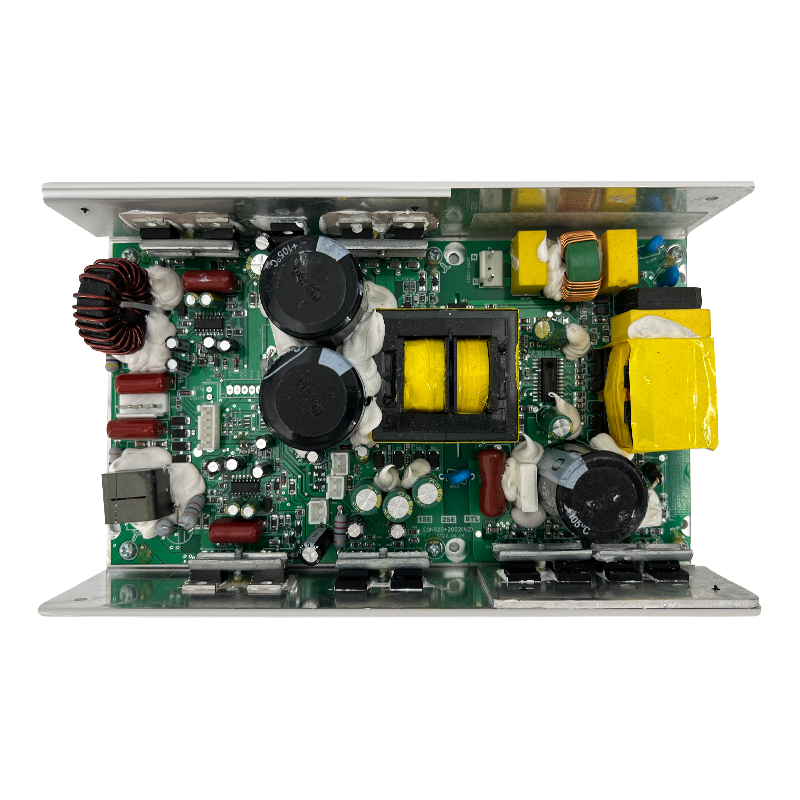
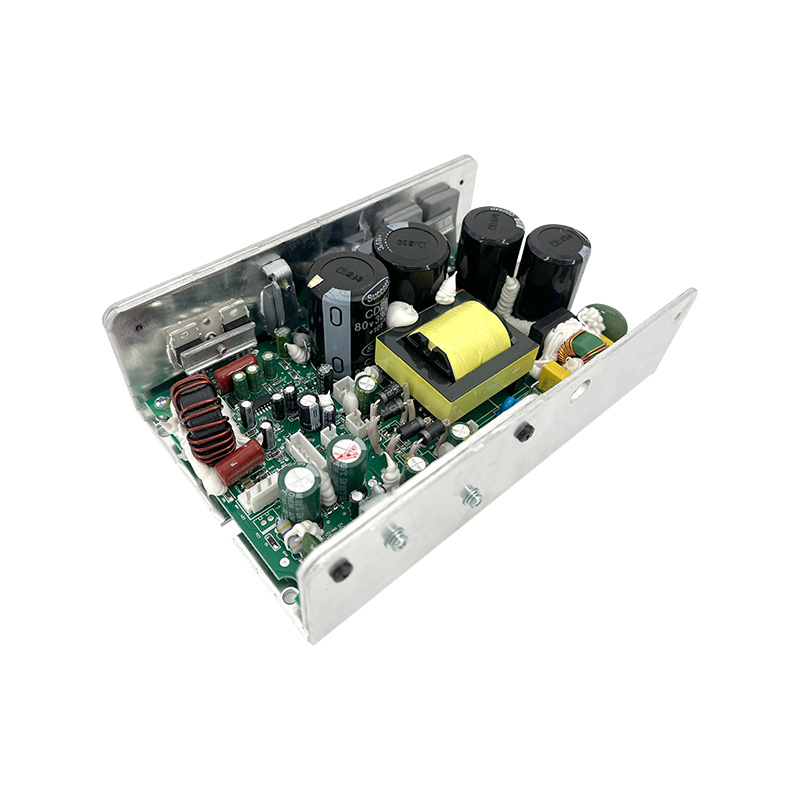
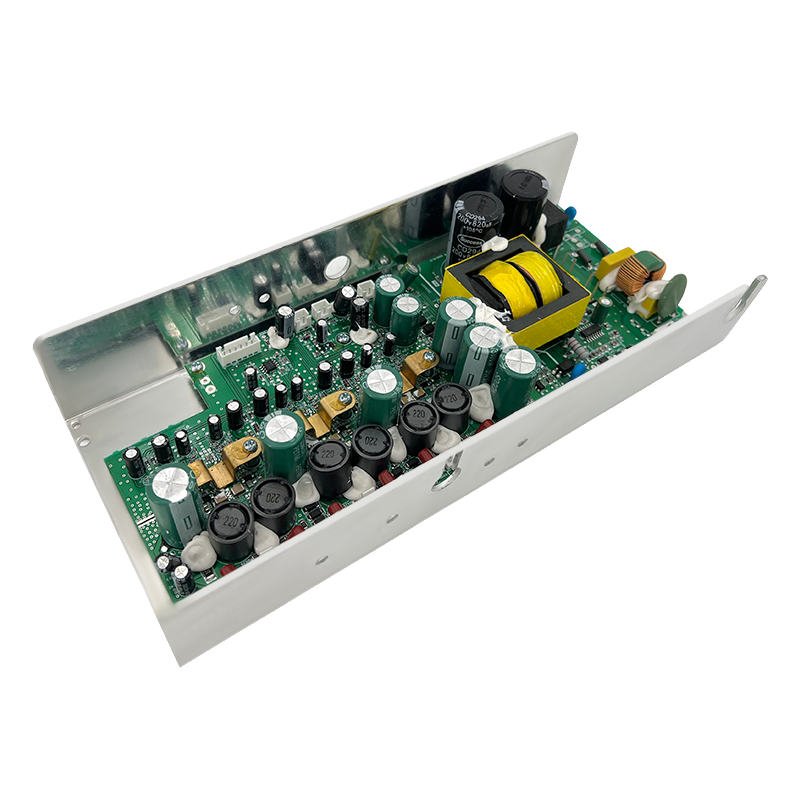
- Class D Power Stage: The analog signal drives a high-efficiency switching power stage. MOSFET transistors switch at frequencies of 300 kHz to 500 kHz, producing a PWM waveform that is filtered by an output inductor-capacitor (LC) network to reconstruct the audio waveform with very high efficiency.
- Switched-Mode Power Supply (SMPS): A high-frequency switching power supply provides regulated, high-current DC rails to the power stage. SMPS designs are far lighter and more efficient than traditional toroidal transformer-based supplies, which is why modern touring sound power amplifiers weigh significantly less than their predecessors.
Pro Line Array Amplifier: Internal Signal Chain
Figure 1: Internal signal chain of a modern DSP line array amplifier. Audio enters via XLR or AES/EBU input, is digitized and processed through the DSP engine, then amplified by the Class D power stage fed by a high-efficiency SMPS. This architecture enables both exceptional sound quality and the lightweight, high-power-density format required for touring applications. Each stage is critical to the amplifier's overall performance and reliability.
Why Line Array Systems Require Dedicated Amplifiers
A line array speaker system is fundamentally different from a conventional point-source speaker. It consists of multiple identical driver modules — typically 8 to 24 elements — arrayed vertically in a curved configuration. The acoustic outputs of these elements combine coherently in the vertical plane, producing a cylindrical wavefront that maintains consistent SPL over long distances. However, this behavior only manifests when all elements are driven with precisely controlled signal levels, time alignment, and frequency content.
This is why a standard stereo amplifier cannot substitute for a purpose-built amplifier for line array speakers. The requirements include:
- Multiple independent output channels (2, 4, or even 8 channels per chassis) to drive individual speaker sections independently
- Per-channel DSP including crossover, delay, and EQ to optimize each driver section within the array
- High damping factor (typically above 1,000) to maintain tight control over driver movement and prevent resonance at high SPL
- Comprehensive loudspeaker protection including RMS and peak limiting, thermal protection, and clip sensing to prevent driver damage during high-SPL events
- Network connectivity (Ethernet, Dante, or proprietary protocols) for remote monitoring and real-time adjustment of large multi-amplifier systems
- High power density — touring rigs require amplifiers that fit in standard racks while delivering thousands of watts per channel without excessive weight
A high power line array amplifier meeting these requirements typically provides between 1,500 W and 5,000 W per channel (into 4 or 8 ohms), with total system output in multi-channel units reaching 10,000 W to 20,000 W. This concentrated power, combined with DSP intelligence, is what enables a line array system to fill a 20,000-seat arena with controlled, high-fidelity audio.
Power Output Comparison: Amplifier Types (W per Channel, 4 Ohm)
Figure 2: Per-channel power output comparison across amplifier categories (rated at 4 ohms). The pro line array amplifier with integrated Class D and DSP delivers the highest power output — up to 5,000 W per channel — while remaining compact and energy-efficient. Consumer-grade amplifiers fall dramatically short of the power levels required for professional line array applications, underscoring the need for purpose-built professional audio equipment.
Class D Amplifier Technology: Efficiency That Powers the Modern Stage
The shift from Class AB to Class D professional amplifier technology has been one of the most transformative developments in professional audio over the past two decades. Understanding why Class D dominates modern line array amplification requires examining the fundamental difference between topologies.
In a Class AB amplifier, output transistors conduct continuously for more than half the audio waveform cycle. They operate in their linear (analog) region, which produces accurate audio reproduction but generates significant heat due to resistive power dissipation. Efficiency typically ranges from 50% to 70%, meaning a 2,000 W Class AB amplifier may draw 3,000–4,000 W from the mains and dissipate 1,000–2,000 W as heat, requiring large heatsinks and heavy transformers.
In contrast, a Class D amplifier operates its output transistors as high-speed switches — fully on or fully off — at frequencies of 300 kHz to 500 kHz. Because the transistors spend minimal time in the transition zone between states, power dissipation is dramatically reduced. Modern Class D designs achieve efficiency ratings of 90% to 96%, meaning a 4,000 W output Class D amplifier draws only approximately 4,200–4,500 W from the mains and generates very little heat. This enables the compact, lightweight chassis essential for touring applications.
Key Technical Advantages of Class D in Line Array Applications
- Weight reduction: A 4-channel Class D line array amplifier can weigh as little as 7–12 kg versus 25–40 kg for an equivalent Class AB unit
- Thermal management: Reduced heat output allows for smaller cooling systems and more reliable long-run operation in warm environments
- Power density: Modern class D amplifier factory designs routinely achieve 1,000+ W per kilogram of amplifier weight
- Lower operating costs: Higher efficiency translates directly to reduced electricity consumption across long touring cycles or permanent installations
- Wide-range power supplies: SMPS designs accept 100–240 V AC universally, essential for international touring
Amplifier Efficiency vs. Output Power Level: Class D vs. Class AB
Figure 3: Efficiency vs. output power level comparison for Class D and Class AB amplifier topologies. Class D efficiency rises steeply from idle to moderate output, stabilizing at 90%–96% across the working range — the range most relevant to real program material. Class AB efficiency is significantly lower across all output levels, particularly at the moderate levels that dominate real-world audio program content. This efficiency gap directly impacts operating costs, thermal management requirements, and system weight in touring deployments.
What DSP Does in a Professional Line Array Amplifier
The DSP section of a DSP line array amplifier is arguably as important as the power stage itself. Without DSP, a line array system cannot achieve its designed acoustic behavior, no matter how powerful the amplifier. Here is what each major DSP function contributes to system performance:
Crossover Filtering
Crossovers divide the full-range audio signal into frequency bands — typically high-frequency (HF), mid-frequency (MF), and low-frequency (LF) — which are sent to the appropriate driver in a multi-way speaker system. Digital crossovers implemented in DSP offer Linkwitz-Riley, Butterworth, or Bessel filter types with slopes up to 48 dB/octave, providing far sharper and more precise band separation than passive crossovers, with no insertion loss.
Parametric EQ
Most professional amplifiers include 8 to 32 bands of fully parametric EQ per output channel. This allows operators to compensate for room acoustics, correct driver irregularities, and implement manufacturer-specified tuning curves that optimize the frequency response of each specific speaker model. High-resolution DSP ensures that these EQ curves are applied with phase accuracy that cannot be matched by analog circuitry.
Delay and Time Alignment
In large venue deployments, multiple speaker clusters (main hangs, front-fills, delays, sub arrays) must arrive at the listening position in phase. DSP-controlled per-channel delay — typically adjustable in steps as fine as 0.02 milliseconds (equivalent to less than 7 mm of acoustic path) — allows precise time alignment between all system elements.
Dynamic Limiting and Speaker Protection
DSP protection algorithms monitor RMS and peak signal levels continuously, applying gain reduction before clipping can occur or before speaker voice coil temperature limits are exceeded. Look-ahead limiting — where the DSP anticipates transients before they occur — can reduce visible distortion artifacts substantially compared to traditional peak limiting. Thermal modeling algorithms estimate driver voice coil temperature in real time, protecting against thermal damage without requiring physical sensors in the speaker.
DSP Line Array Amplifier vs. Traditional Power Amplifier (Score 0–10)
Figure 4: Radar chart comparing a DSP line array amplifier against a traditional power amplifier across six key performance dimensions. The DSP amplifier achieves near-maximum scores in output power, sound control, and protection — areas where traditional amplifiers fall significantly short. The weight/density and flexibility dimensions highlight the practical advantages of modern Class D designs: more power per kilogram and a far broader set of deployment options enabled by integrated DSP.
Key Specifications to Evaluate When Selecting a Line Array Amplifier
When evaluating a professional amplifier supplier or comparing specifications for a touring or installation project, the following parameters are the most critical to assess:
| Specification | Typical Range | What It Means |
|---|---|---|
| Output Power (per ch, 4Ω) | 1,500–5,000 W | Continuous RMS power driving real program material |
| Number of Channels | 2, 4, or 8 | More channels enable more independent speaker sections per rack unit |
| THD+N (at rated power) | <0.05% | Total harmonic distortion — lower is cleaner audio |
| Signal-to-Noise Ratio | >105 dB (A-weighted) | Higher SNR means lower noise floor — critical for quiet passages |
| Damping Factor | >1,000 | Control over driver cone movement — higher = tighter bass |
| Efficiency | 90%–96% | Percentage of input power converted to audio output |
| DSP Resolution | 24-bit / 96–192 kHz | Higher resolution means finer EQ, delay, and crossover precision |
| Input Sensitivity | 0 dBu to +6 dBu | Compatibility with mixing consoles and signal processors |
| Weight | 6–14 kg (2U chassis) | Lighter units reduce touring logistics costs |
| Connectivity | Ethernet, Dante, AES/EBU | Enables remote control and networked audio distribution |
For OEM line array amplifier sourcing and wholesale power amplifier procurement, it is essential to request independent third-party test data rather than relying solely on marketing specifications. Parameters such as THD+N and SNR can be measured under different test conditions that significantly affect the reported numbers. Always specify the measurement standard (e.g., IEC 60268-3) when comparing units from multiple suppliers.
Touring vs. Installed Sound: How Application Shapes Amplifier Selection
The requirements for a touring sound power amplifier differ meaningfully from those of a fixed installation amplifier, even when driving the same type of line array speaker system. Understanding these differences is critical for specifiers and procurement teams.
| Requirement | Touring Application | Installed Sound Application |
|---|---|---|
| Weight Priority | Critical (every kg matters) | Less important |
| Vibration Resistance | High (road transport) | Standard |
| Universal Voltage | Essential (100–240 V) | Fixed local voltage acceptable |
| Remote Monitoring | Useful for large rigs | Essential for unattended operation |
| Rack Integration | Portable rack cases | Permanent equipment rooms |
| Duty Cycle | Hours per show, nightly | 24/7 continuous operation |
| Preset Storage | Multiple venue presets | Fixed venue-specific preset |
SPL Output and Coverage: The Numbers Behind Line Array Performance
One of the most practical questions for system designers is how amplifier power translates into acoustic output in real-world line array deployments. The relationship is logarithmic: doubling amplifier power adds only 3 dB of SPL, while doubling the number of elements in a line array adds 6 dB of SPL on-axis (due to coherent summation) while simultaneously narrowing the vertical coverage angle.
A typical professional line array cabinet driven by a high power line array amplifier at 2,000 W continuous will produce a maximum SPL of approximately 138–145 dB SPL at 1 meter. At 50 meters throw distance, this translates to roughly 106–112 dB SPL — sufficient for high-SPL concert environments. At 100 meters, SPL drops by another 6 dB per doubling of distance (inverse square law), reaching approximately 100–106 dB SPL, which remains viable for outdoor festival environments.
Estimated SPL vs. Throw Distance: Line Array vs. Point Source (dB SPL)
Figure 5: Estimated SPL vs. throw distance for a line array system vs. a point source speaker, both driven at equivalent input power. The line array's cylindrical wavefront propagation results in approximately 3 dB SPL reduction per doubling of distance (versus 6 dB for a point source), maintaining usable levels at 75–100 m that a point-source system at the same power simply cannot reach. This fundamental acoustic advantage is why line array systems — and the high-power dedicated amplifiers that drive them — are indispensable for large-venue applications.
About Ningbo Zhenhai Huage Electronics Co., Ltd.
Ningbo Zhenhai Huage Electronics Co., Ltd. is a professional audio enterprise integrating research and development, production, and sales. As a recognized pro audio amplifier manufacturer and professional amplifier supplier, the company has focused for many years on the production of sound mixers, active power amplifiers, microphones, and related electronic components and equipment.
The company specializes in custom pro line array amplifiers and maintains a professional design, production, and testing team capable of delivering tailored solutions to meet customer-specific requirements. Huage Electronics has established long-term and stable cooperative relations with companies at home and abroad, providing OEM services for many well-known audio brands over an extended period.
Adhering to the business principles of good products, good service, and good reputation, the company welcomes customers from all sectors to visit, provide guidance, and negotiate business cooperation. Whether for wholesale power amplifier sourcing, OEM manufacturing, or custom product development, Huage Electronics provides comprehensive support from initial consultation through production and quality verification.
Frequently Asked Questions
Q1: What is a line array amplifier?
A line array amplifier is a high-power, multi-channel professional power amplifier designed specifically to drive line array speaker systems. Unlike general amplifiers, it includes integrated DSP for crossover filtering, EQ, delay, and speaker protection, and is typically built around a Class D power stage for high efficiency and compact size. It is the central component of any large-scale professional line array sound system.
Q2: How does a line array amplifier work?
Audio enters via XLR or AES/EBU input and is digitized at high resolution. The DSP engine then applies crossover filtering, EQ, delay, and limiting before the signal is converted back to analog and amplified by the Class D power stage, which converts power from the SMPS into audio output. The final signal drives the speaker cabinet at the specified impedance with high accuracy and efficiency.
Q3: Why do line array systems need dedicated amplifiers?
Line arrays require per-channel DSP for time alignment, crossover, and speaker protection that standard amplifiers do not provide. They also demand much higher power per channel (1,500–5,000 W) than consumer or general-purpose amplifiers can deliver, along with a high damping factor and multi-channel architecture to independently control each speaker section within the array.
Q4: What is DSP in a power amplifier?
DSP (Digital Signal Processing) in a power amplifier is an onboard digital processor that performs signal conditioning before amplification. It handles crossover filtering to separate frequency bands for different drivers, parametric EQ to correct frequency response, time delay for system alignment, and dynamic limiting to protect speakers from damage — all in the digital domain with precision and repeatability that analog circuitry cannot match.
Q5: How does DSP improve sound quality?
DSP improves sound quality by enabling precise digital crossovers with slopes up to 48 dB/octave (far steeper than passive crossovers), per-band parametric EQ with phase-accurate correction, and time delay resolution as fine as 0.02 milliseconds. Together, these tools allow system operators to compensate for acoustic room problems, correct driver irregularities, and align multiple speaker clusters perfectly — producing coherent, high-fidelity audio across the full listening area.
Q6: DSP amplifier vs. traditional amplifier — which is better for line arrays?
For line array applications, DSP amplifiers are clearly the more capable solution. Traditional amplifiers require external signal processors and crossovers, adding complexity, cable runs, and potential signal degradation. DSP amplifiers integrate all processing in one optimized unit, reducing latency, minimizing rack space, and enabling precise per-channel control that is essential for correctly driving a multi-element line array speaker system.