English
 Español
 中文简体

Home / News / Industry News / Class Amplifiers Explained: How to Choose Class AB, D or H for Speaker Design
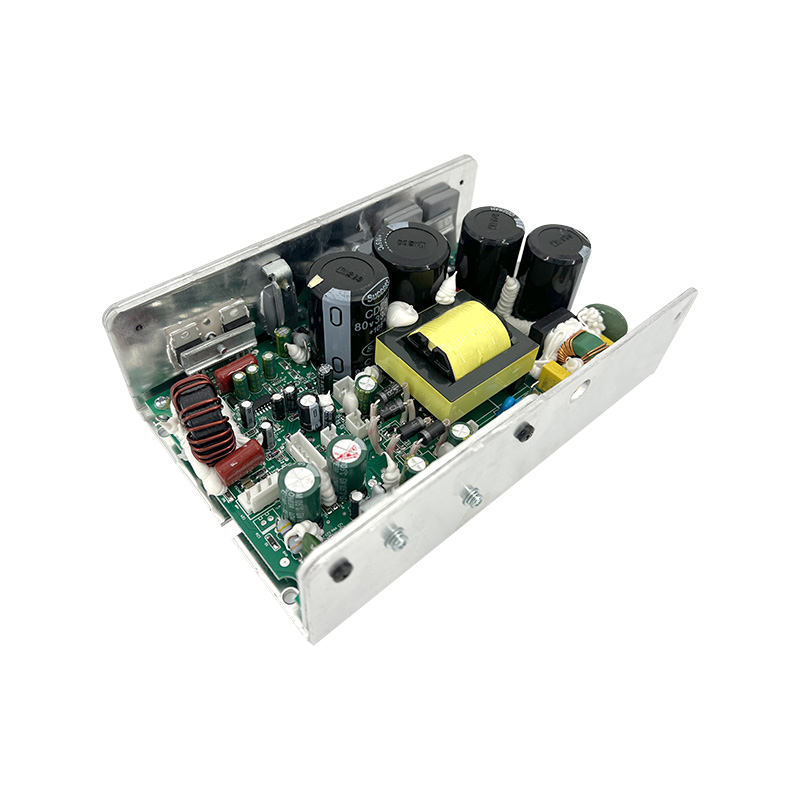
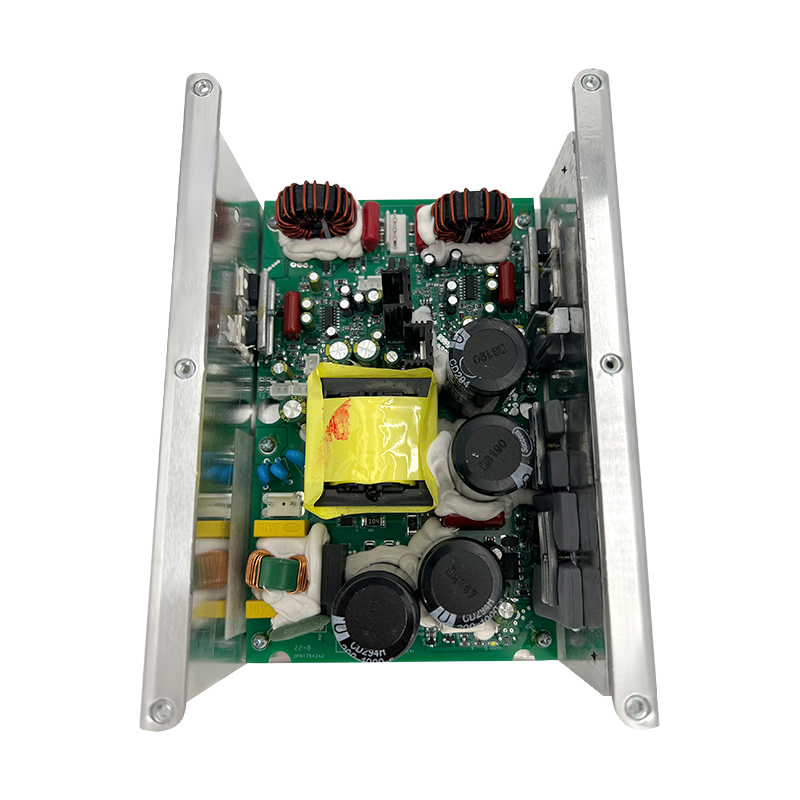
Two quotations land on your desk for the same 2 x 500 W powered subwoofer board. The first is built around a Class AB stage with a heatsink roughly the size of a paperback book. The second uses a Class D stage on a board barely larger than a phone. Both are honest about the power rating. Only one of them will fit the cabinet you have already tooled, and only one will pass the thermal test in a closed wooden enclosure at 40 °C ambient.
That is the real decision behind the phrase "class amplifiers". The class of an amplifier describes how its output devices conduct current across one signal cycle. That single choice sets how much heat you must remove, what kind of power supply you must buy, how much filtering and shielding the board needs, and how much aluminium goes into the chassis. It does not, on its own, decide whether the product sounds good.
Short version: Class AB still wins where linearity and simple supplies matter, Class D wins on efficiency and weight, and Class H exists to keep high output power from turning the chassis into a radiator. Pick the class after you know the cabinet, the load and the supply budget, not before.
Content
- 1 What the class label actually describes
- 2 Efficiency, heat and distortion side by side
- 3 Class AB: linearity you pay for in heat
- 4 Class D: efficiency depends on the supply you pair it with
- 5 Class H: rail switching for the top of the power range
- 6 What the class choice changes further down the module stack
- 7 Matching the class to the product you are building
- 8 What to check with a module supplier before you commit
- 9 Frequently asked questions about class amplifiers
What the class label actually describes
The class name comes from one physical property: how long the output devices stay conductive during a single cycle of the audio signal. Class A keeps them conducting the whole time. Class B splits the cycle between two devices, each handling half. Class AB keeps both devices slightly open at the zero crossing so the handover is smooth. Class D abandons the linear idea entirely and switches the output devices at a few hundred kilohertz, encoding the audio as pulse width. Class H keeps a linear audio stage but makes the supply rail step up and down to follow the signal envelope.
Everything else follows from that. A stage that conducts all the time wastes a large share of its supply as heat. A stage that switches loses almost nothing in the devices but pushes the design problem into the output filter, the gate drive and the electromagnetic interference budget. A stage that moves its rails reduces the voltage across the output devices, which is exactly where the heat in a linear amplifier comes from.
What the label does not tell you is build quality. A poorly laid out Class D module and a carefully engineered one share the same name and can differ by 15 °C in heatsink temperature at the same output level.
Efficiency, heat and distortion side by side
Published design references quote wide efficiency bands, because the real number depends on output level, load impedance and supply design. The figures below are the ranges engineers typically use when comparing topologies at or near full rated output.
| Class | Conduction angle | Typical efficiency | Distortion character | Where it shows up |
|---|---|---|---|---|
| A | 360° | 20-30% | Very low distortion, very high steady heat | Small-signal stages, audiophile and studio designs |
| B | 180° | 70-78% | Crossover notch at low levels | Rarely used alone in audio |
| AB | 180-360° | 50-70% | Low distortion when bias is set correctly | Analog PA, powered mixers, budget active speakers |
| C | Below 180° | 75-85% | High distortion with strong harmonics | RF transmitters, not linear audio |
| D | Switching | 80-95% | Low, dominated by switching residue and filter quality | Powered speakers, subwoofers, portable systems |
| H | Rail tracking | 65-85% | Low, close to a well-biased AB stage | High-power line array and subwoofer amplifiers |
Efficiency bands at or near rated output. In real use, a Class D stage idles far below its headline number.
Class AB: linearity you pay for in heat
Class AB exists to remove the crossover notch of Class B without paying the full cost of Class A. A small bias current keeps both output devices conducting around the zero crossing, so the handover between them stays smooth. Typical quiescent current in a pro-audio module sits in the tens of milliamps per device pair, enough to keep the notch out of the audible range but small enough that the amplifier does not cook at idle.
The trade is that heat is continuous. A 400 W Class AB module draws meaningful current even with no signal, and the heatsink has to be sized for the worst case: pink noise at one-eighth power for an hour in a rack with poor airflow. That is why analog modules tend to carry large extruded heatsinks, U-shaped aluminium brackets and sometimes a fan. Buyers who compare only the wattage on the label often miss this, then discover that the same 400 W in a Class D module needs a fraction of the metal.
The upside is well understood: no switching residue, no output filter interacting with the load, simple transformer-based supplies, and behaviour that field technicians already know how to service.
Class D: efficiency depends on the supply you pair it with
Class D modules switch at a few hundred kilohertz and reconstruct the audio through an LC output filter. The devices spend most of their time either fully on or fully off, so conduction losses are small and the efficiency headline is real. What the headline hides is that the advantage only holds near rated power. At background listening levels, switching and gate-drive losses dominate and efficiency drops sharply, which matters for battery-powered products more than for mains-powered ones.
The rest of the design carries equal weight. Dead time that is too short causes shoot-through; too long and distortion rises at low output. The output filter has to stay stable across the actual load, not the dummy resistor on the bench. And the supply has to keep up: a Class D stage paired with a soft, unregulated rail will sag on bass transients and undo the benefit. That is why resonant LLC supplies and power-factor-corrected front ends have become standard in serious modules.
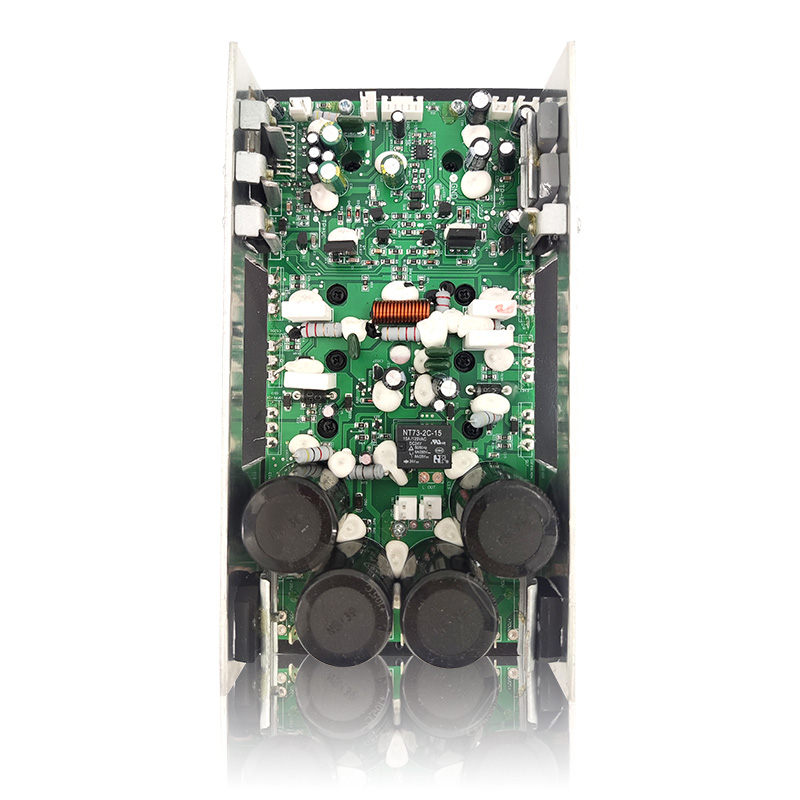
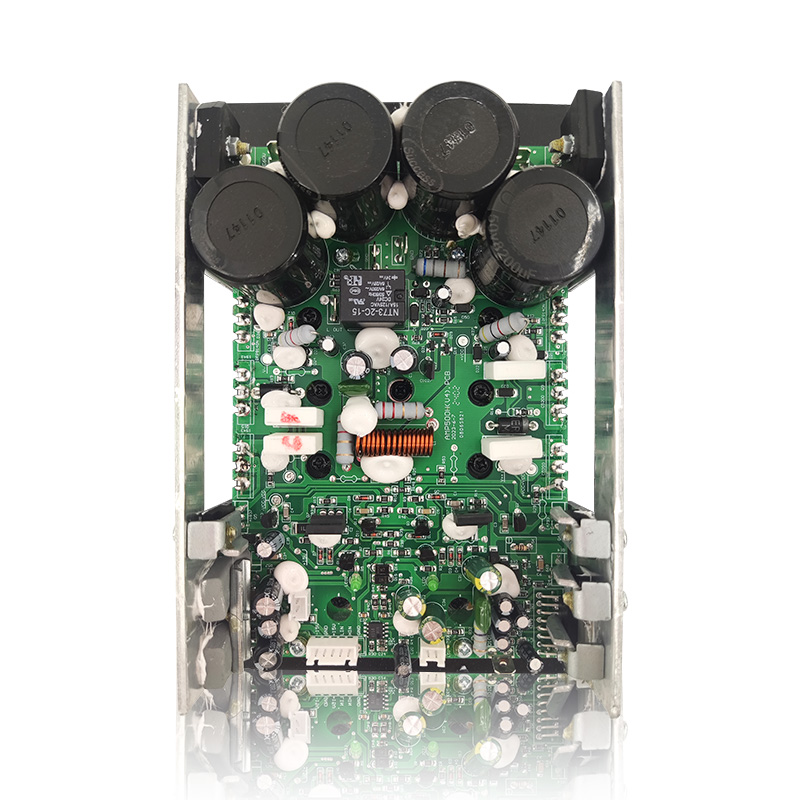
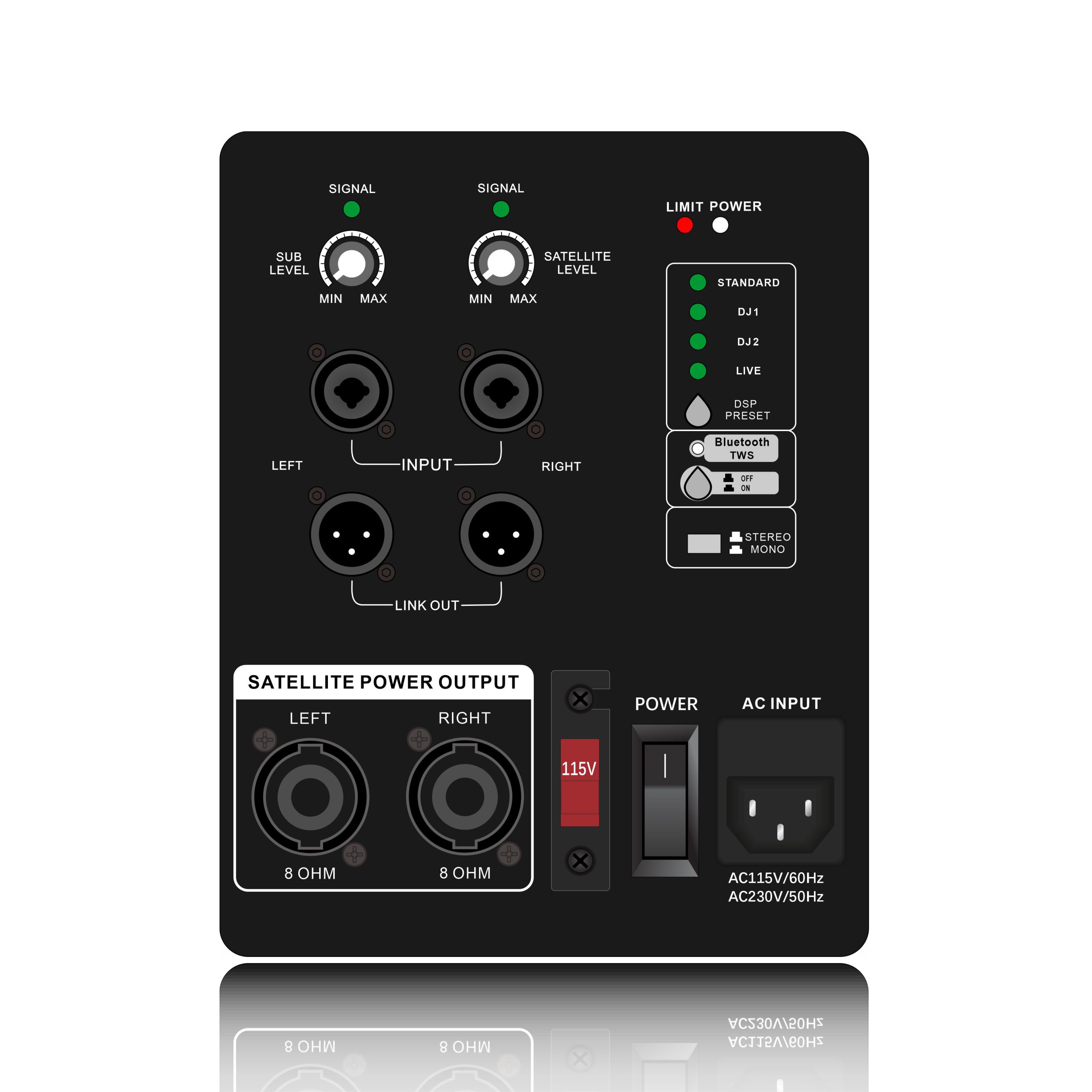
 EON522SUB Active Subwoofer Power Amplifier ModulePairs an 800 W LLC resonant supply with a 500 W Class D bass stage, addressing rail sag and switching noise in powered subwoofers.View Product →
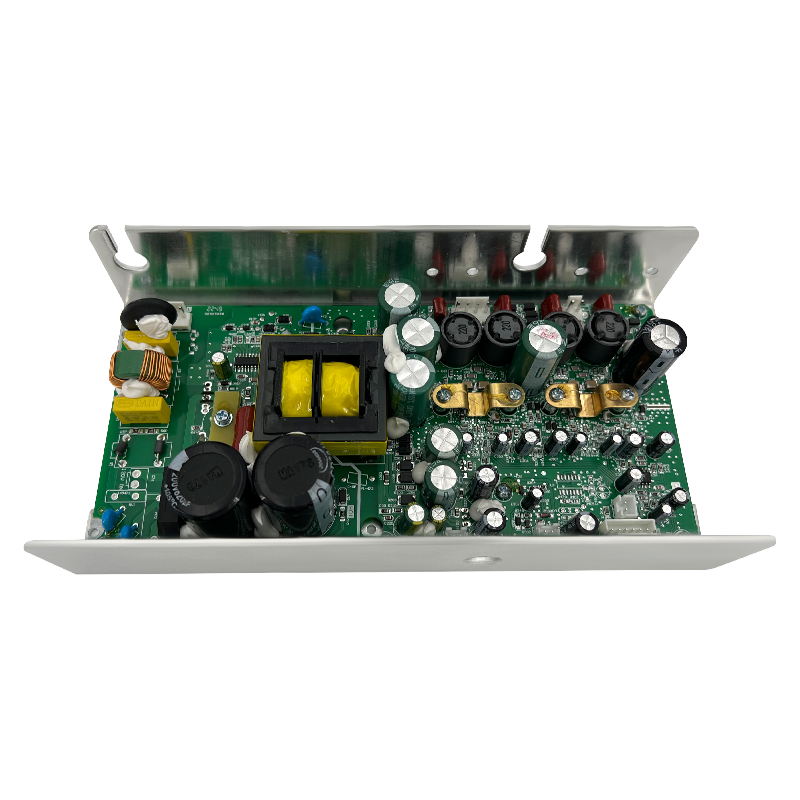
As an example of the pattern, a module such as the EON522D-2092 pairs a 500 W low-pass and 200 W high-pass Class D stage with an LLC resonant supply, which is the combination that keeps rail sag and switching noise under control in a 2.1 enclosure.
Class H: rail switching for the top of the power range
Class H keeps a linear output stage but gives it more than one supply rail. When the signal envelope crosses a threshold, the amplifier switches to a higher rail; when it falls back, the rail drops again. The output devices therefore only ever see a few volts across them instead of the full rail, and the heat that would have gone into the heatsink simply never gets generated. In practice a Class H module delivers the power of a much larger Class AB design in the same chassis depth.
That efficiency is not free. The rail switching circuitry adds parts and cost, the transition can produce artefacts if the comparator thresholds are badly chosen, and the transformer needs multiple taps. It also makes service documentation more important, because a technician who treats the module like a plain AB board will misdiagnose a rail fault as an output device failure.
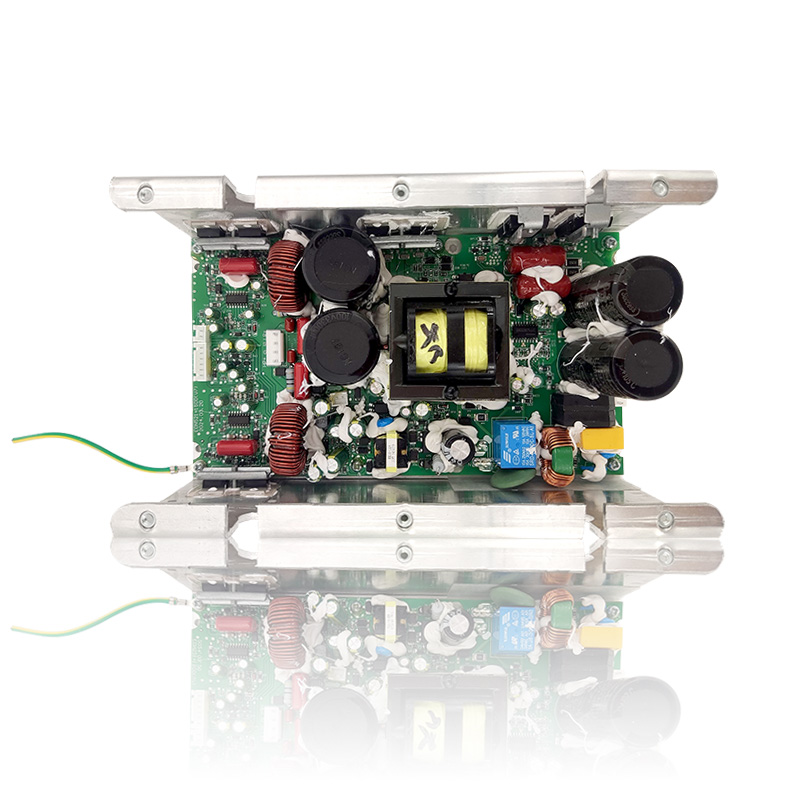
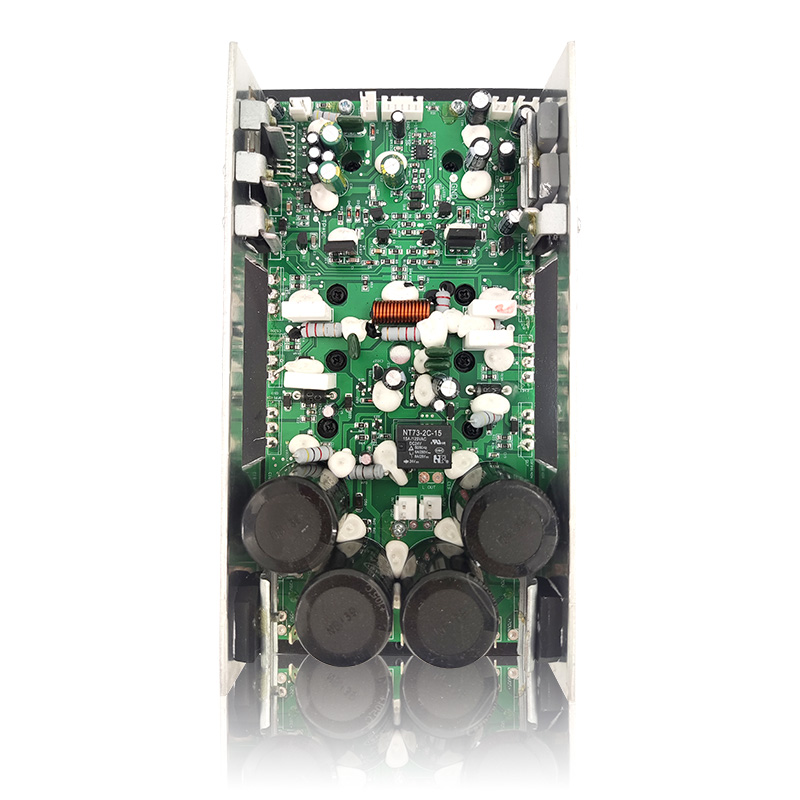 AMP400H+7294 Class H Power Amplifier ModuleCombines a 400 W Class H low/mid stage with a 100 W Class AB high-frequency stage and a U-shaped aluminium radiator for stable output.View Product →
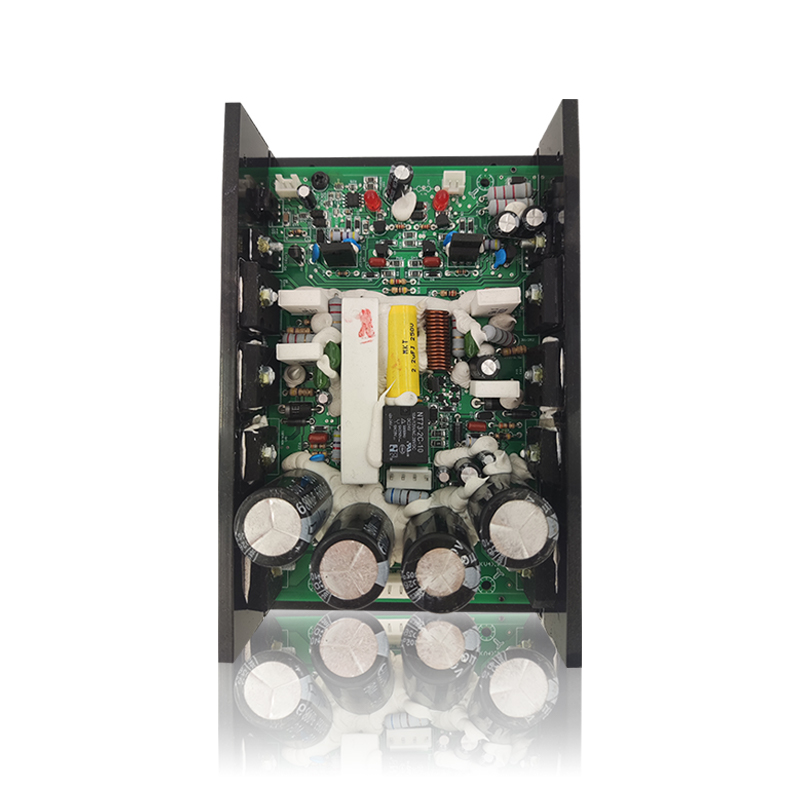
Modules in this category, such as the AMP400H-7294 with its U-shaped aluminium radiator, are typically specified for subwoofer and line array duty where continuous high output is expected for hours rather than minutes.
What the class choice changes further down the module stack
The power stage is one board in a chain, and the class decision ripples through the rest of it. A Class D stage with a fast limiter needs a preamp module that can feed it a clean, well-scaled signal; a Class AB stage with 20 dB of gain headroom will behave differently with the same source. Gain structure, clip behaviour, protection thresholds and even the choice of volume taper all change with the topology.
The power stage is the last block in the chain: every block above it must match its gain, headroom and protection behaviour.
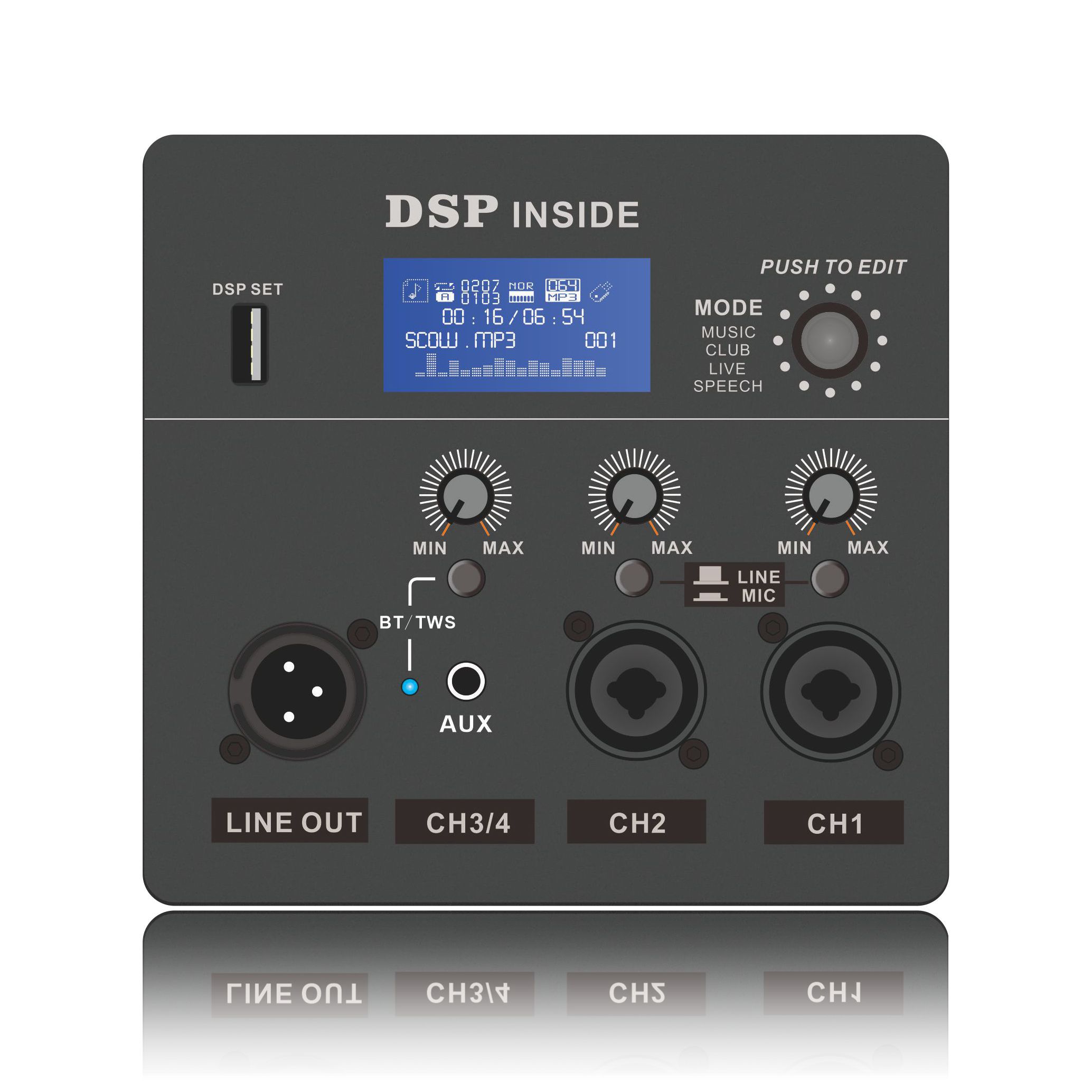
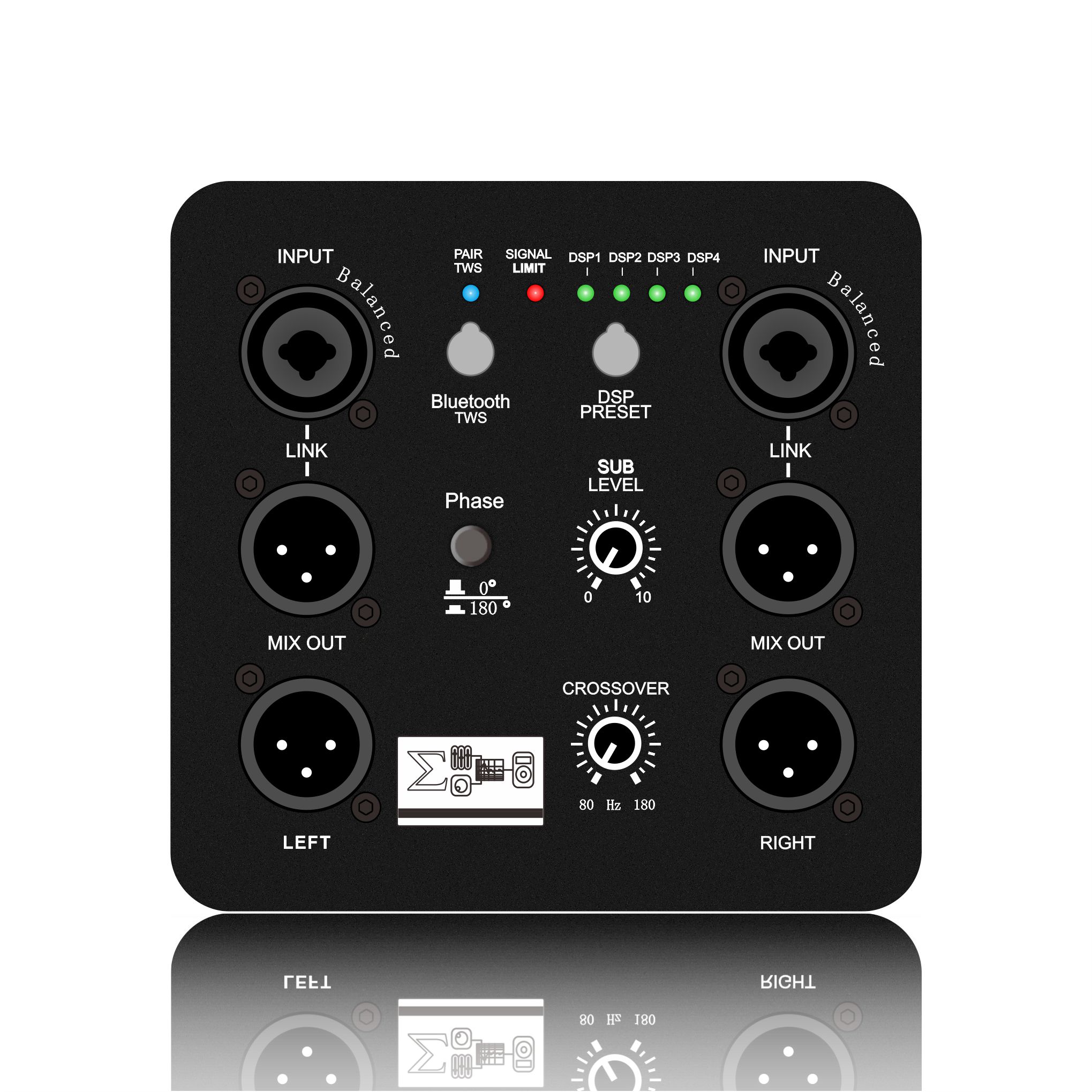
 DSP1903 ADAU1701 DSP Module for 2.1 SystemsADAU1701-based DSP module with four preset EQ modes, Bluetooth, and XLR I/O, suited to matching limiter behaviour in 2.1 line array systems.View Product →
In practice this is where modular suppliers earn their keep. A DSP module such as the DSP1903, built on the ADAU1701 and carrying four preset EQ modes for a 2.1 line array system, has to be matched to the limiter behaviour of whatever power stage sits below it. If the two are specified independently, the system either clips early or protects late. Our walkthrough of the A, AB, D and H design trade-offs goes deeper into how those thresholds are set.
Matching the class to the product you are building
Most powered speaker projects fall into a handful of patterns, and each one narrows the class choice quickly:
- Line array and column systems. Weight and rack density decide. Class D with a resonant supply is the default, with Class H reserved for modules that must run at very high output for long periods.
- Subwoofers. High continuous power into a low-impedance load. Class D with a robust supply handles this best; the supply, not the amplifier, is usually the limiting part.
- Portable and battery-powered speakers. Efficiency at part load matters more than the peak number. Class D is the only realistic option, and the idle losses deserve as much attention as the maximum output.
- Powered mixers and cost-sensitive analog boxes. Class AB with a linear transformer keeps the bill of materials simple and the service story familiar, at the cost of a bigger heatsink.
- High-power touring subwoofers. Class H or a high-rail Class D design, depending on whether the design team prefers linear behaviour or minimum weight.
What to check with a module supplier before you commit
The datasheet wattage is the least useful number in the conversation. These are the points that separate a design that survives field use from one that comes back:
- Efficiency and case temperature at one-eighth power, not just at full rated output, measured in still air at your intended ambient.
- Distortion at 1 W and at 10 W, where crossover and switching artefacts actually live.
- Protection behaviour: what happens on a shorted output, a mismatched load, or a supply sag, and whether the module recovers on its own.
- Supply requirements, including whether power factor correction is needed for the markets you ship to.
- EMI and idle noise, especially for Class D modules feeding high-efficiency compression drivers.
- Consistency between prototype and mass production, which is a manufacturing question as much as an engineering one.
For buyers who need a non-standard configuration, the sensible sequence is to settle the class and the supply topology first, then take the module through custom development for gain structure, connectors and preset behaviour. Changing the class after the cabinet and power supply are frozen is expensive.
Frequently asked questions about class amplifiers
Which amplifier class is the most efficient?
Class D is the most efficient audio class in normal use, typically 80-95% at rated output. Class C is efficient too but distorts heavily and is used for RF, not audio.
What is the difference between Class AB and Class D amplifiers?
Class AB keeps its output devices partially conducting and behaves linearly, at the cost of continuous heat. Class D switches devices on and off at high frequency, which is far more efficient but moves the design challenge to filtering and EMI.
Is Class D good enough for professional audio?
Yes. Modern Class D modules with well-designed output filters and stiff resonant supplies are standard in powered line arrays and subwoofers. The limiting factor is usually the supply and the limiter settings, not the topology.
What is a Class H amplifier used for?
Class H is used where high output power must fit a compact chassis, such as touring subwoofers and high-power line array modules. Rail switching keeps the voltage across the output devices low, so less heat reaches the heatsink.
Do amplifier classes affect sound quality?
Less than layout, supply design and gain structure do. A well-engineered Class D module and a well-engineered Class AB module can both sound clean; a poorly biased AB stage or a badly filtered D stage will not.
Why do Class A amplifiers run so hot?
Because the output devices conduct current during the entire signal cycle, even with no music playing. That constant current produces steady heat, so Class A needs large heatsinks and generous ventilation for modest output power.