English
 Español
 中文简体

Home / News / Industry News / Which Amplifier Class Is Best for Sound Quality? A Practical OEM Guide
Content
- 1 Which Class Amplifier Is Best for Sound Quality? The Short Answer
- 2 Class A, AB, D, and H: What Each One Does to Sound
- 3 Sound Quality Metrics That Matter More Than the Class Name
- 4 Visualizing the Trade-offs
- 5 Where Class AB and Class H Still Fit
- 6 DSP and Integration: The Real Sound-Quality Multiplier
- 7 Practical Selection Rules for OEM Buyers
- 8 Frequently Asked Questions
- 8.1 Q1: Is Class D better than Class AB for sound quality in powered speakers?
- 8.2 Q2: Do Class H amplifiers sound worse than Class AB?
- 8.3 Q3: What does a DSP amplifier module change in sound quality?
- 8.4 Q4: Which amplifier class is best for subwoofers?
- 8.5 Q5: How much power do I need for clear PA sound?
- 8.6 Q6: Can a Class D amplifier module deliver audiophile-grade clarity?
Which Class Amplifier Is Best for Sound Quality? The Short Answer
A product team is finalizing a 12-inch two-way powered speaker. One prototype uses a 500 W Class D module with PFC and LLC resonant power; another uses a linear Class AB board. On pink noise they sound close; after 20 minutes the AB heatsink is hotter and its limiter engages earlier. Which class amplifier is best for sound quality? No class wins everywhere.
For most modern OEM powered speakers, Class D is the best starting point for sound quality per watt. Efficiency, thermal stability, and compact integration matter as much as a distortion figure. Class AB remains strong in low-power audiophile and studio designs. Class H fits high-output PA and subwoofers. Class A is rarely the best system choice outside niche low-power listening.
The class label is only the first layer. Supply, output filter, DSP preset, crossover, limiter, and heatsink decide whether a design sounds clean or strained.
Class A, AB, D, and H: What Each One Does to Sound
Class A keeps output devices conducting through the whole cycle. It avoids crossover distortion and can sound very pure, but typical efficiency is only 20–30%. A 50 W Class A design may dissipate more heat than a much larger Class D module.
Class AB conducts for more than half the cycle, reducing Class B's crossover notch while keeping efficiency above Class A, often around 50–65%. The result is a mature linear topology with predictable clipping and low idle noise. The cost is weight: linear transformers, large capacitors, and substantial heatsinks.
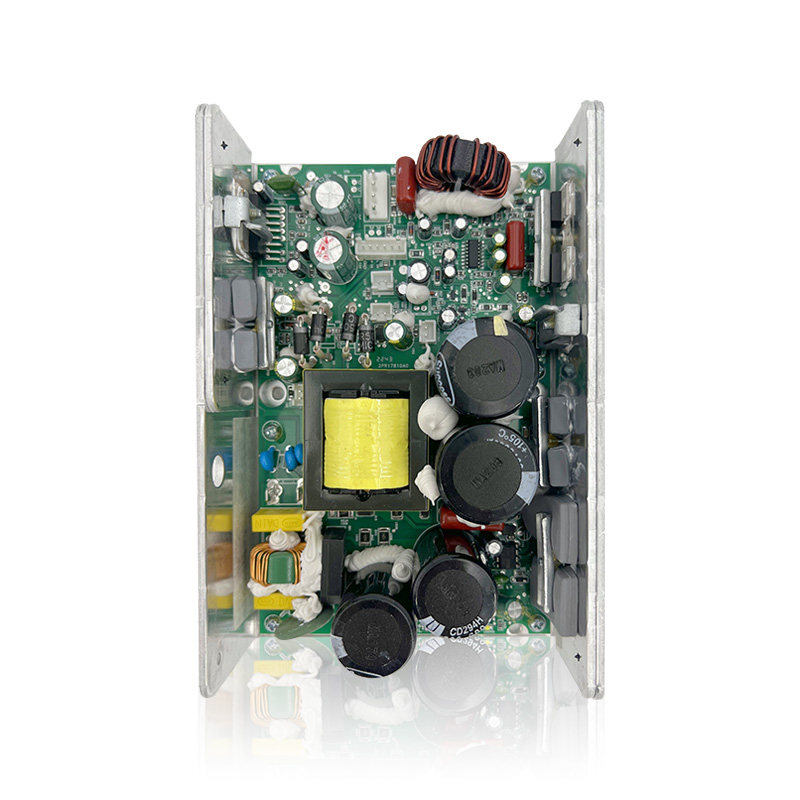
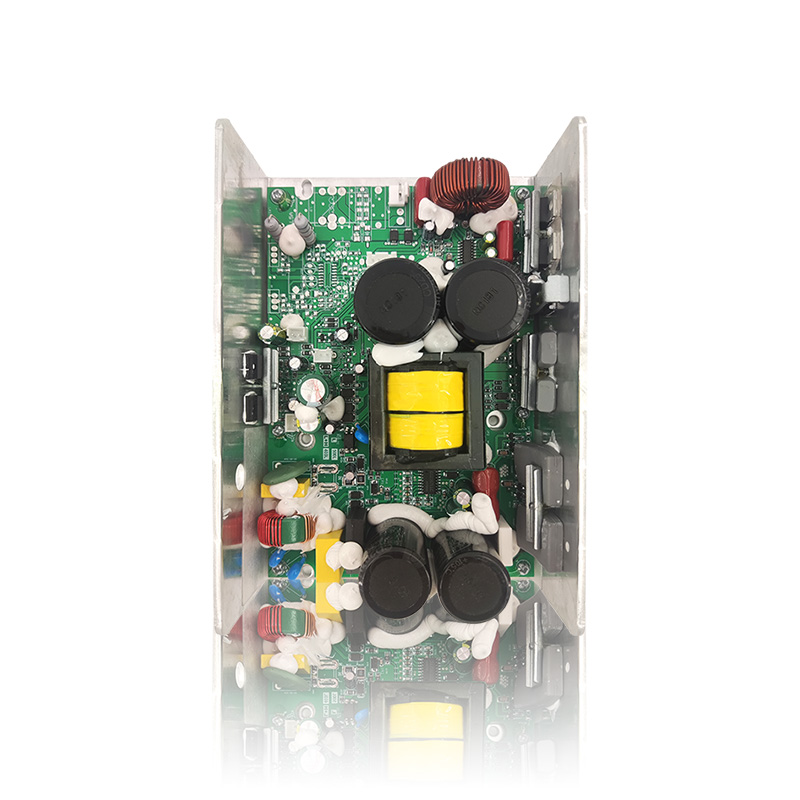
Class D switches at high frequency and reconstructs audio with an output filter. Efficiency often reaches 85–95%, so a compact module can deliver high power with a smaller heatsink. Good designs achieve low distortion and strong bass control; poor layout, weak EMI filtering, or a mismatched filter can still make them sound harsh. For powered speakers, line arrays, and subwoofers, Class D is usually the best balance.
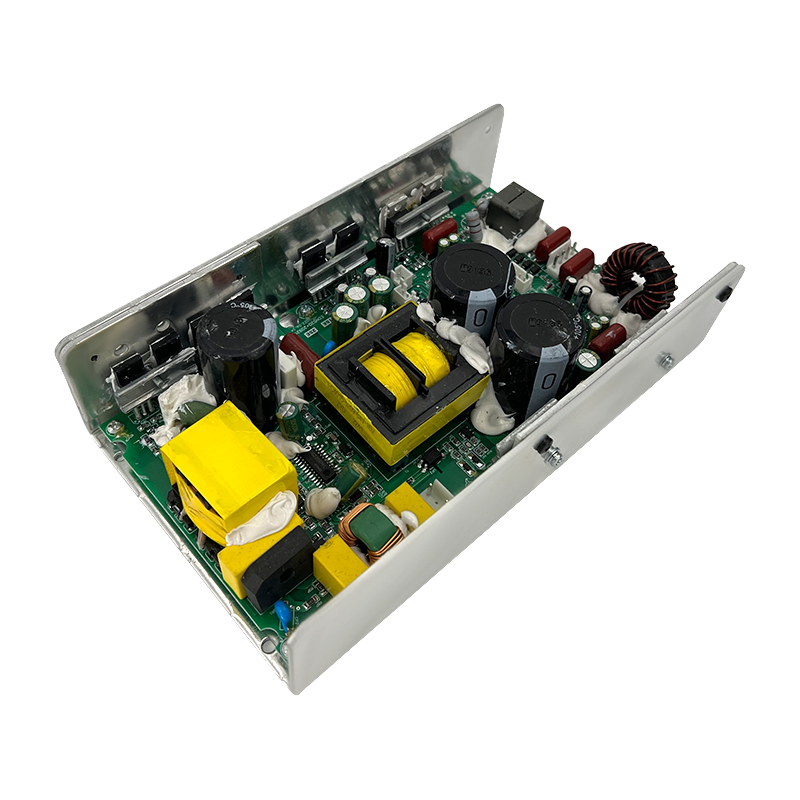 EON520 Class D Power Amplifier ModuleA PFC+LLC wide-voltage Class D module with 400 W low/mid and 100 W high-frequency amplification for active speaker designs.View Product →
Class H adds rail switching to a linear amplifier. Rails step up only when the signal needs more voltage, cutting wasted heat at high output. It is more complex than Class AB but often more practical than a fixed-rail design for subwoofers and PA cabinets.
For a deeper comparison in powered-speaker module design, see the amplifier class guide for powered-speaker modules.
Sound Quality Metrics That Matter More Than the Class Name
Sound quality is not a single score. Listeners hear noise, distortion, frequency response, dynamic compression, and thermal behavior together. The useful question is which class makes those parameters easier to control.
| Class | Typical efficiency | Sound-quality strength | Main engineering cost | Typical best fit |
|---|---|---|---|---|
| A | 20–30% | Low crossover distortion | High heat, low power density | Desktop and low-power monitors |
| AB | 50–65% | Low distortion at normal levels | Moderate heat, heavier supply | Studio monitors, powered cabinets |
| D | 85–95% | Low distortion with good design | Layout and EMI sensitivity | Powered speakers, line arrays, subs |
| H | 70–85% | Low distortion with good rail control | Moderate heat, high output | PA subs, high-SPL systems |
The table is a design map, not a ranking. A Class D amplifier with a clean supply, good output filter, and well-set limiter can outperform a poorly implemented Class AB design in every audible category. Conversely, a Class AB board with generous linear headroom can sound more natural than a Class D module running near its limit.
Visualizing the Trade-offs
The first chart compares typical efficiency ranges. The second is an illustrative design-priority map, not a measured sound-quality score.
Typical efficiency range by amplifier class
Efficiency is power delivered to the load divided by power drawn from the supply. Ranges are typical, not guaranteed.
Design-priority comparison, 1–5 scale
Class D Class AB Class H
Illustrative comparison of design priorities, not a measured sound-quality ranking.
Where Class AB and Class H Still Fit
Class AB is not obsolete. In low-power home audio, studio monitors, and compact powered cabinets, a well-designed Class AB amplifier can deliver low noise, gentle clipping, and predictable thermal behavior. In a portable sealed cabinet, however, its weight and heat compete with battery space and thermal budget.
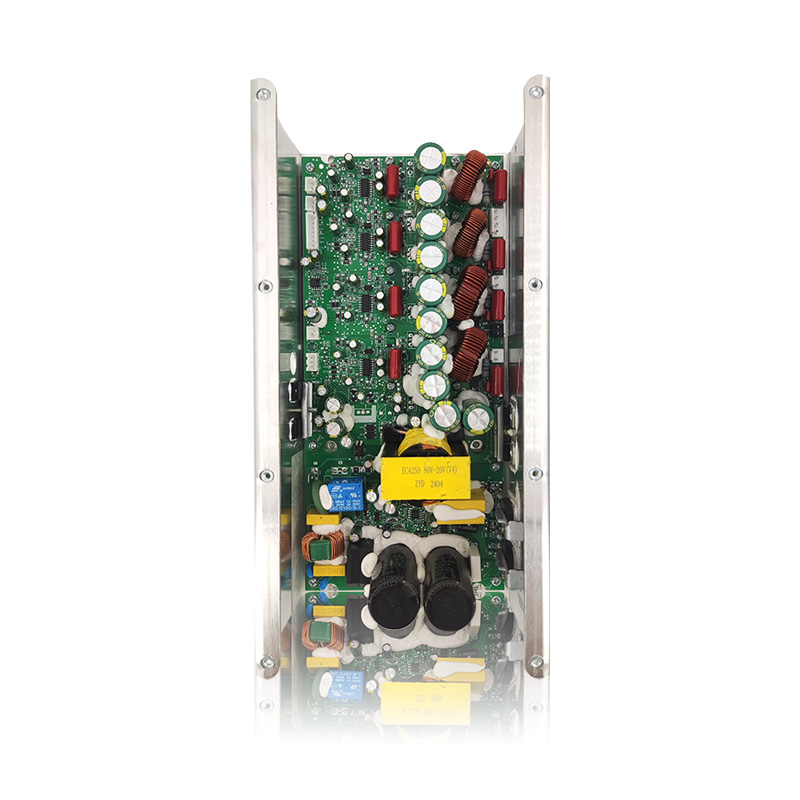
Class H is the high-power compromise. It can deliver more usable output than a fixed-rail Class AB design without Class A's efficiency penalty. The trade-off is complexity: rail switching, protection, and thermal design must work together. A poorly controlled rail transition can add noise or distortion; a well-designed module is a pragmatic choice for a 15-inch subwoofer or compact line array.
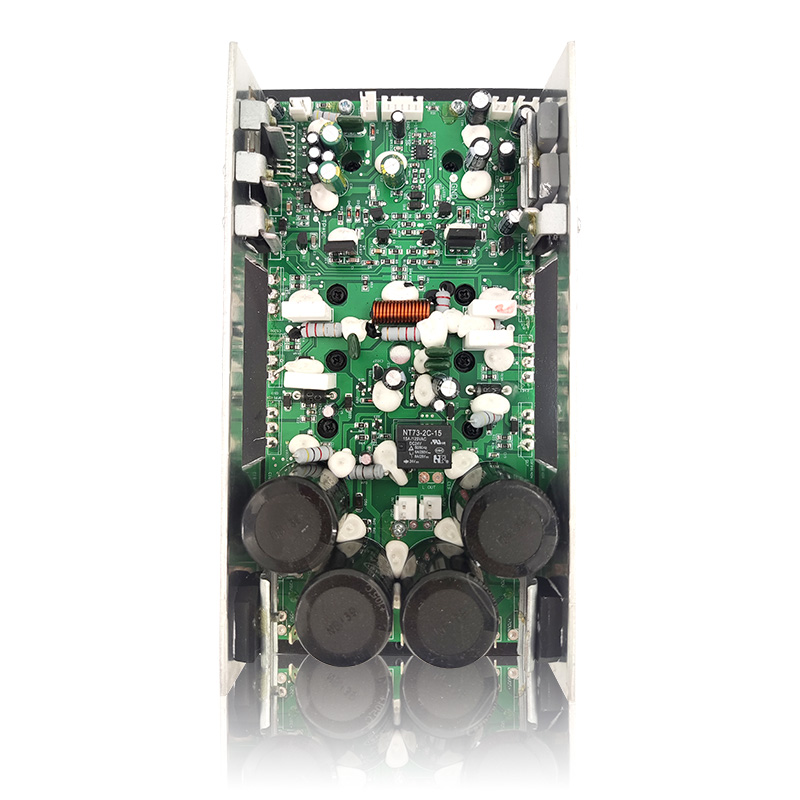 AMP400H+7294 Class H Amplifier ModuleA 500 W linear-supply Class H module with 400 W low/mid and 100 W Class AB high-frequency stages for speaker amplification.View Product →
At high output, Class AB may add compression as it heats, while Class D may hit its current limit or clip suddenly. Both are implementation issues, not class verdicts.
DSP and Integration: The Real Sound-Quality Multiplier
Two amplifiers of the same class can sound different because one has a better DSP preset. A DSP module sets crossover slopes, EQ, phase alignment, and limiting before the signal reaches the amplifier. That control often improves perceived clarity and bass integration more than a class change.
In a powered line array, DSP time-aligns subs and tops, protects drivers, and keeps the module out of clipping. In a portable speaker, it can apply bass boost at low volume and pull it back as the limit approaches. The class sets the efficiency envelope; the DSP decides how intelligently the system uses it.
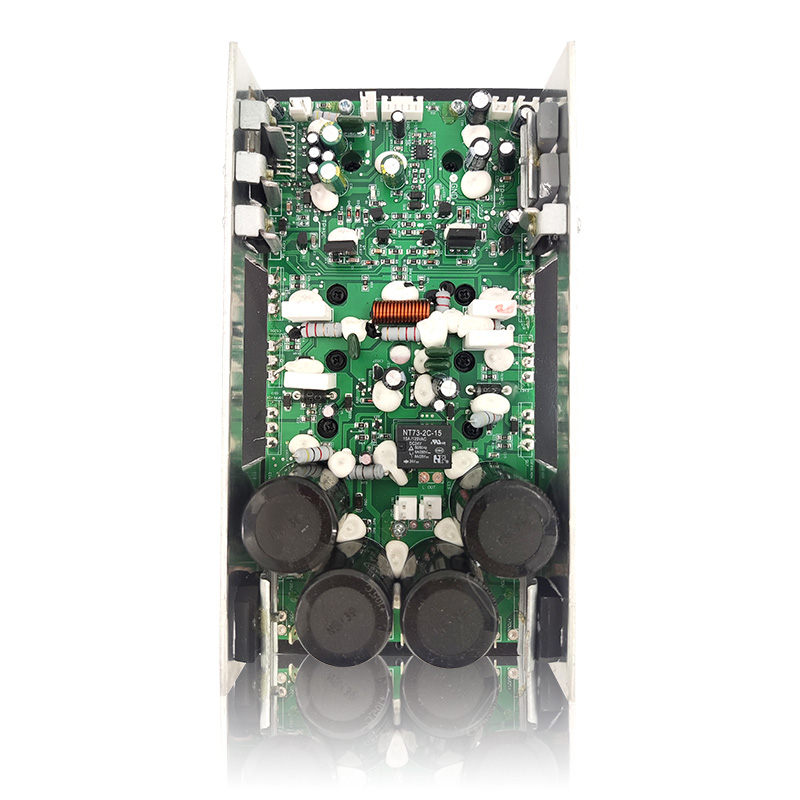
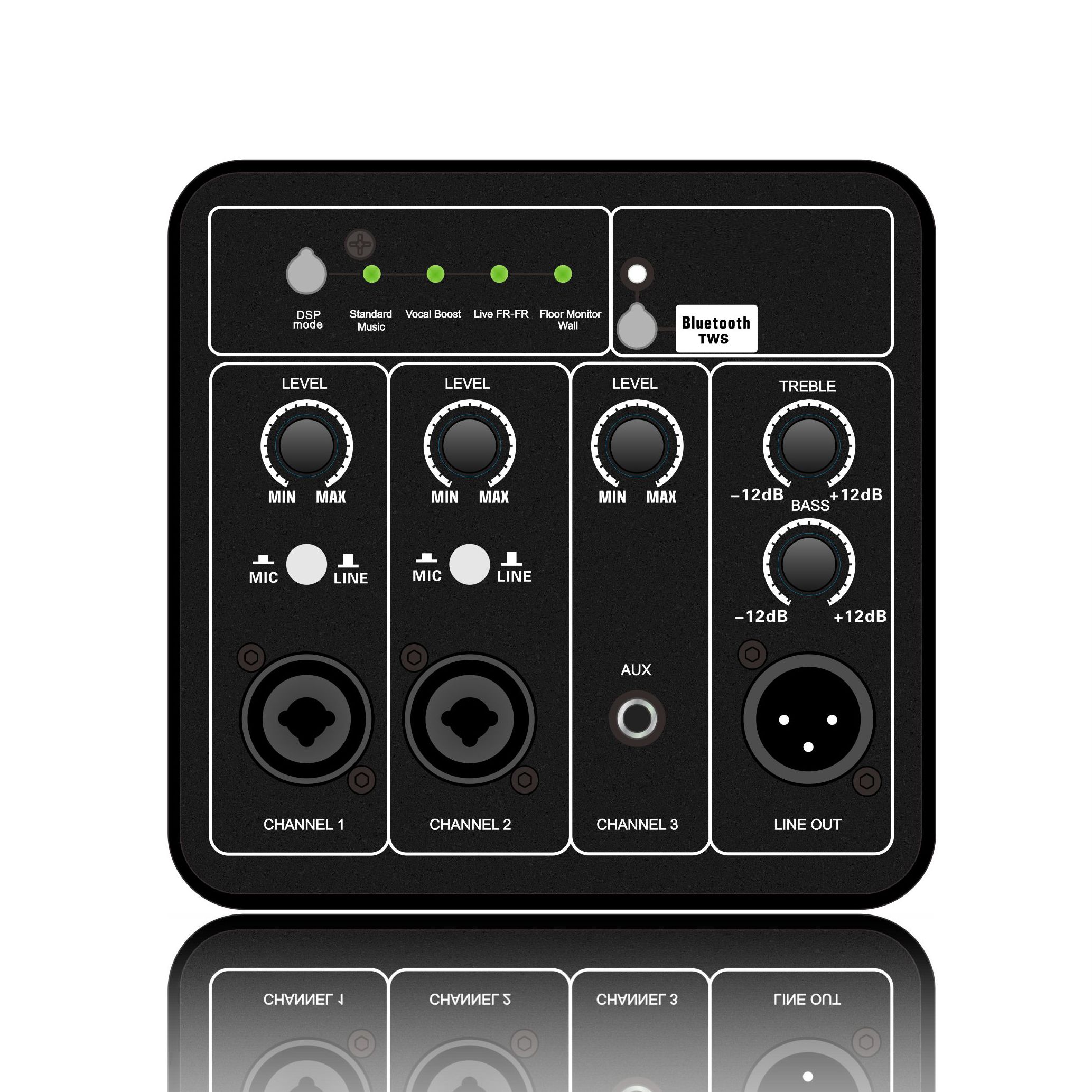
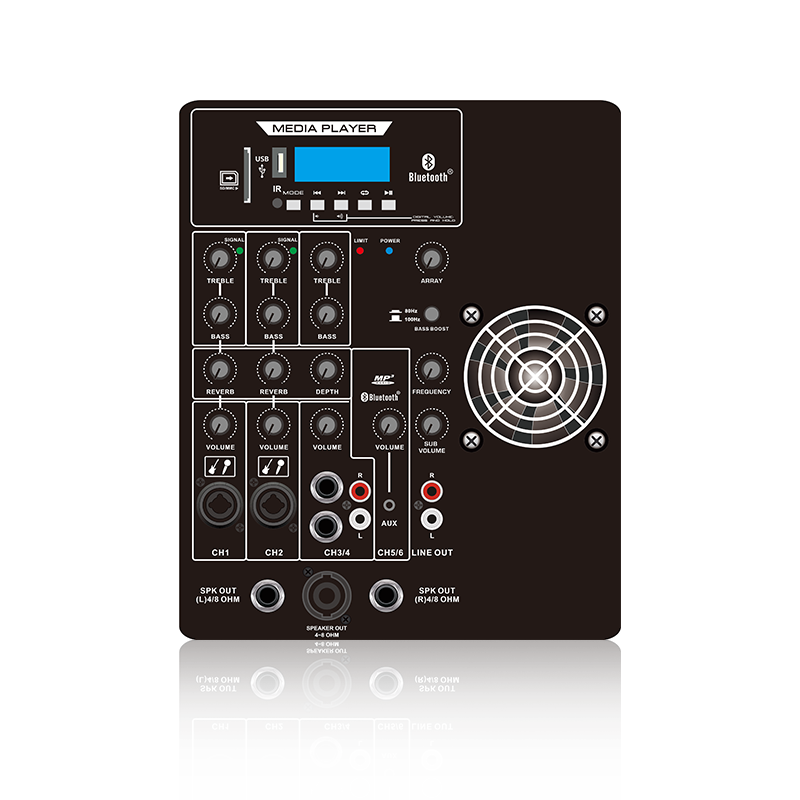
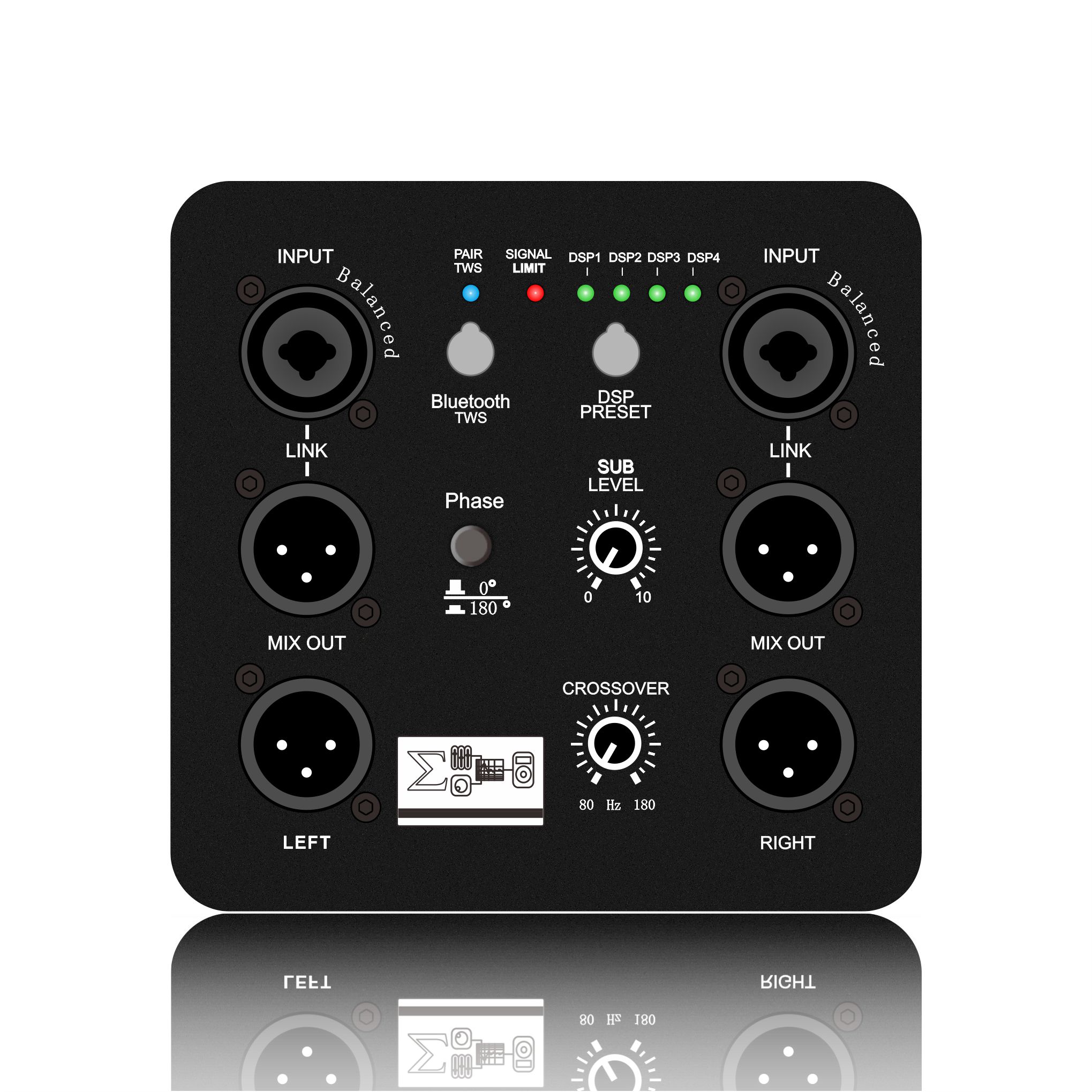
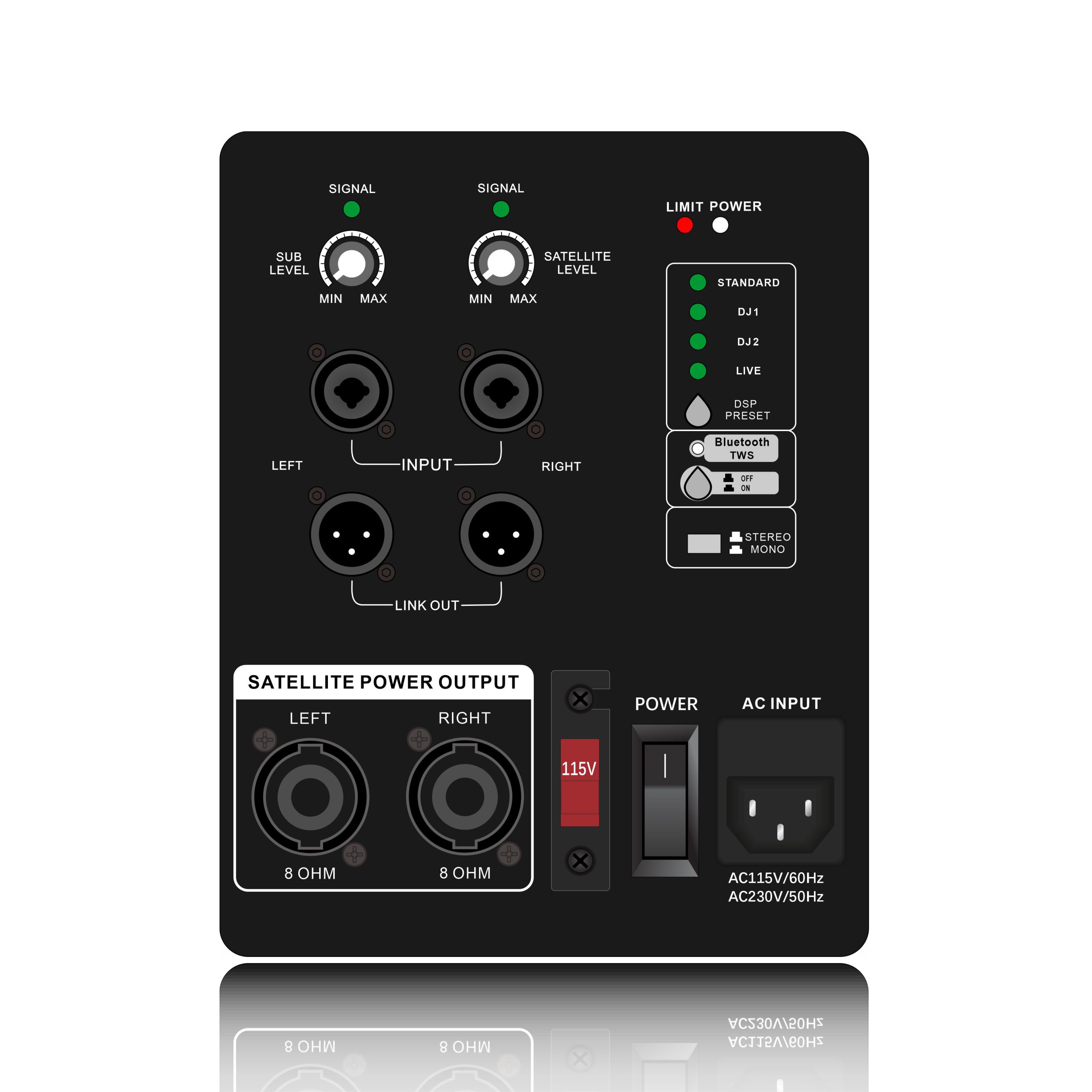 DSP1903 ADAU1701 2.1-Channel DSP ModuleAn ADAU1701-based module with preset EQ, Bluetooth TWS, and mono/stereo switching for powered line-array speaker systems.View Product →
HuaGe's DSP modules use the ADAU1701 platform, with options for multi-channel input, preset EQ, USB MP3, LCD, and Bluetooth TWS. For OEM projects, platform consistency reduces firmware and integration risk. For custom presets or a specific control layout, the custom amplifier module service is the relevant starting point.
Integration is easier to understand when the module is drawn as a stack. The DSP board handles signal routing and presets; the Class D power stage converts DC to audio; the PFC/LLC supply and heatsink set the thermal and safety envelope. Changing one layer changes the sound at the output.
Isometric view of a Class D module stack
Simplified isometric illustration. Actual layout depends on power level, protection, and mechanical design.
Practical Selection Rules for OEM Buyers
Use these rules as a starting filter, then validate with measurements and listening tests.
- Compact powered speaker, portable, or line array: start with Class D. Prioritize PFC/LLC supply, output filter quality, and DSP limiting.
- Low-power audiophile or studio monitor: Class AB remains competitive when idle noise and linear clipping behavior matter.
- High-output subwoofer or PA cabinet: evaluate Class H when Class D current limit or supply cost becomes impractical.
- Any class: require THD vs frequency at rated power, thermal rise at 1/8 and 1/3 power, and limiter behavior. These tests reveal more than a class label.
Also check the load. A module rated at 4 ohms may behave differently at 8 ohms or 2 ohms. Protection thresholds, fan noise, and heatsink orientation can change perceived sound quality in the final cabinet. Ask for the test condition, not just the headline wattage.
Frequently Asked Questions
Q1: Is Class D better than Class AB for sound quality in powered speakers?
For most powered speakers, a well-designed Class D module is the better system choice because it runs cooler and allows more DSP and power in a compact box. Class AB can still sound excellent in low-power designs with generous linear headroom.
Q2: Do Class H amplifiers sound worse than Class AB?
Not inherently. Class H adds rail switching for efficiency at high output. A good implementation sounds clean; a poor one can add noise or distortion. Audition at realistic SPL and check thermal behavior.
Q3: What does a DSP amplifier module change in sound quality?
It controls crossover, EQ, phase, and limiting before amplification. That often improves clarity, bass integration, and protection more than changing amplifier class alone.
Q4: Which amplifier class is best for subwoofers?
Class D is usually the most practical for compact subwoofers; Class H is a strong option for high-output PA subwoofers. The best result depends on the driver, box, supply, and limiter.
Q5: How much power do I need for clear PA sound?
Power is only one factor. Sensitivity, coverage, crossover design, and limiter settings matter. Choose a module with headroom for the real program material, then verify thermal rise.
Q6: Can a Class D amplifier module deliver audiophile-grade clarity?
Yes, when the output filter, supply, grounding, and feedback are well designed. Modern Class D can achieve low distortion and low noise, but implementation quality is decisive.