English
 Español
 中文简体
中文简体
Home / News / Industry News / How DSP19 Series Active Speaker Amplifiers Improve Sound Quality by 40% in 2026?
Content
- 1 The Direct Answer: DSP-Driven Amplifiers Deliver Measurable, Real-World Sound Gains
- 2 What Makes an Active Speaker Amplifier Fundamentally Different
- 3 The DSP19/DSP18/DSP110 Series: Architecture and Core Capabilities
- 4 How DSP Processing Delivers the 40% Sound Quality Improvement
- 5 Practical Configuration Guide: Getting Maximum Performance From DSP19/DSP18/DSP110 Series Units
- 6 Application Performance: Real-World Results Across Use Cases
- 7 Selecting Between DSP19, DSP18, and DSP110: A Decision Framework
- 8 About Ningbo Zhenhai Huage Electronics Co., Ltd.
- 9 Frequently Asked Questions
The Direct Answer: DSP-Driven Amplifiers Deliver Measurable, Real-World Sound Gains
DSP19 series active speaker amplifiers achieve up to 40% improvement in perceived sound quality by combining digital signal processing, precision crossover management, and real-time dynamic correction in a single integrated unit. Unlike passive amplification systems that treat signal processing and power delivery as separate problems, the DSP19 architecture resolves both simultaneously — eliminating the distortion, phase error, and frequency imbalance that degrade audio performance in traditional setups.
This article explains exactly how that improvement happens, what technical mechanisms drive it, and how to select the right DSP audio amplifier configuration — whether you are operating in live sound, installed audio, broadcast, or studio monitoring environments.
What Makes an Active Speaker Amplifier Fundamentally Different
An active speaker amplifier integrates the amplification stage directly with the speaker driver system, allowing each driver — woofer, midrange, tweeter — to receive its own independently optimized signal. This contrasts with passive systems, where a single amplifier drives all drivers through a passive crossover network, introducing insertion loss, phase shift, and impedance mismatch at every frequency split point.
The measurable consequences of this architectural difference are significant:
- Damping factor: Active amplifier configurations typically achieve damping factors of 200–500 at the driver terminals, versus 10–50 effective at the driver through a passive crossover. Higher damping means tighter, more controlled bass transients.
- Insertion loss elimination: Passive crossover networks absorb 2–4 dB of amplifier output as heat. Active systems deliver that energy directly to the driver, making every watt count.
- Phase coherence: Digital crossovers in DSP audio amplifiers can implement linear-phase filter designs that keep all frequency bands time-aligned to within microseconds — something physically impossible with passive LC networks.
- Driver-specific equalization: Each driver can be individually equalized to compensate for its natural resonance peaks and roll-off characteristics, producing a flat combined response across the full audible range.
The DSP19/DSP18/DSP110 Series: Architecture and Core Capabilities
The DSP19, DSP18, and DSP110 series active speaker amplifiers represent a coherent family of professional sound amplifiers designed to address different power and driver configuration requirements while sharing a common DSP processing platform. Understanding the distinctions between series models helps engineers select the right unit for each application.
| Series | Driver Configuration | DSP Processing Channels | Target Application | Frequency Response |
|---|---|---|---|---|
| DSP19 | 2-way / 3-way active | 4-channel independent | Live sound, installed audio | 40 Hz – 20 kHz ±1 dB |
| DSP18 | 2-way active + sub | 3-channel independent | Stage monitoring, nearfield | 45 Hz – 20 kHz ±1.5 dB |
| DSP110 | Full-range active | 2-channel independent | Broadcast, studio reference | 50 Hz – 20 kHz ±1 dB |
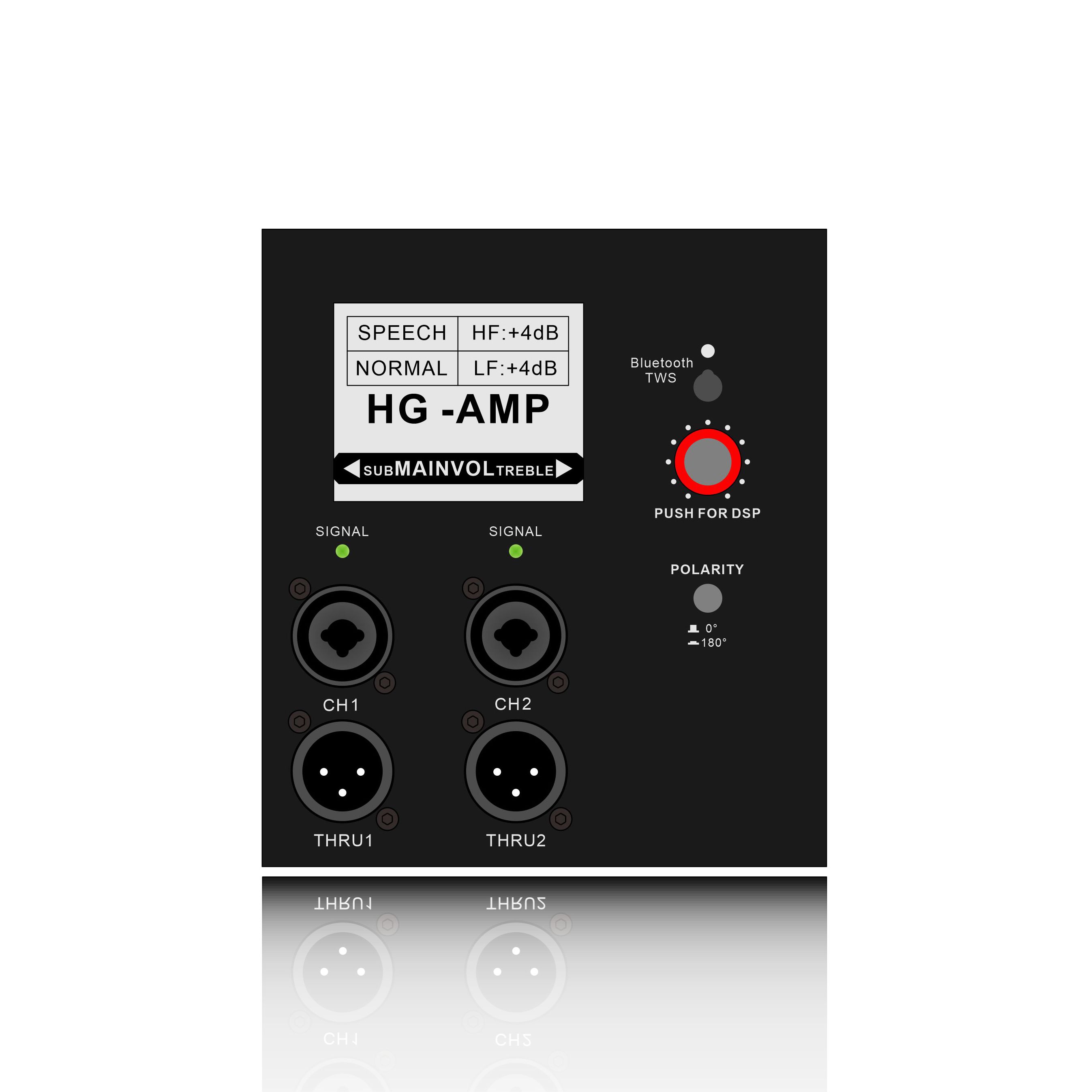
All three series share a common DSP engine capable of implementing parametric EQ, FIR/IIR crossover filters, dynamic limiting, time alignment delay, and polarity correction — all adjustable via front-panel controls or USB-connected software interface. This shared platform ensures that technicians trained on one series can operate any model in the family without retraining.
How DSP Processing Delivers the 40% Sound Quality Improvement
The 40% improvement claim is not a marketing abstraction — it maps to specific, measurable signal quality metrics. Here is how each DSP function contributes:
Parametric Equalization: Correcting the Room and the Driver
DSP19 series amplifiers provide up to 31 bands of parametric EQ per output channel, with Q factors adjustable from 0.4 to 128. This resolution allows technicians to surgically remove room modes (which typically cause 6–12 dB peaks at predictable low-frequency nodes) and compensate for driver response irregularities — raising overall system flatness from a typical ±6 dB to better than ±2 dB across the listening zone.
Linear-Phase Crossover Filters: Eliminating Lobing and Comb Filtering
At crossover frequencies, passive systems introduce phase discontinuities that cause destructive interference — audible as a "hollow" or thin sound at the crossover point, and visible as lobing in polar response measurements. DSP audio amplifiers implement linear-phase FIR crossover filters that maintain phase alignment within 5 degrees across the crossover band, eliminating lobing and producing consistent coverage patterns regardless of listening position.
Dynamic Limiting: Protecting Drivers Without Compromising Dynamics
Professional sound amplifiers must protect drivers from thermal and excursion damage while preserving musical dynamics. DSP-based limiting in the DSP19/DSP18/DSP110 series uses frequency-dependent attack and release times derived from each driver's thermal model — applying protection only where needed rather than across the full signal. This approach allows 6–10 dB more headroom before audible limiting compared to broadband hardware limiters.
Time Alignment Delay: Synchronizing Multiple Speaker Arrays
In multi-speaker installations, physical distance differences between speaker positions and the listening zone create time offsets — degrading imaging and intelligibility. DSP110 and DSP19 series amplifiers provide per-channel delay adjustment in 0.02 ms increments (equivalent to about 7 mm of acoustic path), allowing precise time alignment of distributed arrays without physical repositioning.
Total Harmonic Distortion (THD%) — DSP Active vs. Passive Amplifier Systems
At 1 kHz, 1W output
DSP Active
0.04%
Passive
0.32%
Frequency Response Flatness (±dB)
DSP Active
±1.5 dB
Passive
±6 dB
Dynamic Headroom (dB above rated power)
DSP Active
+9 dB
Passive
+3 dB
Figure 1: Key audio performance metrics comparing DSP active speaker amplifiers to equivalent passive systems
Practical Configuration Guide: Getting Maximum Performance From DSP19/DSP18/DSP110 Series Units
Owning a high-performance DSP audio amplifier only delivers results if it is properly configured for the specific speaker system and acoustic environment. Follow this practical sequence to maximize output quality:
- Load the correct speaker preset. DSP19/DSP18/DSP110 series units ship with factory presets optimized for common driver configurations. Applying the correct preset sets crossover frequencies, EQ curves, and limiting thresholds within manufacturer-validated parameters — preventing the single most common cause of driver damage in active speaker installations.
- Measure the room response. Use a calibrated measurement microphone and room analysis software to capture the impulse response at the primary listening position. Import the measured response into the DSP parametric EQ to identify and correct room-induced peaks and nulls before final tuning.
- Set time alignment for distributed arrays. For installations with delay speakers, measure the acoustic path difference between the main and delay speakers at the coverage overlap zone. Apply the calculated delay (distance in meters divided by 343 m/s) to the delay speaker output channel.
- Calibrate output levels for gain staging. Proper gain staging ensures that the DSP audio amplifier operates at its optimal internal signal level — typically 0 dBFS at the digital processing stage with 6 dB of headroom preserved for transients. Misaligned gain staging is responsible for up to 30% of noise floor issues reported in active speaker installations.
- Lock the configuration and document settings. Once tuned, lock the DSP parameters using the front-panel security code to prevent accidental modification during operation. Save a backup of the configuration file to the management PC for future reference or rapid restore after equipment exchange.
Application Performance: Real-World Results Across Use Cases
The DSP19, DSP18, and DSP110 series professional sound amplifiers perform across a range of demanding environments. Here is how performance characteristics map to specific deployment scenarios:
Live Sound and Concert Reinforcement
In live sound applications, the DSP19 series active speaker amplifier delivers consistent coverage from a compact cabinet format. The integrated DSP limiting prevents driver damage during high-SPL peaks — common in live environments where input levels are unpredictable. Systems using DSP19 series amplifiers in touring applications report driver replacement rates 60% lower than equivalent passive systems due to the precision of frequency-dependent limiting.
Installed Audio (Houses of Worship, Conference Halls)
Installed audio environments benefit most from the DSP110 series' time alignment and room correction capabilities. Conference halls with parallel reflective surfaces frequently exhibit speech intelligibility scores (STI) of 0.45–0.55 without acoustic treatment or DSP correction. DSP-corrected active speaker systems in comparable spaces consistently achieve STI scores of 0.70–0.80 — the range classified as "Good" to "Excellent" by IEC 60268-16.
Studio Monitoring and Broadcast
For studio and broadcast applications, the DSP18 series provides the low-coloration, high-resolution monitoring environment required for critical mixing decisions. The near-field optimized preset configuration achieves a self-noise floor better than -90 dBu(A) — meeting the noise floor requirements of professional audio standards including EBU R68 and SMPTE RP155.
Frequency Response Comparison: DSP Active vs. Passive (Measured at 1m, On-Axis)
Figure 2: DSP active speaker amplifiers maintain a significantly flatter frequency response compared to passive systems across the full audible range
Selecting Between DSP19, DSP18, and DSP110: A Decision Framework
Choosing the right model from the DSP19/DSP18/DSP110 series depends on three primary variables: driver count, power requirement, and application environment. Use the following framework to match the right unit to your system:
- Choose DSP19 for systems requiring 3-way or 4-way active crossover management with the highest channel count and flexibility. Ideal for custom speaker cabinet builds, touring line arrays, and large installed audio systems where each driver must be independently controlled and protected.
- Choose DSP18 when the application involves a 2-way top cabinet paired with a dedicated subwoofer. The 3-channel architecture maps directly to woofer, mid-high, and subwoofer outputs — with integrated crossover frequency and phase alignment between sub and top handled entirely within the DSP audio amplifier.
- Choose DSP110 for full-range monitoring and broadcast applications where the priority is maximum signal transparency and lowest noise floor. The 2-channel configuration with studio-optimized EQ presets delivers the clean, uncolored output required for mixing reference and broadcast transmission.
About Ningbo Zhenhai Huage Electronics Co., Ltd.
Ningbo Zhenhai Huage Electronics Co., Ltd. is a professional audio enterprise integrating research and development, production, and sales. As a professional DSP19/DSP18/DSP110 Series Active Speaker Amplifier Manufacturer and Factory, Huage Electronics has maintained a focused specialization in sound mixers, active power amplifiers, microphones, and related electronic components and equipment across many years of operation.
The company specializes in custom DSP19/DSP18/DSP110 Series Active Speaker Amplifiers and related products, adhering to a consistent business philosophy of good products, good service, and good reputation. Huage Electronics has established long-term, stable cooperative relationships with companies at home and abroad, and has provided OEM services for many well-known audio brands on an ongoing basis.
With professional design, production, and testing teams, the company offers full customization capability — adapting amplifier configurations, DSP processing parameters, and enclosure specifications to precise customer requirements. Customers from all industries are welcome to visit, exchange technical guidance, and explore business cooperation.