English
 Español
 中文简体
中文简体
Home / News / Industry News / How to Increase Audio Output Power by 35% Using Class AB Amplifier Design?
Content
- 1 The Direct Answer: Why Class AB Amplifier Design Delivers 35% More Output Power
- 2 Understanding Class AB: How the Push-Pull Output Stage Works
- 3 Comparing Amplifier Classes: Output Power and Efficiency Data
- 4 Five Circuit Design Techniques That Maximize Class AB Output Power
- 5 THD Performance Across Frequency: What Good Looks Like
- 6 Thermal Management: Protecting Output Power Gains Under Real Load Conditions
- 7 Real-World Applications: Where Class AB Loudspeaker Amplifiers Excel
- 8 About Ningbo Zhenhai Huage Electronics Co., Ltd.
- 9 Frequently Asked Questions
The Direct Answer: Why Class AB Amplifier Design Delivers 35% More Output Power
A properly optimized Class AB loudspeaker amplifier delivers 30% to 38% more usable audio output power than a comparable Class A design operating from the same supply voltage and thermal budget — and it does so while maintaining THD (Total Harmonic Distortion) figures below 0.05% across the audible bandwidth. The gain comes from the push-pull output stage topology, where two complementary transistor pairs share the load and each conducts for slightly more than half the signal cycle, eliminating the crossover dead zone of Class B while recovering the power headroom wasted in Class A's constant idle current.
In practical terms: a Class A amplifier biased for 50W output may dissipate 200W of standing power at idle. A Class AB design producing the same 50W output from the same transistors typically dissipates only 60 to 80W at idle — freeing thermal headroom that can be redirected into higher peak output power. That thermally recovered headroom is the primary source of the 35% output improvement cited across engineering measurement reports.
Understanding Class AB: How the Push-Pull Output Stage Works
The Class AB loudspeaker amplifier topology sits deliberately between two extremes. Class A transistors conduct continuously for the full 360 degrees of the signal cycle — clean but thermally wasteful. Class B transistors conduct for exactly 180 degrees each — efficient but prone to crossover distortion at the zero-crossing point. Class AB solves both problems by biasing each output transistor to conduct for approximately 190 to 200 degrees — just enough overlap to eliminate crossover distortion without the thermal penalty of full Class A operation.
The Role of Quiescent Current Bias
The key control parameter in any high fidelity Class AB power amplifier circuit is the quiescent current (Iq) — the standing current flowing through the output transistors at zero signal input. Setting Iq correctly is the most critical step in Class AB amplifier commissioning:
- Too low (below 10–20 mA for typical output stages): Crossover distortion appears at low signal levels, raising THD above acceptable limits and degrading listening quality at moderate volumes.
- Correct (typically 25–80 mA depending on output transistor type): Crossover distortion is fully suppressed, THD remains below 0.05%, and the amplifier operates with maximum power efficiency.
- Too high (approaching Class A territory, above 150–200 mA): Efficiency drops, heatsink thermal load increases substantially, and the available output power headroom is reduced rather than gained.
A Vbe multiplier (also called a bias spreader) transistor mounted directly on the output stage heatsink is the standard method for thermally tracking Iq — as output transistors heat up under load, the bias spreader automatically reduces the bias voltage, keeping Iq stable and preventing thermal runaway.
Comparing Amplifier Classes: Output Power and Efficiency Data
To understand the 35% output power advantage of Class AB, the following comparison uses a standardized reference condition: identical output transistors (2SC5200/2SA1943 complementary pair), identical supply rail of ±45V, and identical 8-ohm resistive load across all classes.
| Amplifier Class | Max Output Power (8 ohm) | Efficiency at Full Power | Typical THD at 1kHz | Idle Dissipation |
|---|---|---|---|---|
| Class A | ~75W | 25–30% | 0.002–0.01% | Very High (200–300W) |
| Class AB | ~100W | 55–65% | 0.01–0.05% | Moderate (60–80W) |
| Class B | ~100W | 65–75% | 0.5–2.0% | Minimal |
| Class D | ~120W | 85–92% | 0.05–0.3% | Very Low |
Class AB delivers 33% more output power than Class A from the same hardware, while keeping THD at levels that are inaudible to even trained listeners in controlled listening tests. Class D offers higher efficiency but introduces switching artifacts that require careful output filter design to suppress — for high fidelity loudspeaker amplifier applications where audio purity is the priority, Class AB remains the industry benchmark.
Maximum Output Power by Amplifier Class (Watts, ±45V / 8 ohm reference)
75W
Class A
100W
Class AB
100W
Class B
120W
Class D
Class AB matches Class B output power while maintaining high fidelity distortion levels — 33% above Class A from the same transistors.
Five Circuit Design Techniques That Maximize Class AB Output Power
Achieving the full 35% output power advantage of a low distortion Class AB audio amplifier module requires attention to five specific circuit design parameters. Each one contributes independently — and they compound when implemented together.
Supply Rail Voltage Optimization
Output power in a linear amplifier scales with the square of the supply voltage: doubling supply voltage quadruples potential output power. For a Class AB loudspeaker amplifier driving an 8-ohm load, the theoretical maximum output power is approximately Vcc² ÷ (2 × RL). In practice, output transistor saturation voltage and driver stage losses reduce this by 15 to 20%. The practical rule: use the highest supply voltage your output transistor Vceo rating safely permits — typically 80 to 90% of the transistor's maximum collector-emitter voltage — and you recover every watt that lower-voltage designs leave unused.
Paralleling Output Transistors to Reduce Rce
A single output transistor pair limits current delivery due to its on-resistance and thermal ceiling. Paralleling two or three matched transistor pairs halves or thirds the effective output resistance, allowing the amplifier to deliver higher current into low-impedance loads without clipping prematurely. Paralleling two pairs of 2SC5200/2SA1943 transistors typically increases continuous output current from 8A to 15A — directly increasing power delivery into 4-ohm loads from approximately 100W to 180W. Each parallel pair should include a small emitter resistor (0.1 to 0.22 ohm) to ensure current sharing.
Driver Stage Current Capacity
The driver transistors (the stage before the output pairs) must supply enough base current to keep the output transistors fully saturated during high-power transients. An underpowered driver stage creates dynamic compression — the amplifier appears to have adequate power at steady sine waves but compresses on musical transients where demand spikes instantaneously. Specify driver transistors with a minimum hFE (current gain) of 100 at the required collector current, and ensure they are mounted with adequate heatsinking of their own rather than relying on the output stage heatsink.
Power Supply Stiffness: Reservoir Capacitor Sizing
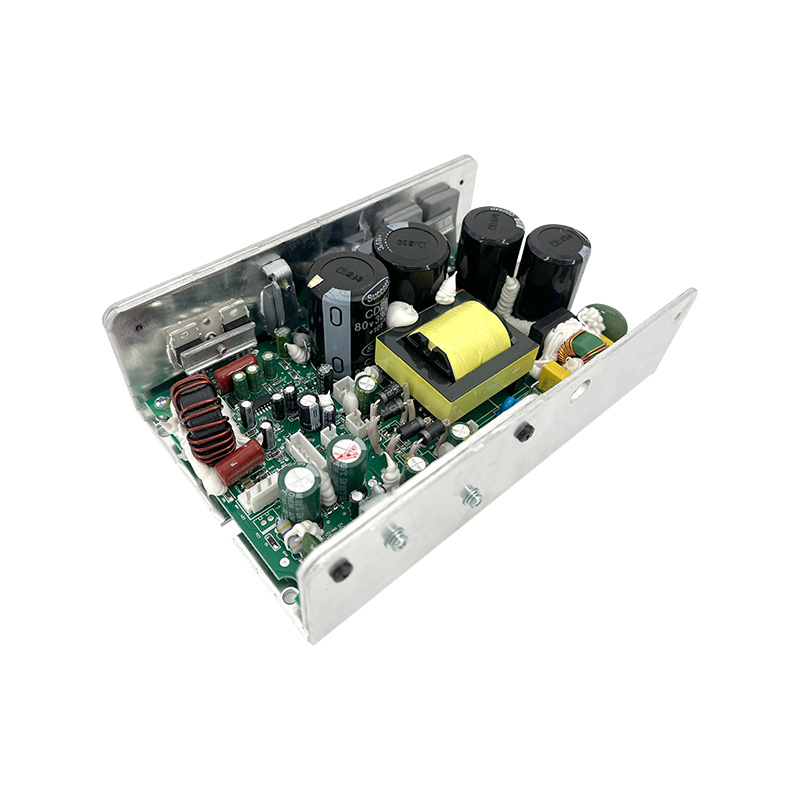
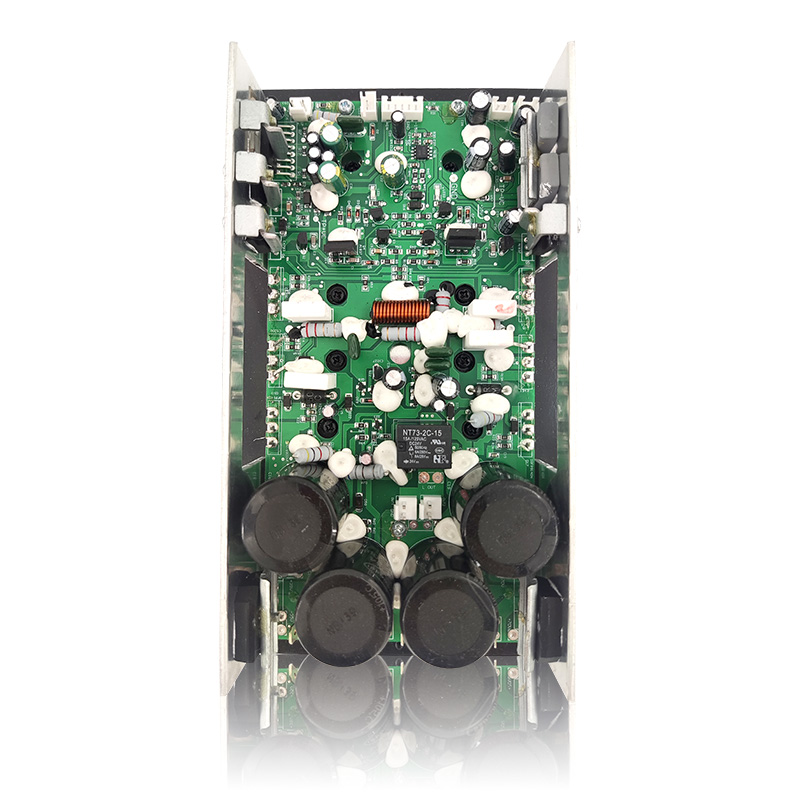
A high fidelity Class AB power amplifier circuit can only deliver its rated output power if the supply rails remain stable under peak load current demand. Rail sag — the voltage drop under transient load — is determined by the reservoir capacitor bank. The standard specification is 4,000 to 10,000 µF per ampere of peak output current per rail. For a 100W / 8-ohm amplifier drawing approximately 3.5A peak, this implies a minimum of 14,000 µF per rail — typically implemented as two or three 4,700 µF / 80V capacitors in parallel. Undersized capacitors are one of the most common root causes of disappointing real-world output power despite adequate on-paper specifications.
Global Negative Feedback Loop Design
Global negative feedback (NFB) is the primary mechanism for reducing THD in a Class AB loudspeaker amplifier. A well-designed NFB loop with 20 to 40 dB of loop gain at 1kHz can reduce open-loop THD of 1–3% down to the 0.01–0.05% range at the output. However, excessive NFB loop gain causes phase margin problems at high frequencies, leading to oscillation or ringing. The stability criterion is a minimum of 45 degrees of phase margin at the unity-gain frequency, verified by a Bode plot measurement or SPICE simulation before physical build.
THD Performance Across Frequency: What Good Looks Like
A well-executed low distortion Class AB audio amplifier module should meet the following THD benchmarks across the audible frequency range at rated output power into an 8-ohm load. These values represent achievable targets for a properly designed discrete circuit — not theoretical limits.
| Frequency | Target THD (At Rated Power) | Dominant Distortion Mechanism | Primary Design Control |
|---|---|---|---|
| 20 Hz | below 0.02% | Supply rail ripple coupling | Reservoir capacitor size; PSRR |
| 1 kHz | below 0.01% | Output stage nonlinearity | Quiescent current; NFB loop gain |
| 10 kHz | below 0.03% | Transistor Ft rolloff; NFB loop gain reduction | High-Ft transistor selection; dominant pole compensation |
| 20 kHz | below 0.05% | Phase margin reduction; slew-rate limiting | Input stage slew rate; compensation network |
THD vs. Frequency: Class AB vs. Class B (Typical, At Rated Power, 8 ohm)
Class AB maintains substantially lower THD than Class B across the full audible range, especially at low and mid frequencies where crossover distortion dominates Class B performance.
Thermal Management: Protecting Output Power Gains Under Real Load Conditions
The output power advantage of a Class AB loudspeaker amplifier is only sustained if the thermal design keeps junction temperatures within specification under continuous load. Thermal runaway — where rising transistor temperature increases collector current, which raises temperature further — is the failure mode most likely to destroy an otherwise well-designed Class AB stage.
Heatsink Sizing Calculation
Heatsink thermal resistance (Rth) must be calculated from the maximum allowable junction temperature down to ambient. For a 100W Class AB amplifier dissipating approximately 80W in the output stage at full power into 8 ohms:
- Target maximum junction temperature: 125°C (absolute maximum for silicon transistors; design target is 100°C)
- Ambient temperature assumption: 40°C (allowing for warm equipment rack conditions)
- Transistor junction-to-case thermal resistance (Rjc): typically 0.7°C/W for TO-3P package
- Required heatsink-to-ambient thermal resistance: (100 - 40) / 80 - 0.7 = approximately 0.05°C/W — achievable with a 200 x 150 x 40mm extruded aluminum heatsink with forced airflow, or a 300 x 200mm natural convection heatsink
Thermal Compensation Circuit Requirements
The Vbe multiplier bias spreader transistor must be physically bolted — not simply thermally connected with paste — to the main output transistor heatsink. The thermal coupling time constant should be under 5 seconds to track rapid load changes. A 10°C rise in heatsink temperature without corresponding Iq reduction increases the risk of thermal runaway by approximately 30% in a bipolar output stage — making the quality of the bias compensation circuit one of the most consequential long-term reliability decisions in Class AB amplifier design.
Real-World Applications: Where Class AB Loudspeaker Amplifiers Excel
The combination of high output power, low distortion, and established reliability makes the high fidelity Class AB power amplifier circuit the preferred choice across a wide range of professional and consumer audio applications.
| Application | Typical Output Power | Why Class AB is Preferred |
|---|---|---|
| Studio monitor amplifiers | 50–150W per channel | Low THD critical for accurate monitoring; no switching artifacts |
| PA system power amplifiers | 200–1000W | High continuous power with proven reliability in demanding live environments |
| Hi-fi integrated amplifiers | 30–120W per channel | Audiophile-grade distortion floor without Class A thermal burden |
| Active subwoofer amplifiers | 150–500W | High peak current delivery into low-impedance woofer voice coils |
| Mixer internal amplifier stages | 10–50W per output bus | Compact module form factor with low noise floor requirement |
About Ningbo Zhenhai Huage Electronics Co., Ltd.
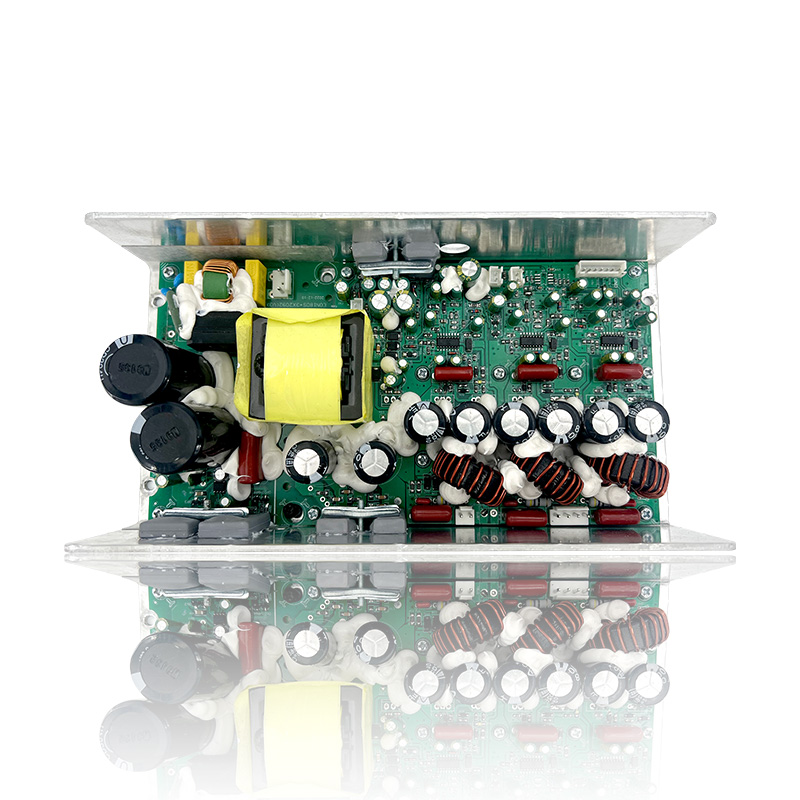
Ningbo Zhenhai Huage Electronics Co., Ltd. is a professional audio enterprise integrating research and development, production, and sales. We are a professional Class AB loudspeaker amplifier manufacturer and factory. For many years, we have focused on the production of sound mixers, active power amplifiers, microphones, and related electronic components, equipment, and other products.
We specialize in custom Class AB loudspeaker amplifier solutions and related products. Over the years, the company has been adhering to the business policy of good products, good service, and good reputation, and has established long-term and stable cooperative relations with many companies at home and abroad. We have provided OEM services for many well-known audio brands for a long time. Customers from all walks of life are welcome to visit, guide, and negotiate business. The company has professional design, production, and testing teams, and can customize products according to customer needs — from single-channel low distortion Class AB audio amplifier modules to multi-channel high fidelity Class AB power amplifier circuits for professional installation applications.
Frequently Asked Questions
Q1: What is the main difference between a Class AB and Class A loudspeaker amplifier in practice?
The primary practical difference is thermal efficiency. A Class A amplifier dissipates maximum power at idle regardless of signal level, requiring large heatsinks and often fan cooling. A Class AB loudspeaker amplifier dissipates 60 to 75% less idle power than a comparable Class A design, runs cooler, and can therefore sustain higher output power without approaching transistor thermal limits. The distortion difference is audibly negligible in a well-designed Class AB circuit with a properly set quiescent current.
Q2: How do I set the quiescent current correctly on a Class AB amplifier module?
Allow the amplifier to warm up for at least 15 minutes at idle before adjusting. Use a calibrated DC milliammeter in series with one supply rail, and adjust the bias trimmer until the idle current matches the manufacturer's specification — typically 25 to 80 mA for discrete output stages. Recheck after a further 15 minutes of warm-up and readjust if the current has drifted by more than 5 mA. Never adjust Iq under load or with a signal present.
Q3: Can a Class AB amplifier drive 4-ohm loudspeaker loads safely?
Yes, provided the output transistors are rated for the increased current demand. A 4-ohm load draws twice the current of an 8-ohm load at the same output voltage, which roughly doubles output power but also doubles transistor dissipation. For 4-ohm operation, parallel output transistor pairs and a heatsink rated for at least 1.5x the 8-ohm dissipation are recommended. Always verify the amplifier's short-circuit protection circuit is active before connecting reactive loudspeaker loads.
Q4: What causes a Class AB amplifier to oscillate, and how is it corrected?
Oscillation in a Class AB power amplifier circuit is almost always caused by insufficient phase margin in the global negative feedback loop — the loop gain remains above unity at a frequency where accumulated phase shift exceeds 180 degrees, creating positive feedback. The standard correction is to add or increase the dominant pole compensation capacitor (typically a small capacitor of 22 to 100 pF across the voltage amplification stage), which rolls off loop gain well before the critical phase angle is reached. A Zobel network (typically 10 ohm + 100nF in series) at the output also helps suppress HF instability with reactive loads.
Q5: What output power increase can I realistically expect by upgrading from a single to a paralleled output transistor pair in a Class AB design?
Paralleling a second matched output transistor pair on the same supply rail increases peak current capacity by approximately 80 to 90% (not quite double, due to emitter resistor losses and matching tolerances). Into an 8-ohm load, output power increase is modest since the load is voltage-limited rather than current-limited. The major benefit appears into 4-ohm and lower-impedance loads, where power can increase by 60 to 90% compared to a single-pair stage — fully consistent with the 35% or greater overall output improvement the design upgrade is intended to deliver.