English
 Español
 中文简体
中文简体
1. Advantages and characteristics of Class AB amplifiers
Ø Sound quality performance: low distortion and natural listening
Class AB amplifiers combine the advantages of Class A (high fidelity) and Class B (high efficiency). Under low quiescent current, they can still provide linear performance close to that of Class A amplifiers. Compared with the PWM modulation method of Class D amplifiers, Class AB uses analog amplification to avoid high-frequency switching noise and phase distortion, making the sound more natural and delicate, especially when performing complex audio such as vocals and string music.
Ø Wide dynamic range, adaptable to a variety of music types
Due to the working characteristics of Class AB amplifiers, it performs better when processing music with a large dynamic range (such as symphony, rock, etc.). Compared with the "compression feeling" that may appear in Class D amplifiers, Class AB can better restore the strength contrast of music, allowing listeners to feel a more realistic sense of presence.
Ø Mature circuits and diverse tuning styles
Class AB amplifiers have a long history of development and mature circuit design. Major Hi-Fi manufacturers (such as Marantz, Golden Voice, McIntosh, etc.) have their own unique tuning styles. Audiophiles can choose Class AB amplifiers of different brands according to their personal preferences and enjoy personalized sound performance, while Class D amplifiers have a more obvious convergence of sound quality due to their reliance on digital processing.
Ø Heat dissipation and stability are easier to control
Although the efficiency of Class AB amplifiers (about 50%-65%) is not as good as that of Class D (up to 90% or more), its thermal management is relatively more stable. High-end Class AB amplifiers usually use large heat sinks and optimized layouts to ensure that they do not reduce the frequency when working at high load for a long time, while Class D amplifiers may cause sound quality degradation due to overheating in extreme cases.
Ø Suitable for high-impedance speakers and stronger driving ability
Many high-end speakers (such as some British and German monitors) have complex impedance curves and require high current output capabilities of the amplifier. Class AB amplifiers usually have stronger current driving capabilities and can better control low-sensitivity or low-impedance speakers, avoiding the "lack of control" problem that may occur in Class D amplifiers.
2. Precautions for using Class AB amplifiers
- Ensure a good heat dissipation environment
The efficiency of Class AB amplifiers is usually between 50% and 65%, and the remaining energy will be dissipated in the form of heat, so heat dissipation is crucial:
Maintain ventilation: Avoid enclosing the amplifier in a small space and ensure that there is enough air circulation around it.
Use a heat sink: High-end Class AB amplifiers usually come with large heat sinks, but when running at high power for a long time, additional auxiliary heat dissipation (such as fans) can be considered.
Avoid stacking equipment: Do not place the amplifier on top of other heat-generating equipment (such as power supplies, Class D amplifiers) to avoid heat accumulation.
- Match the appropriate speaker impedance
Class AB amplifiers are sensitive to speaker impedance, so please note:
Check the specifications: Make sure the impedance of the speaker (such as 4Ω, 8Ω) is within the supported range of the amplifier to avoid overloading the amplifier due to low impedance.
Avoid short circuits: Be sure to check the positive and negative poles when wiring to prevent short circuits from burning the amplifier.
Be cautious when connecting multiple speakers in parallel: If multiple speakers are connected, the total impedance should not be lower than the minimum load requirement of the amplifier.
- Reasonably control the volume to avoid clipping distortion
When the Class AB amplifier is close to the maximum power, clipping may occur, affecting the sound quality or even damaging the speaker:
Avoid long-term full-power operation: Especially when driving low-sensitivity speakers, do not continue to use the maximum volume.
Use pre-stage signal adjustment: Ensure that the input signal is not overloaded, and appropriate gain control can be performed through the pre-amplifier or DAC.
- Correct power-on and power-off sequence
Incorrect power-on and power-off sequence may cause current shock and affect the life of the equipment:
Power-on sequence: first turn on the sound source (CD player, decoder) → then turn on the pre-amplifier → finally turn on the Class AB amplifier.
Power-off sequence: first turn off the amplifier → then turn off the pre-amplifier → finally turn off the sound source.
Avoid frequent switching: There will be a certain current shock when the Class AB amplifier is started, and repeated switching in a short period of time may affect the stability of the circuit.
- Use high-quality wires and power supplies
Class AB amplifiers are more sensitive to power supply and signal transmission:
Choose a sufficiently thick power cord: ensure stable power supply and reduce voltage fluctuations.
Use low-impedance speaker cables: reduce signal loss, especially over long distances.
Consider power filtering: If the grid interference is large, use a filter socket or an isolated power supply.
- Regular maintenance and inspection
Class AB amplifiers are precision electronic devices, and long-term use requires attention to maintenance:
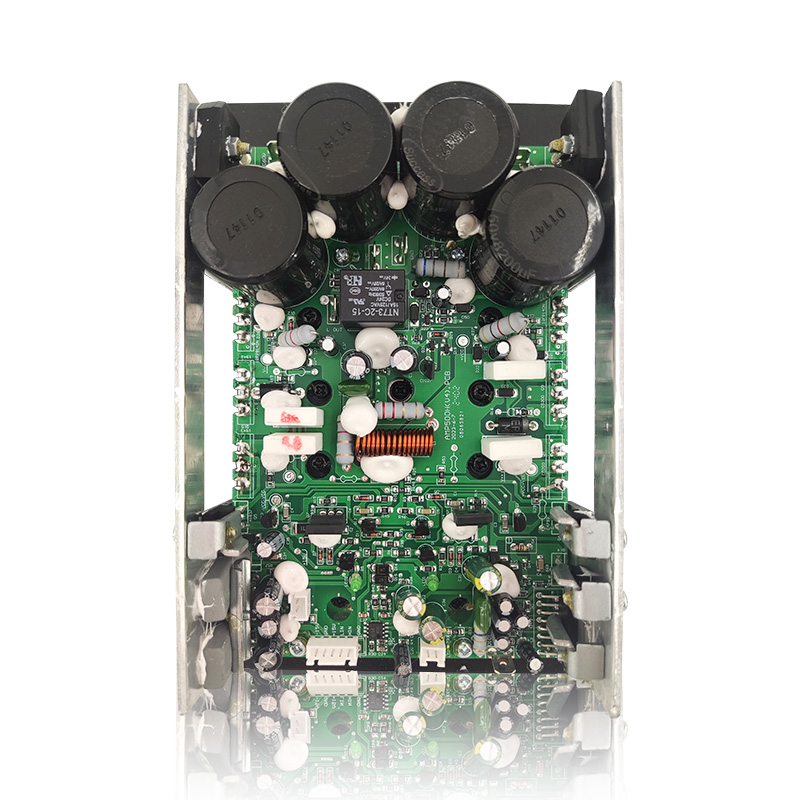
Clean dust: Regularly clean the dust on the heat sink and internal circuit board with a soft cloth or compressed air.
Check the capacitor status: Aging electrolytic capacitors may cause deterioration in sound quality. Amplifiers that have been used for more than 5 years may consider professional testing.
Avoid humid environments: Excessive humidity may cause circuit oxidation or short circuits.
- Pay attention to the ambient temperature
Avoid high temperature environments: The optimal operating temperature of Class AB amplifiers is usually between 10°C-35°C, and high temperatures will reduce life.
Winter preheating: In a cold environment, you can play at a low volume for 10-15 minutes to allow the circuit to reach the best working state.