English
 Español
 中文简体

Home / News / Industry News / Active Loudspeaker Amplifier Module: Choosing Class, Supply and DSP for OEM Builds
Twelve weeks before launch, a 12-inch battery-powered PA box fails its first thermal run. The cabinet is fine, the woofer is fine, but the Class AB module that looked like a bargain sits at 78 °C on the heatsink after forty minutes of pink noise, and thermal derating has already eaten 3 dB of usable headroom. That is usually the moment an OEM team starts reading module datasheets properly.
The safer order of decisions: pick the amplifier class from the thermal and weight budget, pick the power supply from the mains environment the product will actually meet, and only then pick the DSP, EQ and playback modules from the feature list printed on the retail box. An active loudspeaker amplifier module is a system decision, not a component purchase — power stage, supply and front end share one thermal envelope, one board outline and one BOM.
Content
- 1 What an active loudspeaker amplifier module actually contains
- 2 Amplifier class decides the heatsink before it decides the sound
- 3 Power supply topology: PFC plus LLC resonance, or a linear transformer
- 4 The interface list that decides whether the module bolts into your chassis
- 5 DSP, EQ and playback modules: where the product features live
- 6 What to put in the RFQ
- 7 Frequently asked questions about active loudspeaker amplifier modules
- 7.1 Q1. What is an active loudspeaker amplifier module?
- 7.2 Q2. Class D or Class AB for an active speaker?
- 7.3 Q3. How much power does my powered speaker module need?
- 7.4 Q4. Do amplifier modules include PFC and LLC?
- 7.5 Q5. What THD is acceptable for a DSP amplifier module?
- 7.6 Q6. Can amplifier modules be customized for OEM production?
What an active loudspeaker amplifier module actually contains
Open the rear of a powered speaker and you find four working blocks, usually spread across two or three boards. Knowing which block you are negotiating over keeps a specification conversation short.
- Power stage — sets continuous and peak output, and therefore heatsink area, fan noise and cabinet bracing.
- Power supply — sets weight, mains tolerance and whether the product can claim power-factor correction.
- Signal front end — preset EQ, electronic crossover, mic mixing, echo and talkover priority.
- Protection layer — over-temperature, over-current, DC and short-circuit protection; subwoofer modules usually add a limiter.
- Mechanical interface — board outline, standoff pattern, connector positions and heatsink mounting.
The last block is where integration projects lose the most time. A module with the right wattage but a 3 mm connector offset, or a heatsink that needs 15 mm of clearance behind the driver magnet, can force a chassis redesign that nobody budgeted for.
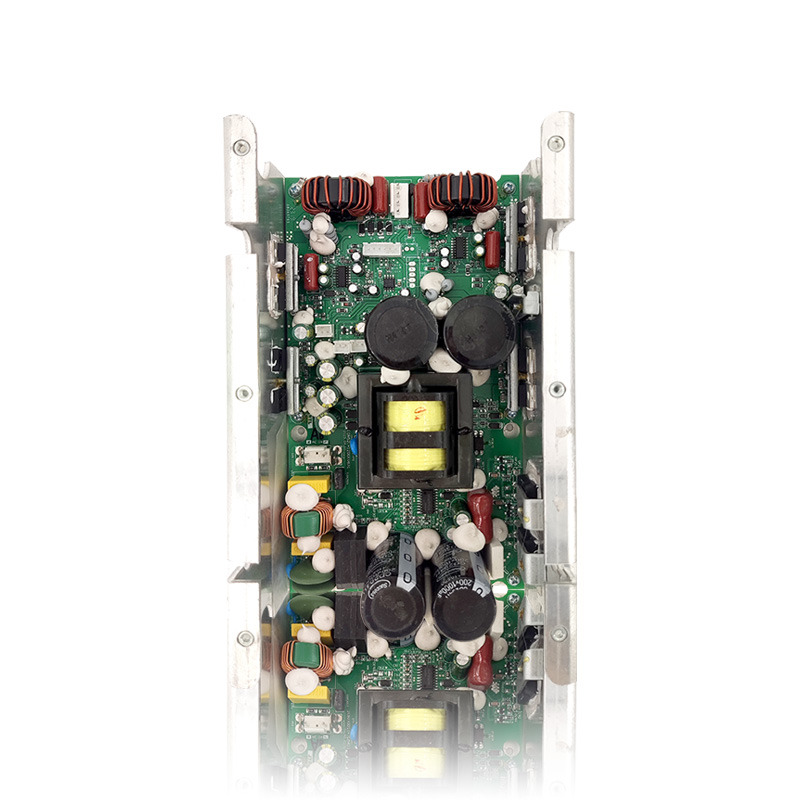
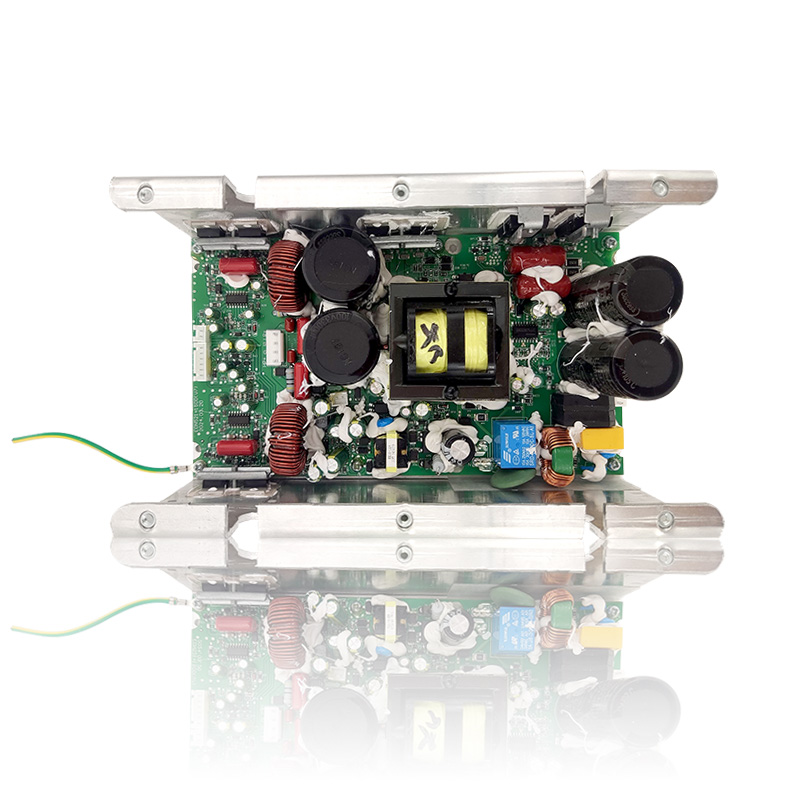
Exploded view of a typical module stack: processing on top, amplifier in the middle, power supply at the base.
Amplifier class decides the heatsink before it decides the sound
For a pro or MI loudspeaker the realistic shortlist is Class D, Class H and Class AB. The efficiency gap is not academic — it decides whether you can use a passive heatsink or a fan, and whether the carton weighs 14 kg or 19 kg at the dock.
| Class | Typical full-power efficiency | Waste heat at 500 W | Best fit | Main trade-off |
|---|---|---|---|---|
| Class D | 80–95% | ~70 W | Portable, battery, line array, weight-critical boxes | Layout and output filter sensitive; EMI needs care |
| Class H | 60–80% | ~210 W | High-power subwoofers and full-range pro cabinets | Heavier supply; rail switching adds complexity |
| Class AB | 45–65% | ~400 W | Compact full-range, cost-driven SKUs | Large heatsink, fan noise, early thermal derating |
Read the table backwards, starting from the thermal column. At 500 W continuous, a Class D module near 88% efficiency dumps roughly 70 W of heat. A Class H design near 70% dumps about 210 W. A Class AB design near 55% dumps around 400 W. That 340 W gap becomes a heatsink, a fan, a larger cutout and a heavier carton — paid for on every unit you ship.
Class H still earns its place. Rail switching tracks the signal, so small-signal losses drop while the output stage keeps the predictable behaviour many touring engineers trust on subwoofer duty. Class AB survives in compact full-range boxes where idle noise and landed cost matter more than kilograms.
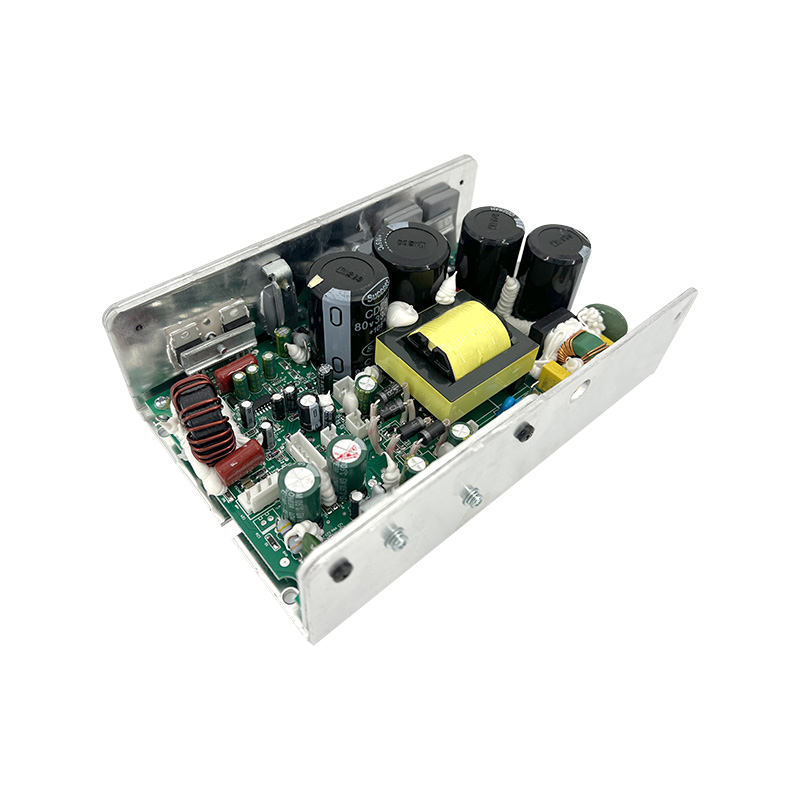
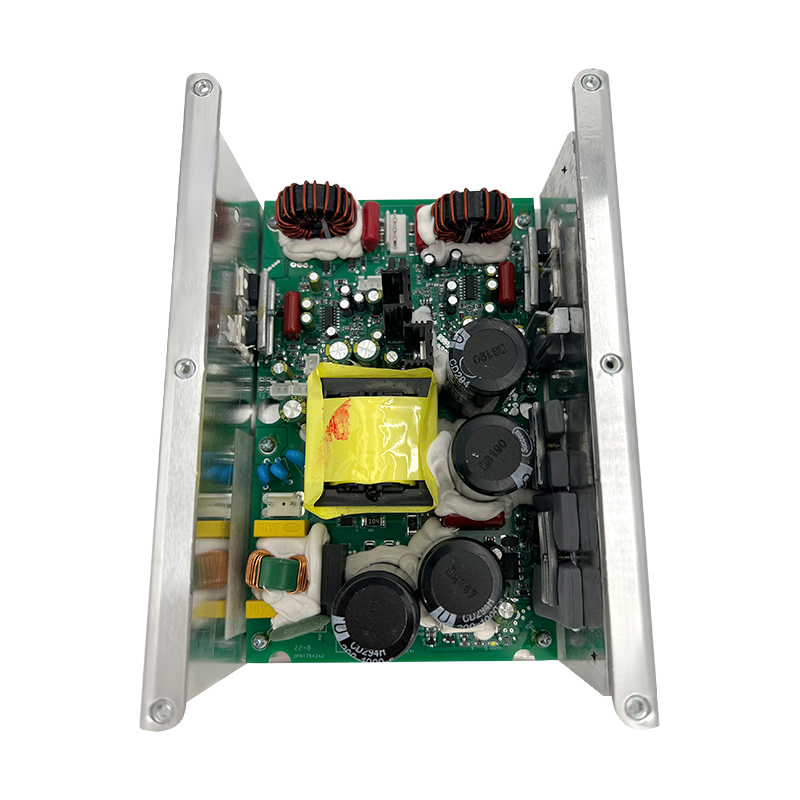
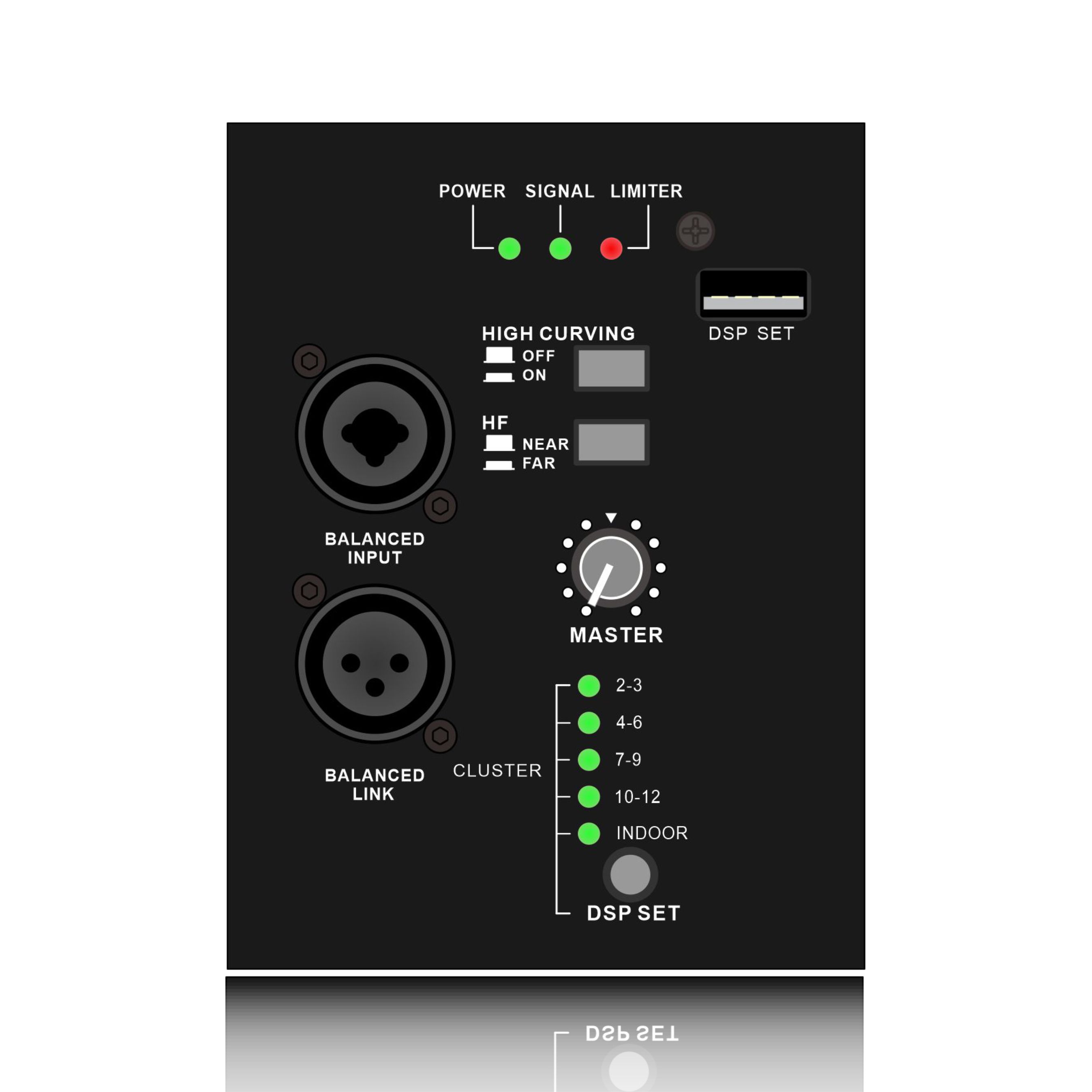
 EON522SUB LLC Resonant Active Subwoofer Amplifier ModuleCombines an 800 W LLC resonant supply with a 500 W Class D subwoofer amplifier, protection, and a U-shaped aluminum radiator for active subwoofer designs.View Product →
Power supply topology: PFC plus LLC resonance, or a linear transformer
A 2 kW subwoofer module cannot be discussed without its supply, because the supply usually sets the failure rate. Two families dominate commercial designs.
LLC resonant converters switch softly, which keeps EMI low and allows wide mains input — commonly 90–264 V — so one SKU covers most export markets. A PFC front end keeps input current close to sinusoidal, which matters for harmonics limits such as EN 61000-3-2 and for running several boxes from a single 16 A circuit. The cost is complexity: more components, tighter PCB layout, and service partners who need real training to repair it.
Linear transformer supplies are heavier and mains-specific, but they absorb abuse, deliver large burst current into a subwoofer voice coil and are easy to service in the field. For installed subwoofers that is often the better engineering answer; for a battery-powered portable cabinet it usually is not.
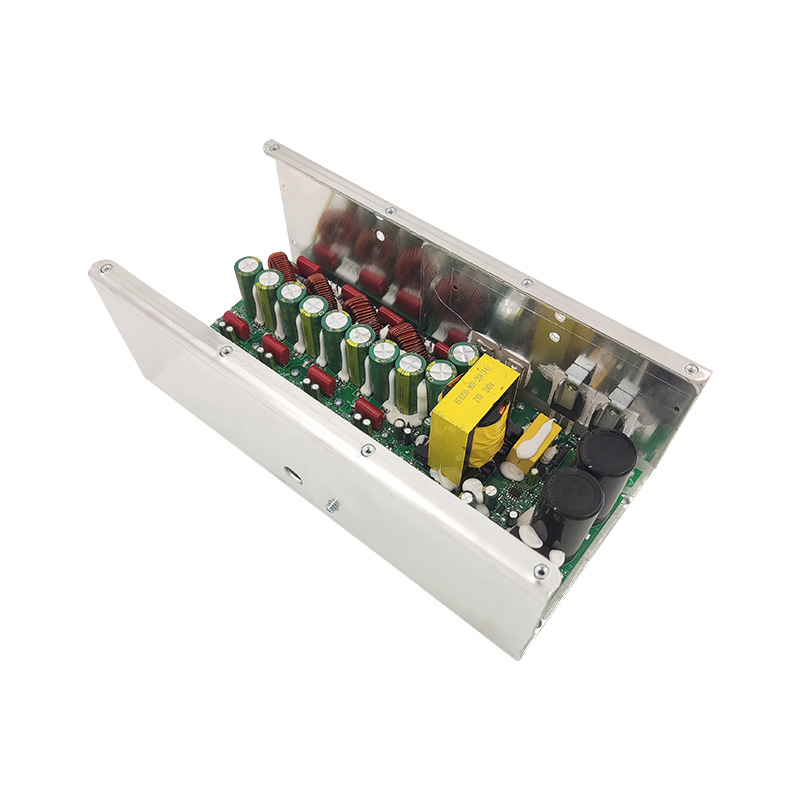
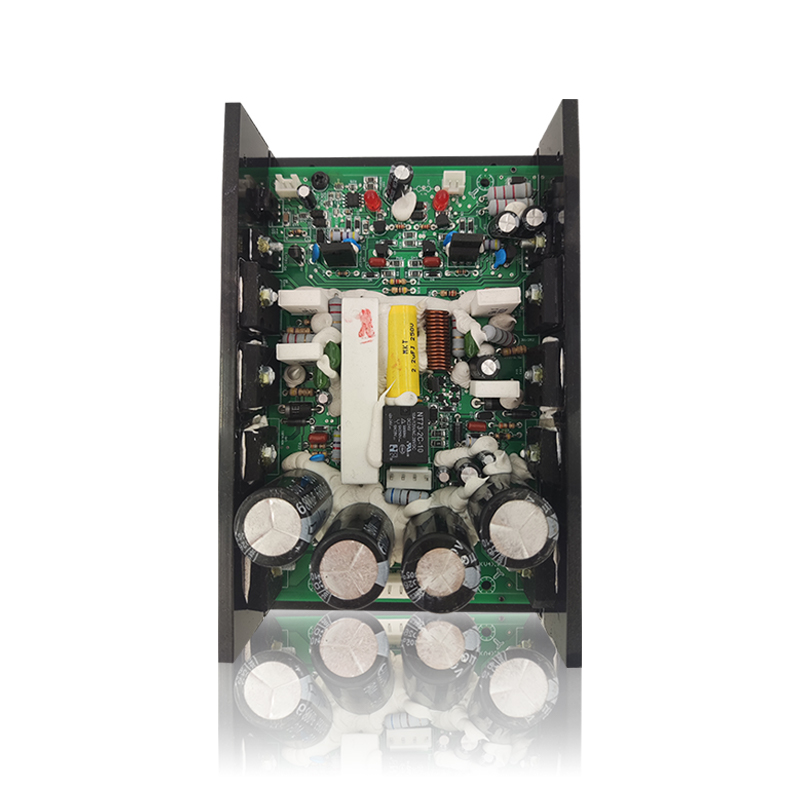
 AMP250H Class H Full-Range Amplifier ModuleUses a 400 W linear transformer supply and delivers full-range Class H 400 W into 4 ohms, with protection and a U-shaped aluminum radiator.View Product →
The interface list that decides whether the module bolts into your chassis
Ask these six questions before you approve a sample. Each one has caused a delayed tooling release somewhere in the industry.
- Board outline and standoff pattern — does it clear the driver magnet, the port tube and the rear connector plate?
- Connector types and orientation — speakON, XLR combo, IEC inlet, terminal blocks; right-angle versus vertical changes the harness.
- Thermal path — heatsink orientation, airflow direction and rated ambient inside the cabinet, not in open air.
- Mains and safety — input range per market, fuse rating, creepage and clearance consistent with IEC 62368-1.
- Idle and standby behaviour — quiescent draw and pop-free power on/off, which reviewers notice immediately.
- Test and traceability — 100% functional test, serial tracking and a test log you can show a distributor.
DSP, EQ and playback modules: where the product features live
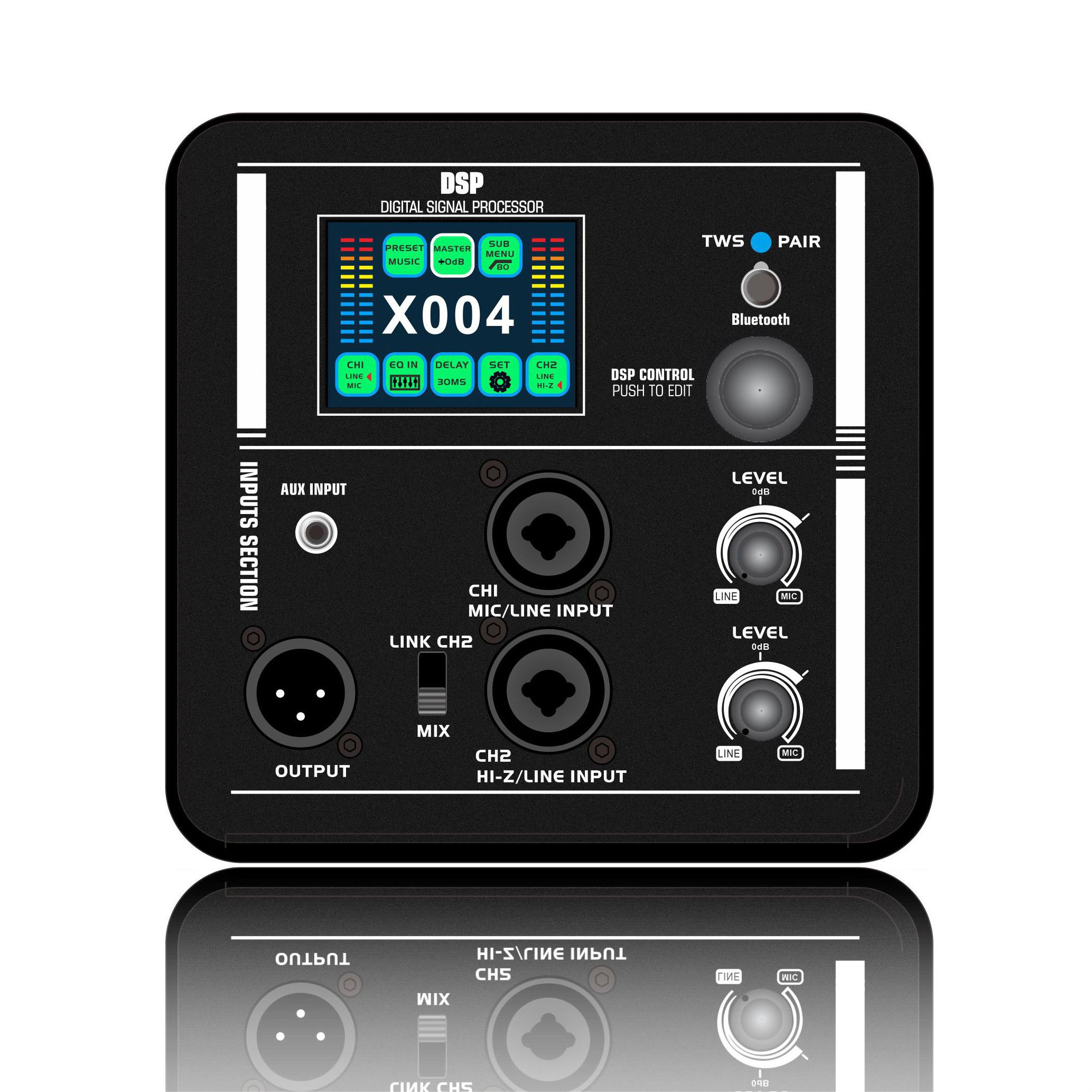
On the retail side, the module stack is what sells the box. A DSP module built on a fixed-audio-DSP core such as the ADAU1701 delivers preset EQ modes, limiter thresholds and crossover slopes without any firmware work from your side — the OEM simply selects a preset.
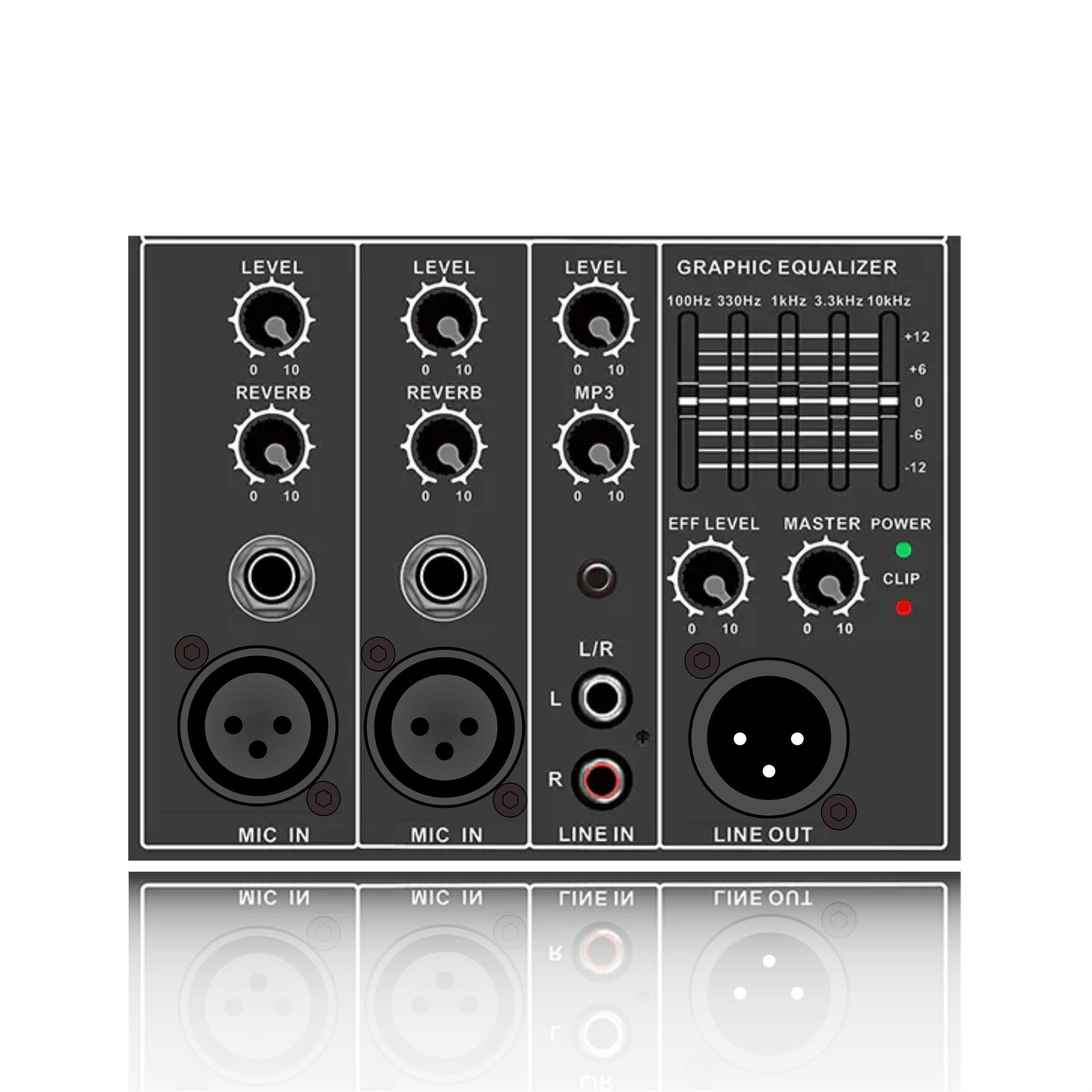
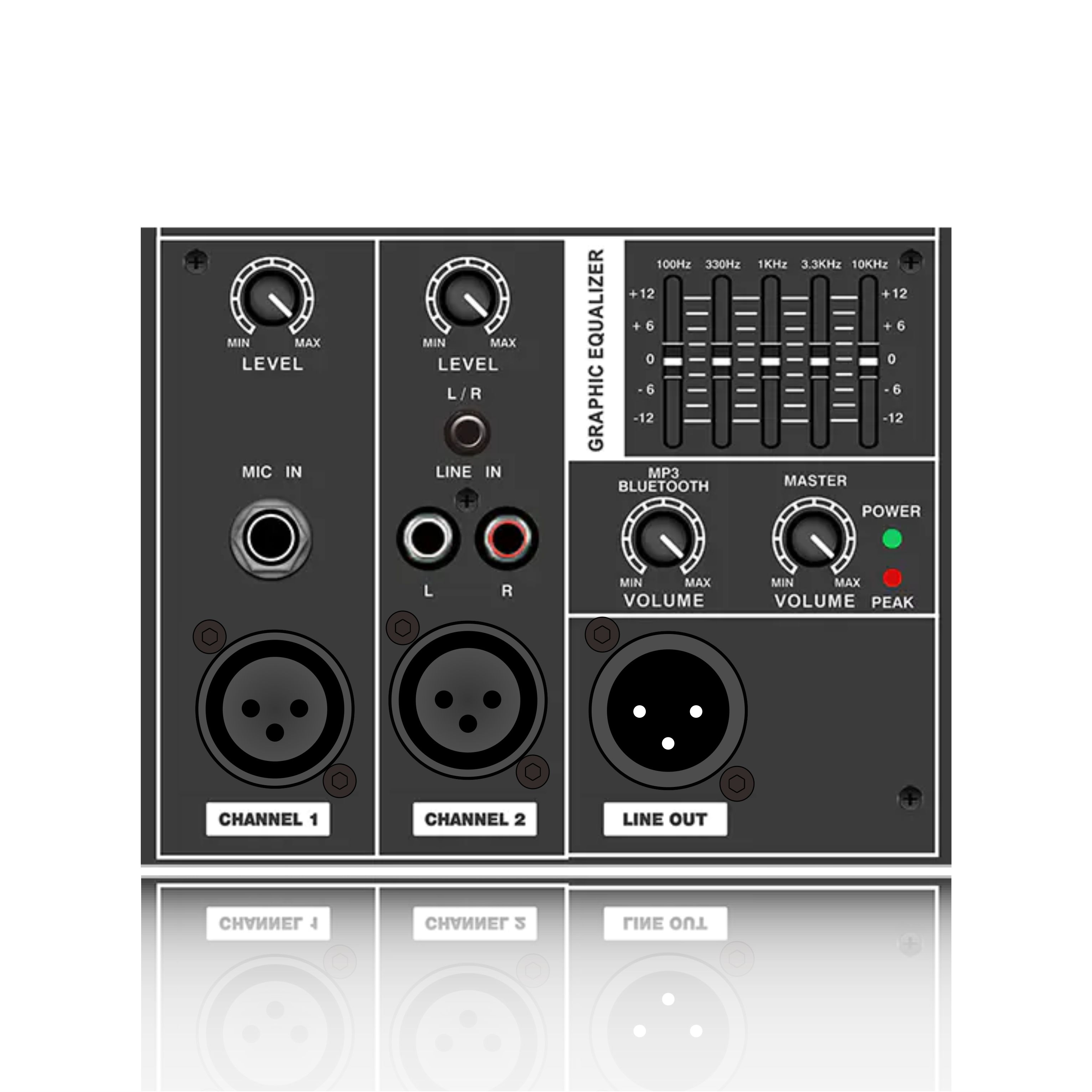
Analog function modules still make sense for cost-sensitive SKUs: five-band graphic EQ, mic priority, echo and reverb, mix-out. Pair them with an MP3 and Bluetooth player module supporting SD/USB input plus TWS pairing, and one platform can carry several retail variants.
 DSP1907 ADAU1701 Audio DSP ModuleOffers Sigma Studio configuration, four preset modes, balanced XLR/TRS and Bluetooth inputs, balanced XLR output, and TWS linking for multi-variant audio platforms.View Product →
Consistency pays off here more than raw specification. One DSP platform, one connector family and one preset tool means a 12-inch and a 15-inch model differ only in the power module and the preset file — no second training cycle for the line, no second spare-parts list for the distributor.
What to put in the RFQ
Write the request around what the module must survive, not around a wattage headline. State continuous output at a declared THD, the ambient temperature inside the cabinet, the mains ranges for each market, the maximum heatsink height, and the certification files you need to see.
Suppliers that also run SMT, assembly and audio test in-house can usually answer with a modified board rather than a new design — worth asking about their production flow and test room before you commit to tooling; our own module production line is a fair example of the questions to raise. Modules built for OEM programmes normally come with a customization path as well: preset EQ, silkscreen branding, connector changes and board-outline edits. Confirm which of those are standard and which trigger tooling, and treat the customization service scope as part of the commercial negotiation rather than an afterthought.
Frequently asked questions about active loudspeaker amplifier modules
Q1. What is an active loudspeaker amplifier module?
A self-contained board set inside a powered speaker that combines the power supply, the power amplifier and usually a pre-amp or DSP, so the cabinet only needs a driver, a mains inlet and a control panel.
Q2. Class D or Class AB for an active speaker?
Class D when weight and heat decide the design; Class AB in small full-range boxes where landed cost and familiar tone matter more; Class H in between for high-power subwoofers.
Q3. How much power does my powered speaker module need?
Match continuous output to the driver rating with 1.5–2× headroom for peaks. A 500 W woofer typically wants 300–500 W of continuous module output at the declared distortion limit.
Q4. Do amplifier modules include PFC and LLC?
Higher-power switch-mode modules usually do — PFC meets harmonics limits and LLC gives wide mains input with lower EMI. Small modules often skip PFC to protect the BOM.
Q5. What THD is acceptable for a DSP amplifier module?
Below 0.1% at rated power is a common target for professional modules. Reading above 1% at 1 kHz usually points to layout, grounding or supply design rather than the chip.
Q6. Can amplifier modules be customized for OEM production?
Yes. Preset EQ, connector types, board outline, heatsink size and branding are all adjustable. Confirm MOQ, sample lead time and tooling cost before the design freeze.