English
 Español
 中文简体
中文简体
Home / News / Industry News / Amplifier Classes Explained: Real Differences Between Class A, AB, D, and H
Two engineers compare power modules for a new 12-inch powered loudspeaker. The first specification they check is the amplifier class, because that single letter determines heatsink size, power supply type, cabinet space and continuous output. Here is the short answer: Class D offers the highest practical efficiency, Class AB delivers the most proven linear performance, and Class H brings rail-switching efficiency to analog output stages. Each class defines how the output devices conduct over the audio cycle, and that one detail drives almost every downstream design decision.
Content
- 1 What the Amplifier Class Letter Actually Tells You
- 2 Class A: The Reference for Linearity
- 3 Class AB: The Long-Standing Compromise
- 4 Class D: The Efficiency Breakthrough
- 5 Class G and Class H: Rail Switching for High Power
- 6 Class A vs Class AB vs Class D: A Radar Comparison
- 7 What This Means When You Buy Amplifier Modules
- 8 Inside a Class D Module: Isometric View
- 9 Frequently Asked Questions
- 9.1 Q1. Which amplifier class has the best sound quality?
- 9.2 Q2. What is the difference between Class A/B and Class D amplifiers?
- 9.3 Q3. What is a Class D amplifier board?
- 9.4 Q4. Which amplifier class is the most efficient?
- 9.5 Q5. What is a Class H amplifier used for?
- 9.6 Q6. How do I choose the amplifier class for a powered speaker?
What the Amplifier Class Letter Actually Tells You
The class letter describes the conduction angle of the output stage — the portion of the full signal cycle during which the output devices draw current. A Class A stage conducts for the entire 360° cycle. A Class B stage conducts for 180°, one half of the cycle. A Class AB stage sits between those limits with a small overlap of bias. Class D does not conduct linearly at all: it switches the output devices fully on and off at a frequency far above the audio band, then reconstructs the signal with an LC filter. Classes G and H retain a linear output stage but change the supply rail voltage dynamically to reduce wasted power.
| Class | Conduction angle | Practical efficiency | Typical application |
|---|---|---|---|
| Class A | 360° | 25–30% | Headphone amps, studio gear |
| Class AB | 180–360° with bias overlap | 50–65% | Hi-Fi amps, powered speakers |
| Class D | Switching / PWM | 85–92% | Active PA, subwoofers, portable speakers |
| Class G / H | 180–360° with rail switching | 65–80% | Pro audio power amplifiers |
Class A: The Reference for Linearity
Class A amplifiers bias the output stage so that current runs continuously, even with no signal present. The benefit is the lowest distortion of any conventional topology, with a smooth and well-controlled curve even at low output levels. The cost is heat. Practical efficiency is around 25–30%, roughly the figure cited in What Hi-Fi's amplifier class guide. A 50 W Class A speaker channel can idle like a 200 W heater. For that reason, Class A survives today mainly in headphone amplifiers, preamps and high-end studio monitors, where output power is low and linearity matters more than thermals.
Class AB: The Long-Standing Compromise
Class AB solved two problems at once: the heat of Class A and the crossover distortion of Class B. Each push-pull output device receives a small quiescent bias, so both devices conduct briefly around the zero-crossing point. The result is clean linear amplification with practical efficiency of about 50–65%, roughly double the Class A figure. For more than four decades, Class AB was the default for Hi-Fi amplifiers and mid-power powered speakers. It handles reactive loads calmly, its distortion behaviour is predictable, and service engineers understand it extremely well. The trade-off is thermal: a 300 W Class AB module needs a substantial heatsink and a stiff transformer, which adds weight and cost to the final cabinet.
Class D: The Efficiency Breakthrough
Class D is the most misunderstood letter in audio. Despite the "D", it is not a digital amplifier in the information sense; it is a switching amplifier. The output stage produces a pulse-width-modulated square wave, and a passive LC filter recovers the audio signal. Because the output devices are either fully on or fully off, they dissipate very little power. Practical efficiency reaches 85–92%, which What Hi-Fi describes as almost triple that of Class A. The advantages ripple through the whole product: a smaller heatsink, a lighter switch-mode power supply, a more compact cabinet and much lower idle consumption. That is why Class D dominates active subwoofers, line-array modules, column speakers and battery-powered portable PA.
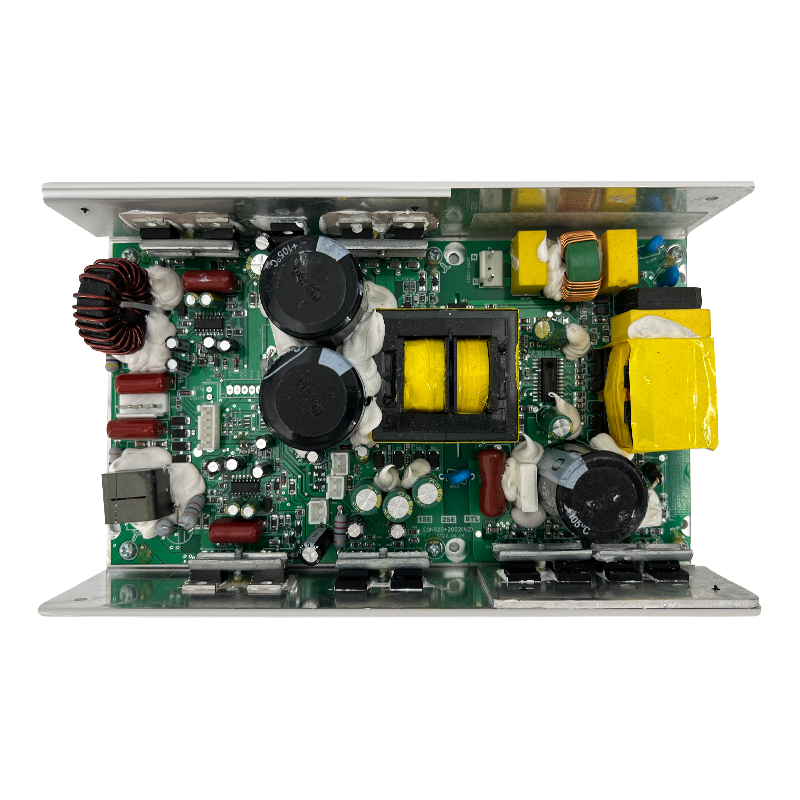
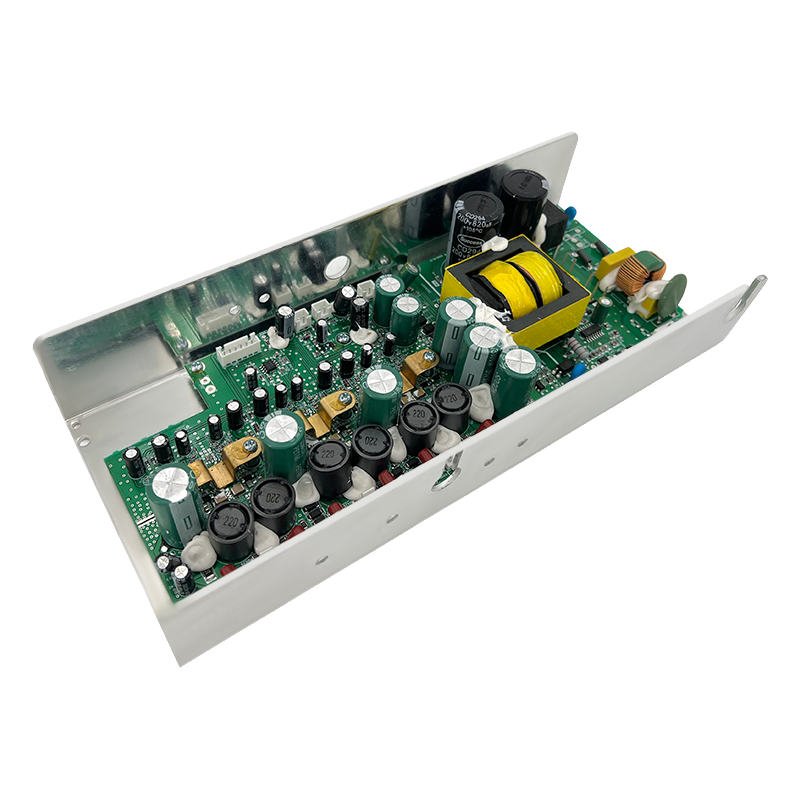
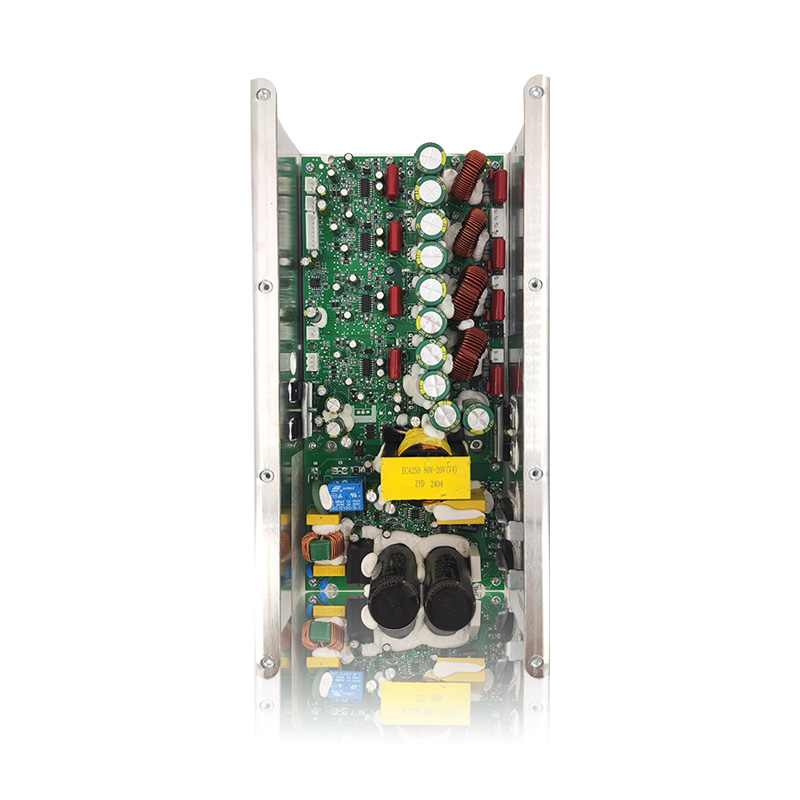
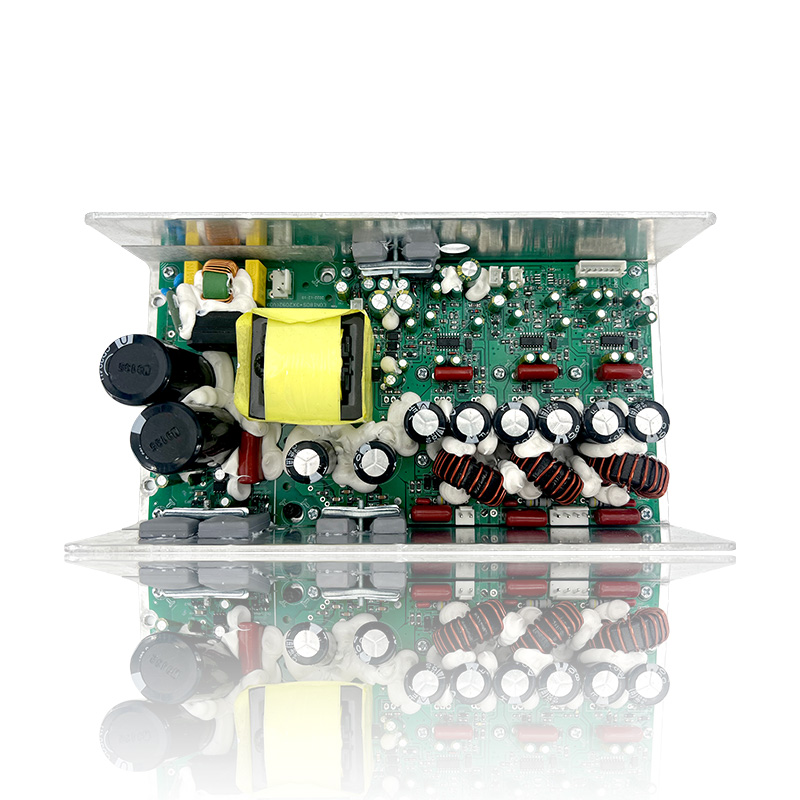
The performance of a Class D module depends on the whole power chain, not just the switching stage. A good design pairs the amplifier with a switch-mode supply that keeps the rails stable under load and protects against overcurrent. A concrete production example is the eon520-2092 500 W Class D power amplifier module with PFC and LLC resonant supply, which delivers 500 W low-frequency output and 200 W high-frequency output from a wide AC input voltage range. That architecture is exactly what makes a compact, efficient powered speaker possible.
Class G and Class H: Rail Switching for High Power
Class G and Class H were developed to make a linear amplifier more efficient without switching to PWM. Class G switches between two or more fixed supply rails as the signal level rises and falls. Class H modulates the supply rail so it tracks the program envelope continuously. Both approaches reduce the voltage drop across the output transistors, which is the main source of wasted power in a linear stage. Practical efficiency ranges from about 65% to 80%.
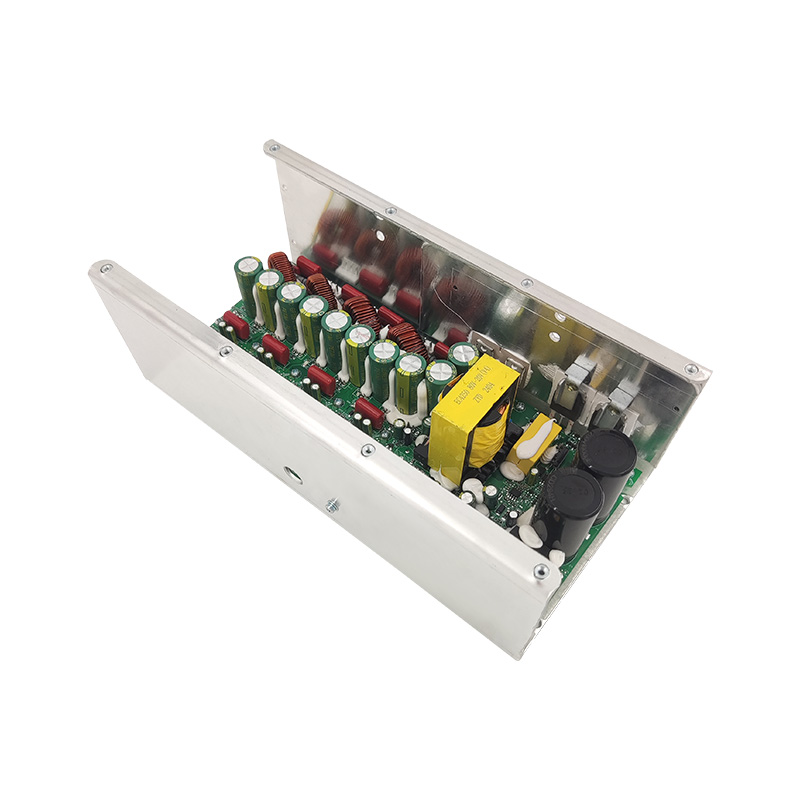
Class H is still common in professional power amplifiers and powered PA speakers because music has a high crest factor: the amplifier delivers full power on peaks but sits at a low average level, so a rail-tracking supply cuts losses dramatically. Our amp400h-7294 400 W Class H amplifier module with linear transformer power supply and U-shaped aluminium heatsink is designed for those exact conditions. The linear transformer keeps the rails quiet, the aluminium radiator absorbs continuous output, and the topology preserves a transparent analog character that many sound engineers prefer over a Class D stage.
 Wholesale AMP400H+7294: LP 400W+HP 100W Poweful Output with U-shaped Aluminum RaAs China AMP400H+7294: LP 400W+HP 100W Poweful Output with U-shaped Aluminum Radiator Class H Power Amplifier Module suppliers and compan...View Product →
Class A vs Class AB vs Class D: A Radar Comparison
The radar chart below compares the three classes most often used in speaker manufacturing — Class A, Class AB and Class D — across five engineering criteria: efficiency, sound quality, compactness, cost-effectiveness and heat control.
Two conclusions emerge. First, Class A wins the sound-quality axis but loses every thermal and practical axis, which is why it rarely appears in loudspeaker modules. Second, Class D dominates efficiency, compactness and heat control, while Class AB stays competitive on cost and subjective sound. For an OEM, the deciding factor is not the letter alone but the total module design: the power supply, the protection circuitry, the EMC behaviour and the way the module behaves with real speaker loads.
What This Means When You Buy Amplifier Modules
Choosing between amplifier classes is a system-level decision. The following checklist summarises the practical trade-offs:
- Thermal budget: sealed, fanless or battery-powered cabinets point toward Class D.
- Audio character: if the product brief expects a proven analog signature, Class AB or Class H is the safer route.
- Power density: above 300 W per channel in a compact package, Class D and Class H are the realistic choices.
- Power supply cost: Class AB typically needs a linear transformer; Class D works with a compact LLC resonant supply, which can reduce the total bill of materials.
For a broader view of how amplifier modules, DSP and preamp functions are combined inside a speaker, read our guide explaining what an audio module is and how it fits into a speaker system. You can also review the current module lineup on our website, where Class D, Class H and DSP modules are listed with their protection and power-supply specifications.
Inside a Class D Module: Isometric View
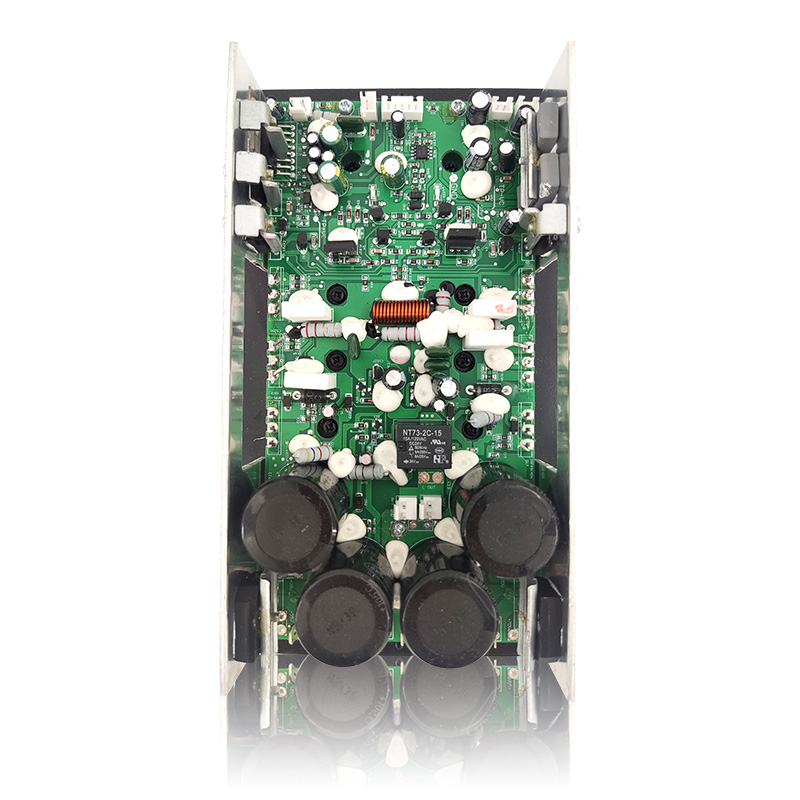
The diagram below shows the internal block structure of a typical high-power Class D amplifier module — the architecture used in our 2092-based modules. The line input feeds a PWM controller, which drives a MOSFET power stage. The high-frequency square wave is converted back to audio by an LC filter, while feedback from the filter returns to the controller to keep the output stable. The PFC and LLC resonant supply powers the stage from a wide-range AC input and keeps idle losses low. This is the core layout that allows Class D modules to deliver high wattage from a small board.
Frequently Asked Questions
Q1. Which amplifier class has the best sound quality?
Class A offers the lowest distortion, which is why high-end headphone and studio gear still use it. For speaker-level power, Class AB is the practical compromise, and modern Class D designs have closed most of the audible gap.
Q2. What is the difference between Class A/B and Class D amplifiers?
Class AB runs output devices in a linear mode with about 50–65% efficiency, while Class D switches devices at high frequency and reaches 85–92% efficiency. In practice, AB produces more heat and needs larger heatsinks; D runs cooler and smaller.
Q3. What is a Class D amplifier board?
A Class D amplifier board is a module that contains a switching output stage, a power supply, an output filter and protection circuits. It is used in active speakers, subwoofers, line-array cabinets and portable battery-powered speakers.
Q4. Which amplifier class is the most efficient?
Class D is the most efficient, typically 85–92%. Class H follows at roughly 75–80%, Class AB at 50–65%, and Class A at only 25–30%.
Q5. What is a Class H amplifier used for?
Class H amplifiers are used in professional power amplifiers and powered PA speakers. They keep a linear output stage but vary the supply rail, so they deliver high output power with lower heat than Class AB.
Q6. How do I choose the amplifier class for a powered speaker?
Match the class to the product constraints. Choose Class D for compact or battery-powered designs, Class AB for proven analog performance when space and cooling allow, and Class H for high-power PA modules where rail-tracking efficiency helps.