English
 Español
 中文简体
中文简体
Home / News / Industry News / Class A vs Class D Amplifiers: Efficiency, Sound Quality, and How to Choose
You are specifying the amplifier for a powered loudspeaker, and the supplier asks one question: Class A or Class D? The answer changes the size of the transformer, the amount of heatsinking, the cabinet weight, and the production cost. This article compares the two topologies on efficiency, sound quality, heat, size, and cost, and shows what those differences mean when you are choosing an amplifier module for a real product.
Content
- 1 Class A vs Class D: The Short Answer
- 2 How a Class A and a Class D Amplifier Actually Work
- 3 Efficiency: The Gap That Changes Your Power Supply
- 4 Sound Quality, Distortion, and Perceived Tone
- 5 Size, Weight, and System Integration
- 6 Which One Should You Choose?
- 7 What to Check Before Buying an Amplifier Module
- 8 Class A vs Class D Amplifiers: Frequently Asked Questions
- 8.1 Q1: What is the difference between a Class A and a Class D amplifier?
- 8.2 Q2: Which sounds better, Class A or Class D?
- 8.3 Q3: Are Class D amplifiers efficient enough for battery-powered speakers?
- 8.4 Q4: Can Class D amplifiers drive subwoofers?
- 8.5 Q5: Why do Class A amplifiers run so hot?
- 8.6 Q6: Which amplifier class is best for a professional PA speaker?
Class A vs Class D: The Short Answer
For most professional and commercial audio products, Class D is the better choice: it is roughly three times as efficient as Class A, runs far cooler, and achieves high output power in a small footprint. Class A still has a place in low-power, high-purity circuits and in designs where its particular sonic character is deliberately wanted.
None of this means Class D is automatically better in every situation. A well-executed Class A stage can outperform a poorly designed Class D module on measured distortion. The class label describes the topology, not the final quality. The sections below look at each trade-off individually.
How a Class A and a Class D Amplifier Actually Work
Class A keeps the output transistor biased so that current flows for the entire 360-degree signal cycle. The device never switches off, so there is no crossover point and the transfer curve is extremely linear. The price is continuous idle current: a 10 W Class A amplifier can feel as hot as a much more powerful Class AB design.
Class D runs the output stage as switches. A modulator turns the audio signal into a high-frequency pulse-width-modulated (PWM) stream; the transistors are fully on or fully off, so power loss in the devices stays very low. An LC filter rebuilds the audio signal. The engineering difficulty moves to the filter, the gate driver, and electromagnetic interference control.
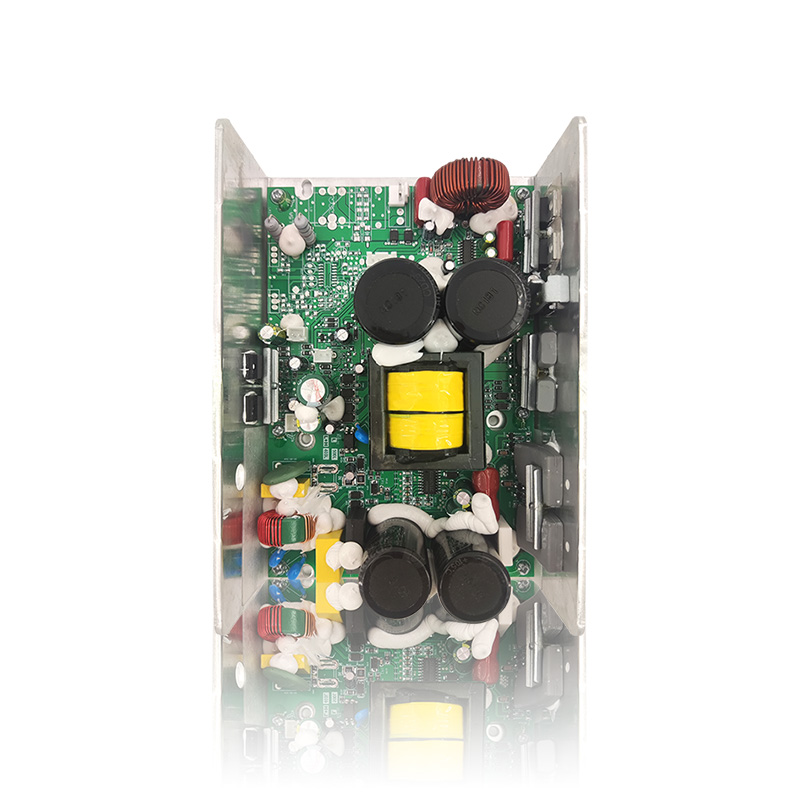
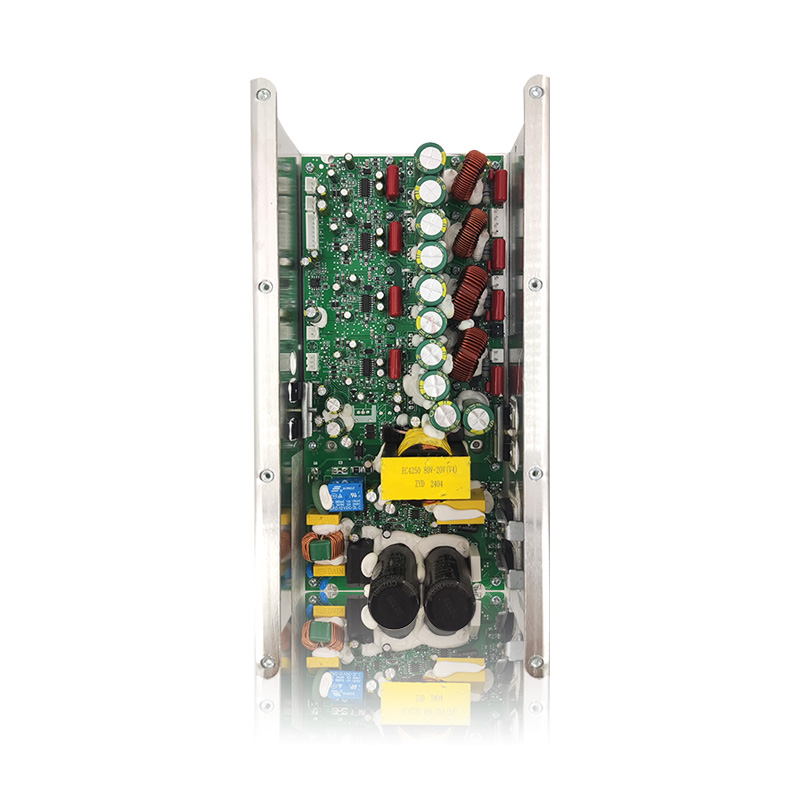
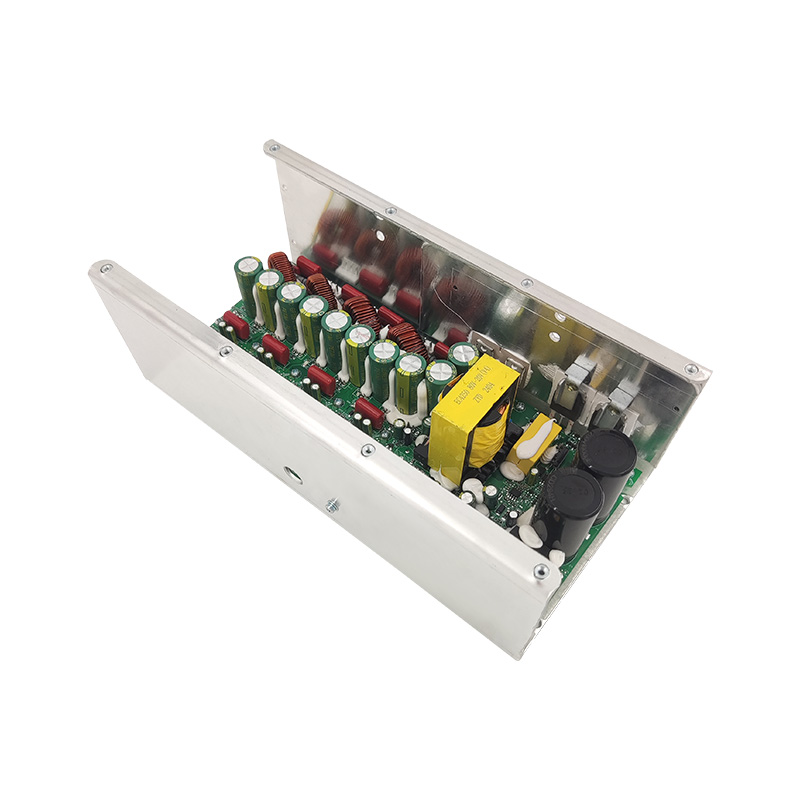
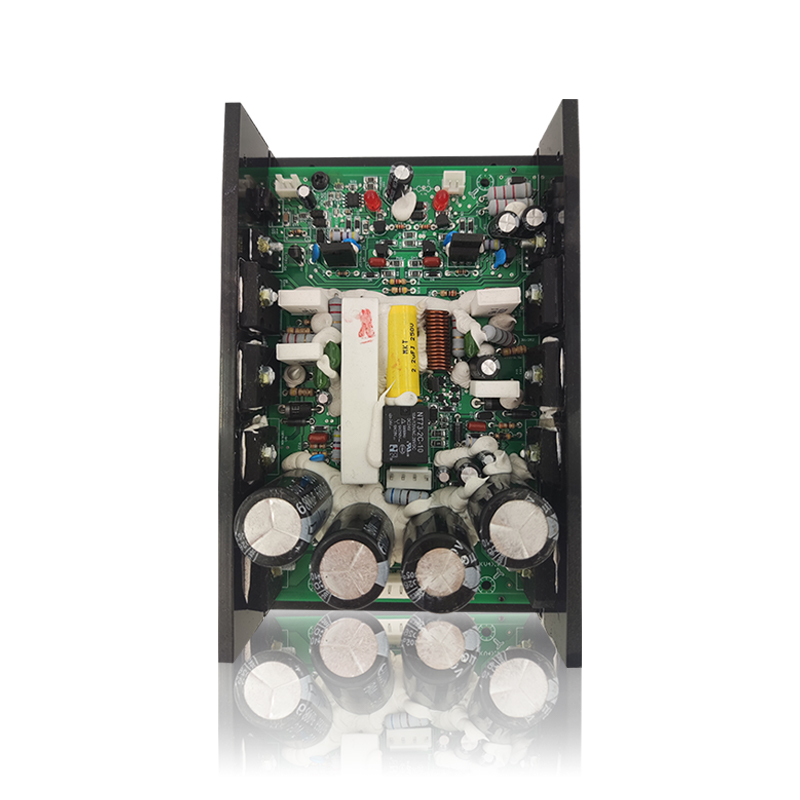
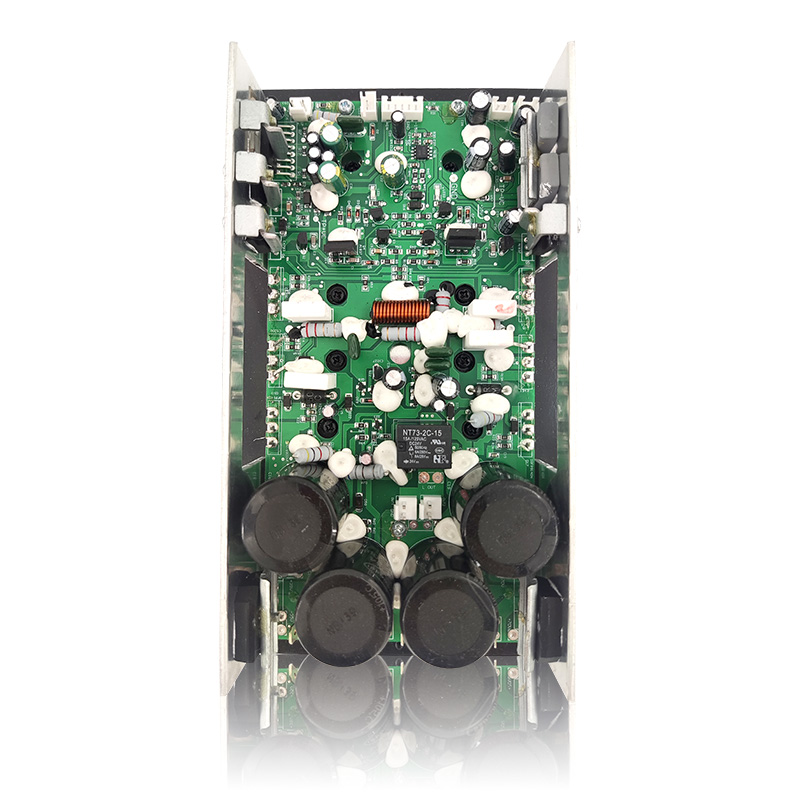
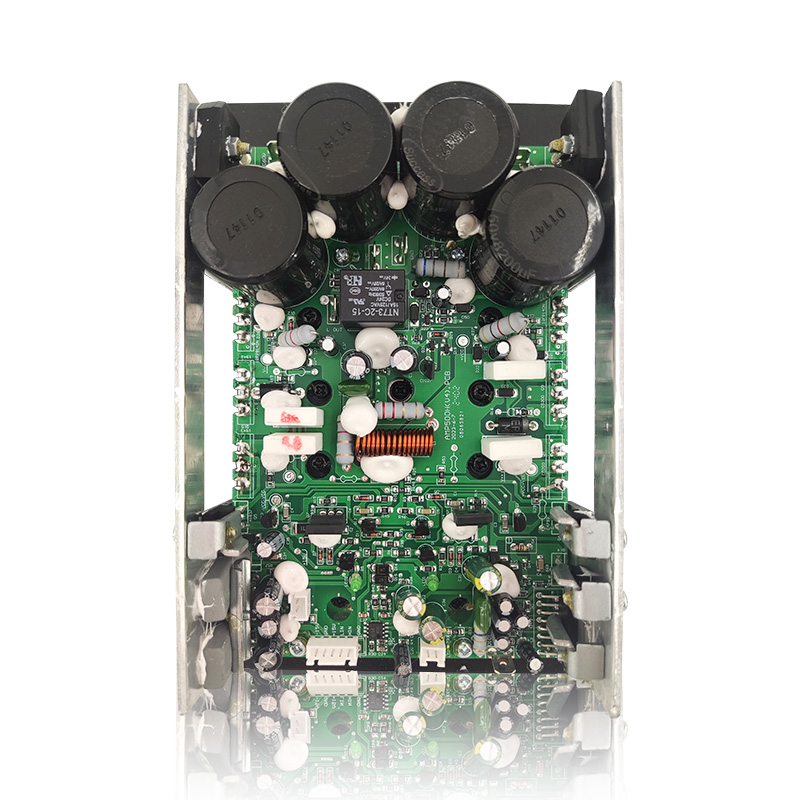
Inside a Class D amplifier module
Efficiency: The Gap That Changes Your Power Supply
Efficiency is the specification with the largest impact on the rest of your design. The typical figures are consistent across published measurements and amplifier datasheets:
- Class A: 20–30% efficiency
- Class AB: 50–60% efficiency
- Class D: 85–90% efficiency
Typical efficiency at full output
These values apply near full output. Linear classes waste proportionally more at low output and at idle, while Class D stays efficient across most of its operating range.
Plugging those percentages into a real example: at 500 W continuous output, a 25%-efficient Class A stage draws about 2,000 W from the mains and dissipates about 1,500 W as heat. An 88%-efficient Class D module draws about 570 W and sheds only about 68 W. The table below shows the same arithmetic at three output levels.
| Continuous output power | Class A (25% efficiency) | Class D (88% efficiency) |
|---|---|---|
| 100 W | 400 W input / 300 W heat | 114 W input / 14 W heat |
| 500 W | 2,000 W input / 1,500 W heat | 568 W input / 68 W heat |
| 1,000 W | 4,000 W input / 3,000 W heat | 1,136 W input / 136 W heat |
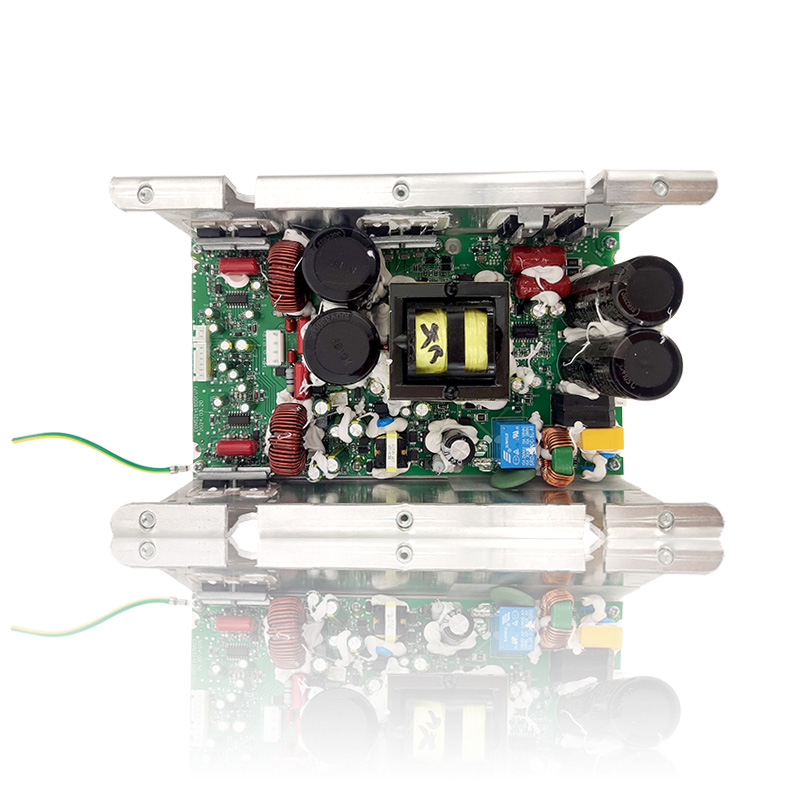
For a battery-powered column speaker or a high-output subwoofer, this difference decides whether the product needs a cooling fan, how long the battery lasts between charges, and how much the enclosure weighs when it ships. It is the main reason Class D modules have become the default in those product categories. A module such as the eon520-2092 with LP500W/HP200W combines PFC and LLC resonant power in a Class D design, so the supply stage and the switching stage share one compact board.
Sound Quality, Distortion, and Perceived Tone
Class A has a long-standing reputation for purity. Because the output devices never switch off, crossover distortion is practically absent, and the distortion spectrum stays low. That is why Class A still dominates high-end headphone amplifiers and small preamplifiers.
Modern Class D has closed most of the gap. With switching frequencies above 200 kHz, closed-loop feedback around the power stage, and carefully selected output inductors, a quality Class D module achieves THD+N below 0.05% at rated power and reproduces transients cleanly. Damping factor, which describes how well the amplifier controls woofer motion, is also high in feedback-based Class D designs.
If someone says Class D sounds digital, they are usually describing an early implementation with a poorly designed output filter. When the LC filter, grounding, and power supply are executed correctly, Class D is audibly transparent. The way an amplifier module shapes perceived sound quality stems from its filter, feedback, and protection circuitry more than from the class badge.
Size, Weight, and System Integration
For module buyers, integration cost is as important as audio performance. A 100 W Class A stage needs a large toroidal transformer, a big heatsink, and airflow around it. A Class D module at the same power fits on a small PCB, can be convection-cooled in many cabinets, and leaves room for DSP and input circuitry. This is why powered line arrays, column speakers, and subwoofers have moved almost completely to Class D.
Class H deserves a mention as a middle ground. It keeps the linear output stage of Class AB but adds a tracking supply that reduces the voltage across the output transistors, improving efficiency while preserving a linear power-stage character. OEM customers building higher-end powered speakers sometimes request this topology when they want a heavier analog feel without the heat of pure Class A.
Browse the amplifier module categories on our site to see how each topology is packaged with power supply, protection, and control interfaces.
Which One Should You Choose?
The trade-offs come into focus when scored against the needs of real products. The radar chart below rates Class A and Class D from 1 to 5 across six selection criteria, with higher being better.
Selection priorities: Class A vs Class D
The same criteria applied to common product categories lead to clear recommendations:
| Application | Recommended class | Reason |
|---|---|---|
| Headphone amplifier / low-power preamp | Class A | Low power keeps heat manageable; delivers very low distortion. |
| Powered PA speaker / column speaker | Class D | Compact and light; high efficiency suits continuous output. |
| Subwoofer / bass cabinet | Class D | High continuous power; BTL designs reach 500 W to 650 W. |
| Studio monitor | Class D or Class AB | Modern Class D is transparent; Class AB suits a specific voicing. |
| Portable / battery-powered speaker | Class D | Efficiency extends battery life and reduces enclosure heat. |
What to Check Before Buying an Amplifier Module
Whichever class you choose, the module implementation decides the final performance. Compare these six points when evaluating modules:
- Efficiency at typical operating power, not just peak rating.
- Power supply design: PFC and LLC resonant supplies handle wide mains voltage swings better than simple flyback stages.
- Protection set: look for overload, overcurrent, short-circuit, and thermal protection in one module.
- Output filter design and EMI behavior, especially if the module sits near wireless transceivers.
- Stated THD+N, signal-to-noise ratio, and damping factor at realistic loads.
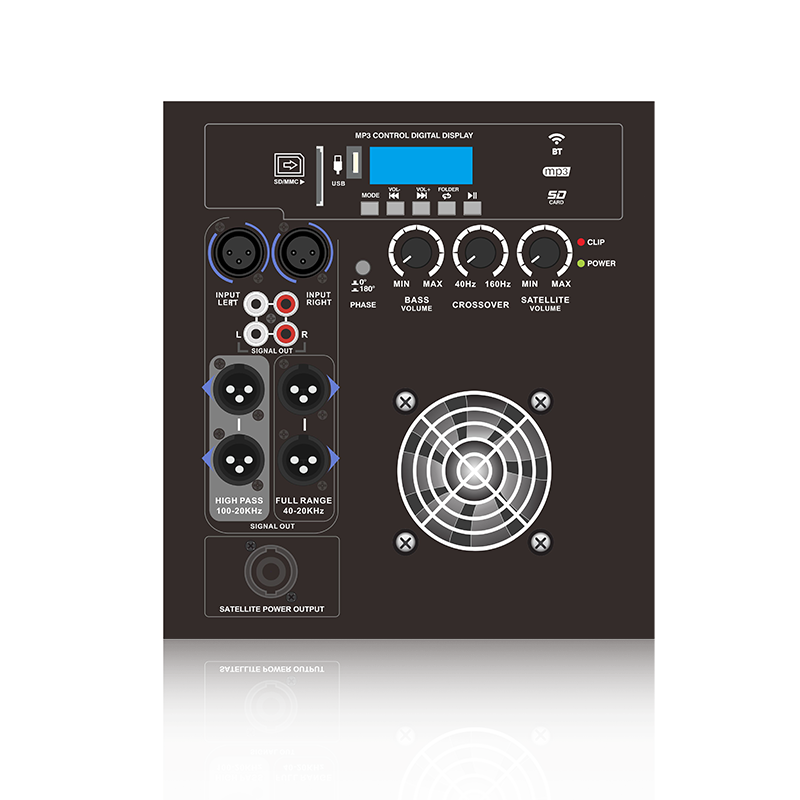
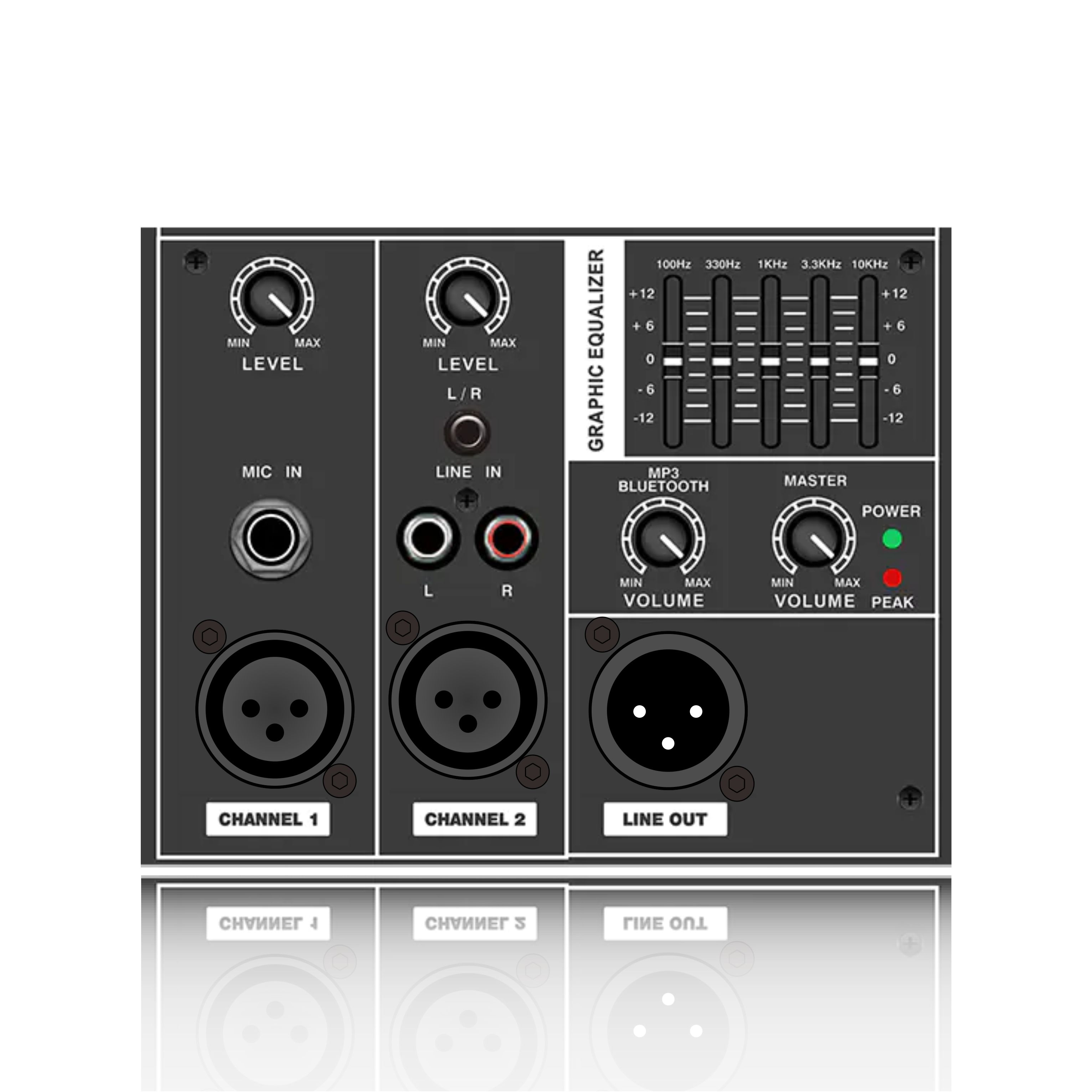
- Control options: DSP presets, analog EQ, and Bluetooth or MP3 input can remove the need for a separate preamp board.
A reliable module also needs a robust supply section. The eon522d-2092 (LP500W/HP200W) uses an LLC resonant design, which is one example of how input-stage engineering matters as much as the switching stage. Always verify that the protection features match the abuse your product will see in the field.
 EON522SUB 500W LLC Resonant Active Subwoofer Amplifier ModuleThis module pairs an LLC resonant switching supply with a Class D bass amplifier, delivering high efficiency and reliability for subwoofer applications. Its protection features suit demanding field use.View Product →
Class A vs Class D Amplifiers: Frequently Asked Questions
Q1: What is the difference between a Class A and a Class D amplifier?
Class A amplifiers keep output transistors conducting for the whole signal cycle, giving high linearity but only 20–30% efficiency. Class D amplifiers switch transistors rapidly and filter the output, reaching 85–90% efficiency with less heat and smaller parts.
Q2: Which sounds better, Class A or Class D?
Implementation matters more than the class. Class A has a reputation for warmth, while modern Class D modules achieve THD+N below 0.05% and are audibly transparent. In blind listening, listeners often cannot tell them apart.
Q3: Are Class D amplifiers efficient enough for battery-powered speakers?
Yes. Their 85–90% efficiency means less wasted heat and longer battery life, which is why most portable and column speakers use Class D modules.
Q4: Can Class D amplifiers drive subwoofers?
Yes. With BTL configurations, Class D subwoofer modules deliver 500 W to 650 W continuous and maintain high damping factor for tight low-frequency control.
Q5: Why do Class A amplifiers run so hot?
Because the output stage is biased to conduct current continuously, most input power becomes heat. A 100 W Class A stage typically dissipates about 300 W of heat.
Q6: Which amplifier class is best for a professional PA speaker?
Class D. It provides the high continuous power, low weight, and reduced thermal load that PA enclosures need; most pro line array and subwoofer systems are now built around Class D modules.