English
 Español
 中文简体
中文简体
Home / News / Industry News / Class H Amplifier: Working Principle, Efficiency, and Applications in Pro Audio
When a powered speaker manufacturer evaluates amplifier platforms, every option carries a trade-off. Class AB is proven but runs hot, Class D is efficient but introduces switching artifacts, and Class H tends to sit between the two. Its engineering logic is simple: make the power supply follow the audio signal, so the output stage never wastes large amounts of voltage as heat. Class H amplifiers deliver analog sound quality with higher efficiency, and they remain a well-established option in professional audio module catalogs. This guide explains how Class H works, what efficiency you can expect, and how to evaluate Class H amplifier modules for OEM speaker and subwoofer designs.
Content
What Is a Class H Amplifier?
A Class H amplifier is an analog power amplifier with a modulated power supply rail. In a conventional Class AB amplifier, the supply voltage stays fixed while the audio signal fluctuates, so the output transistors continuously dissipate the excess voltage as heat. In a Class H amplifier, a tracking circuit raises and lowers the supply rail so that it stays just above the level of the audio signal.
This technique is commonly called rail tracking. When the music is quiet, the rail voltage drops; when a transient or kick drum hit arrives, the rail voltage rises to give the output stage enough headroom. The result is lower heat generation and better overall efficiency than fixed-rail analog designs. Design discussions among audio engineers often cite current savings of roughly 20-30% at typical music levels compared with a fixed-rail Class AB amplifier. According to the widely cited Wikipedia article on power amplifier classes, Class H differs from Class G in that the supply rail varies continuously rather than in discrete steps in response to the input.
For a manufacturer, this same architecture is available as a building block: an active power amplifier module integrates the preamp, tracking controller, and output stage on one board, so you can adopt Class H performance without designing a tracking supply from scratch. A module such as the Amp300H-7294, for example, delivers 300 W low-frequency plus 50 W high-frequency output from a linear transformer supply for bi-amped speaker systems.
Efficiency at a Glance: How Class H Compares
Efficiency figures depend on load, signal content, and circuit design. Audio engineering references typically cite the following ranges at continuous high-level output:
Class A dissipates the most energy because its output devices always conduct fully. Class AB improves on that but still burns significant heat at idle and at partial output. Class H reduces this dissipation by following the signal envelope, while Class D reaches the highest efficiency by switching its output stage at high frequency.
| Class | Typical efficiency | Supply rail | Output stage | Heat management |
|---|---|---|---|---|
| Class A | 20-30% | Fixed | Linear, always conducting | Large heat sinks required |
| Class AB | 50-65% | Fixed | Linear | Moderate heat sinks |
| Class H | 70-80% | Tracking | Linear | Small-to-moderate heat sinks |
| Class D | 85-90% | Switched | Switching | Minimal, but output filtering required |
How the Tracking Supply Rail Works
The diagram below illustrates the key behavior. The central signal is a sine wave; the dashed lines above and below are the positive and negative supply rails. The positive rail rises only during the positive half of the signal, and the negative rail deepens only during the negative half.
The tracking controller performs this modulation continuously. It monitors the input signal, predicts the required headroom, and drives an active regulation stage that feeds the output transistors. In practical module designs with a linear transformer power supply, the controller adjusts the rail so that the output stage always sees the minimum sufficient supply voltage.
- The input preamp conditions the audio signal and sends it to the tracking controller.
- The controller compares the instantaneous output envelope with the current rail voltage.
- The supply regulation stage raises or lowers the rail within microseconds, keeping a small margin above the signal peak.
- The output transistors amplify the signal using a rail that is just high enough, converting far less excess power into heat.
Strengths and Trade-Offs of Class H
What Class H does well
- Higher efficiency than Class AB at music duty cycles, with less heat sink burden
- Clean analog output with no switching noise or high-frequency artifacts
- Lower idle power consumption benefits thermally constrained or battery-powered products
- Peak headroom remains available for transients because the rail can rise quickly
Where Class H makes you pay
- More complex power supply stage increases module cost relative to Class AB
- Tracking controller must be stabilized carefully to avoid distortion on fast transients
- Efficiency still falls short of Class D at sustained full power
- Linear transformer supplies add weight compared with compact switching supplies
Design discussions among audio engineers note that Class H never became the dominant topology in consumer hi-fi, largely because the added cost and complexity of rail tracking were hard to justify for low-power, single-voltage applications. In professional speaker products, however, the efficiency and heat benefits matter much more, and module-based Class H designs sidestep much of the complexity concern.
What to Check When Choosing a Class H Power Amplifier Module
Not every Class H module behaves the same way. These points separate a rugged professional module from a board that will create problems in the field:
- Rated power and impedance: confirm the LP and HP power ratings and the nominal load impedance, such as 400 W and 100 W into 8 ohms.
- Supply topology: linear transformer supplies provide robust transient current and low noise, while switching supplies reduce weight and cost.
- Heat sink design: a large U-shaped aluminum radiator improves long-term reliability at high output levels.
- Protection circuits: look for overload, short-circuit, and over-temperature protection built into the module.
- Customization: if you are an OEM, check whether the manufacturer will adjust EQ presets, input sensitivity, or connector layouts.
- Manufacturing quality: SMT assembly, automated testing, and consistent component sourcing are essential for repeatable module performance.
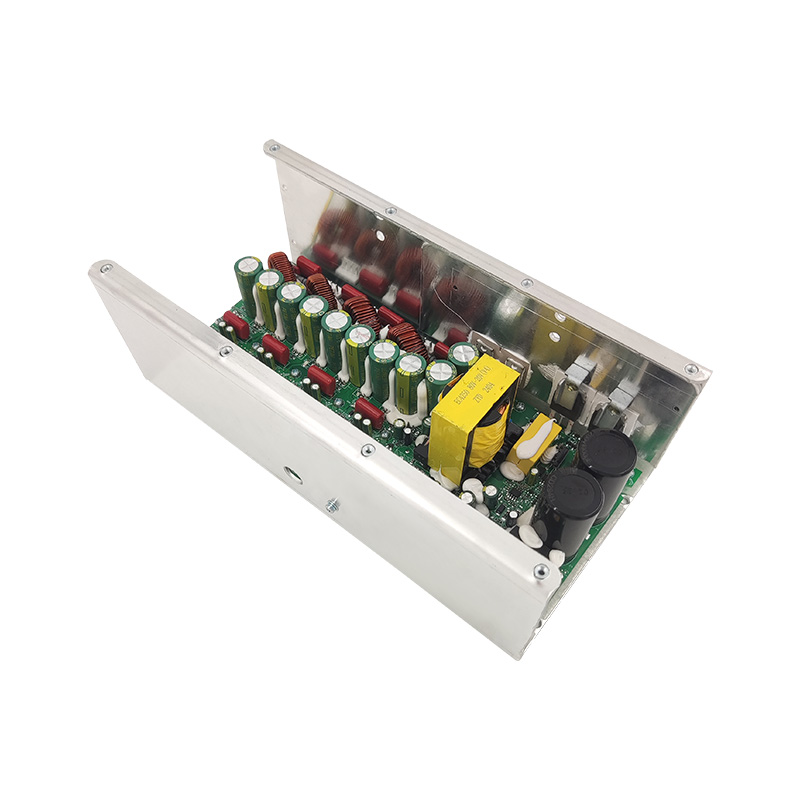
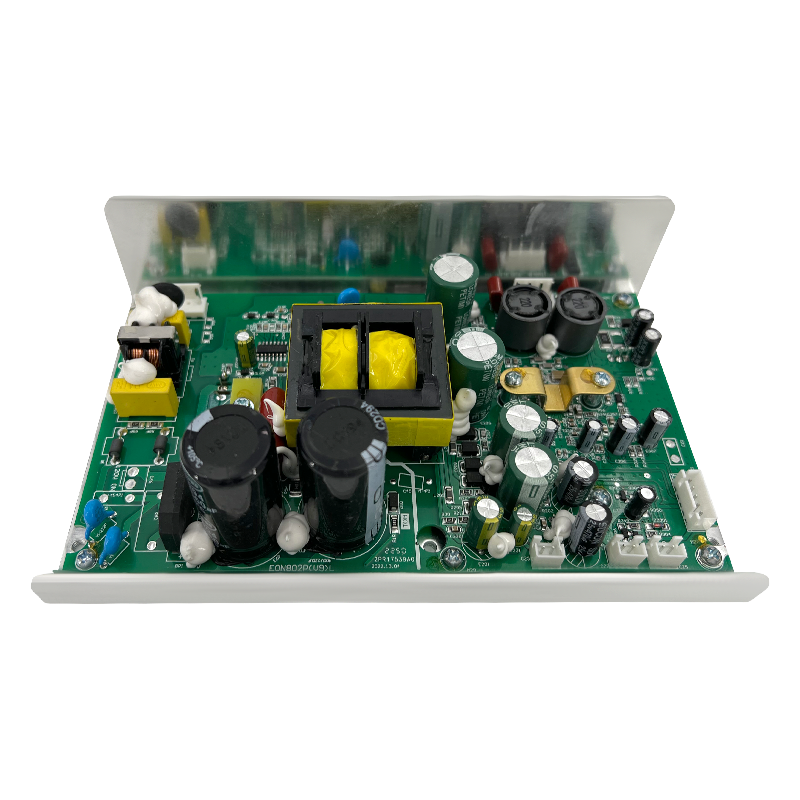
Isometric view: major building blocks of a compact Class H amplifier module.
An example in this category is the Amp400H-7294, which delivers 400 W low-frequency plus 100 W high-frequency output with a U-shaped aluminum radiator and a linear transformer power supply. It is designed for OEMs who need dependable headroom in a compact module footprint.
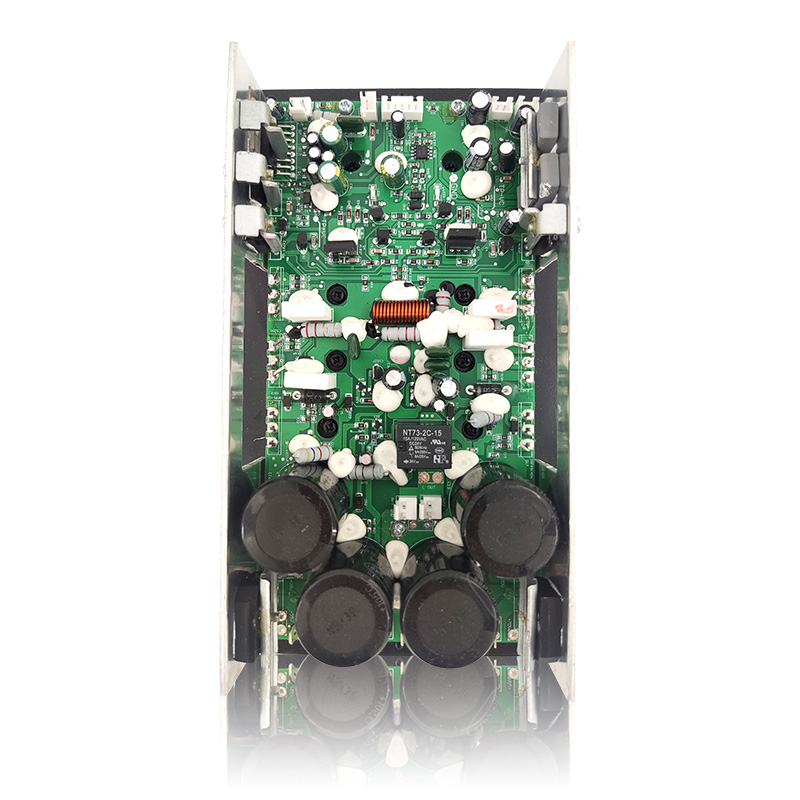 AMP400H+7294 Class H Amplifier Module with 400W LF and 100W HF OutputThis compact Class H module offers 400W low-frequency and 100W high-frequency power with a linear transformer supply and U-shaped aluminum radiator, making it a reliable choice for powered speakers requiring headroom.View Product →
Where Class H Fits in Professional Audio
Class H modules are most useful in powered speakers that play material with a high crest factor: short peaks above a relatively modest average level. This includes PA monitors, column speakers, line-array cabinets, and especially subwoofers.
- Subwoofers: bass transients demand sudden current, and the tracking rail supplies exactly the headroom needed without idling at the full supply voltage.
- Line arrays: amplifier modules are installed inside sealed cabinets where heat is difficult to remove; Class H reduces the thermal load compared with Class AB.
- Column speakers: compact form factors make efficient heat sink use essential, and the tracking supply helps keep the enclosure temperature manageable.
For subwoofer duty, the Amp600S-FP delivers 600 W through a professional linear transformer power supply, making it a direct example of how Class H suits high-power low-frequency output. The same reasoning that makes it useful in subwoofer designs applies broadly when you evaluate how audio amplifier modules enhance sound quality in speaker systems: the amplifier must deliver clean power without overheating the cabinet.
Frequently Asked Questions
Is a Class H amplifier better than Class AB?
Class H is more efficient than Class AB because the supply rail tracks the signal, which reduces heat at typical music levels while keeping an analog output character. Class AB remains simpler and less expensive for low-power, fixed-level applications.
What is the efficiency of a Class H amplifier?
Typical efficiency is around 70-80% at high output levels, depending on design and load. That is higher than Class AB at 50-65% but lower than Class D at 85-90%.
Is a Class H amplifier good for speakers?
Yes. Class H works well in powered speakers, column speakers, and subwoofers because it reduces heat and idle power loss while producing clean analog output without switching artifacts.
What is the difference between Class D and Class H amplifier?
Class D switches the output stage on and off for very high efficiency and needs output filtering. Class H keeps a linear output stage but modulates its supply voltage; it uses more current than Class D but is easier to integrate for clean analog performance.
Does a Class H amplifier sound good?
Class H can sound very good in practice. The output stage is linear, and the tracking supply preserves transient headroom, so the sonic character is close to a well-designed Class AB amp without the heat burden.
Why use a Class H amplifier in a subwoofer?
Bass content has a high crest factor: short peaks above a modest average level. Class H delivers the headroom when the peaks arrive and lowers the rail in between, which minimizes heat and power loss exactly where it matters most.