English
 Español
 中文简体
中文简体
Home / News / Industry News / Class D Amplifier Sound Quality: What OEM Buyers Should Verify Before Mass Production
A 500 W Class D amplifier module and a similar-power Class AB module dropped into the same 12-inch powered speaker behave very differently before anyone even starts talking about sound. The Class D board runs warm after two hours of programme material; the Class AB board is hot to the touch, and the battery pack behind it drains noticeably faster. The question of Class D sound quality usually arrives later, once the module is measured properly — and by that point, most of the old complaints have already shrunk into a much shorter list.
That shorter list is the subject of this article. It is written for engineers and purchasing teams choosing amplifier modules for powered speakers, line arrays, subwoofers and portable systems — the people who need to separate the parts of "Class D sound" that are genuine design trade-offs from the parts that were simply inherited from the early 2000s.
Content
- 1 The Short Answer on Class D Sound Quality
- 2 Why Class D Earned a Bad Reputation for Sound
- 3 The Four Things That Actually Decide Class D Sound Quality
- 4 Class D, Class AB and Class H Side by Side
- 5 Specifications Worth Writing Into a Purchase Agreement
- 6 Where Class D Modules Make the Most Sense
- 7 A Practical Evaluation Checklist for a Production Project
- 8 Frequently Asked Questions
The Short Answer on Class D Sound Quality
A well-designed Class D module is transparent enough that, inside a modern powered speaker, it is difficult to distinguish from a good Class AB module of the same power. It is also measurably better at the things an amplifier is judged on in real deployments: thermal stability, output consistency under load, and long-duration performance at high volume.
The differences that remain are not caused by the letter D. They come from four design decisions:
- The switching frequency and the output filter built around it.
- The power supply topology, specifically whether the module uses power factor correction and an LLC resonant stage.
- The signal chain in front of the amplifier, including DSP, EQ and limiting.
- Thermal design and board layout.
The practical consequence is that comparing "Class D versus Class AB" at catalogue level tells you almost nothing. Compare the power supply, the filter and the DSP, and the sound quality question largely answers itself.
Why Class D Earned a Bad Reputation for Sound
The criticism was justified once, and it is worth knowing exactly why, because the same failure modes still appear in inexpensive modules today.
- Output filter roll-off. Early modules switched at roughly 50–150 kHz, which forced the output filter to begin cutting well below 20 kHz. The result was a rolled-off top end that listeners described as dull or closed-in.
- Dead-time distortion. The blanking interval that prevents shoot-through in the output stage introduces a nonlinear error. Without compensation, that error lands in the treble, exactly where the ear is most sensitive to it.
- Poor supply rejection in open-loop designs. With no feedback loop, ripple on the supply rail appears directly at the output, and rail sag under load turns into audible compression.
- EMI from careless switching layout. Noise coupled into the preamp stage and input cabling, producing hiss and buzz that had nothing to do with the audio path itself.
Every one of these problems has a known engineering answer: higher switching frequencies, dead-time compensation, closed-loop modulation and disciplined EMI layout. What matters for a buyer is not whether Class D can sound good — it clearly can — but whether the specific module in front of you has had those answers applied.
The Four Things That Actually Decide Class D Sound Quality
Switching Frequency and the Output Filter
The switching frequency sets how much room the output filter has to work in. Professional Class D modules commonly switch somewhere between 300 kHz and 1 MHz. The higher the switching frequency, the higher the filter corner can sit, which keeps phase and amplitude behaviour clean up to and beyond 20 kHz. The cost is greater switching loss and a more demanding EMI design.
For an OEM project, the practical checks are straightforward:
- What switching frequency does the module specify?
- Where does the output filter corner sit relative to 20 kHz?
- Can the supplier provide a measured 20 Hz–20 kHz response curve rather than a printed "±3 dB" claim?
Power Supply Topology: PFC, LLC and Why They Appear in Datasheets
A Class D output stage draws current in switching pulses, so the amplifier is bounded by the quality of the rail feeding it. Two supply features are worth knowing by name.
Power factor correction (PFC) keeps the module stable across a wide mains voltage range, which matters for products exported to markets where the grid is not tightly regulated.
LLC resonance is a soft-switching topology. It lowers switching loss and EMI, produces cleaner output ripple, and holds efficiency well under heavy load. In practice, the same Class D stage fed by a basic flyback supply and by an LLC resonant supply will not behave like the same amplifier — the difference shows up first in bass control and in how composed the system stays during loud passages.
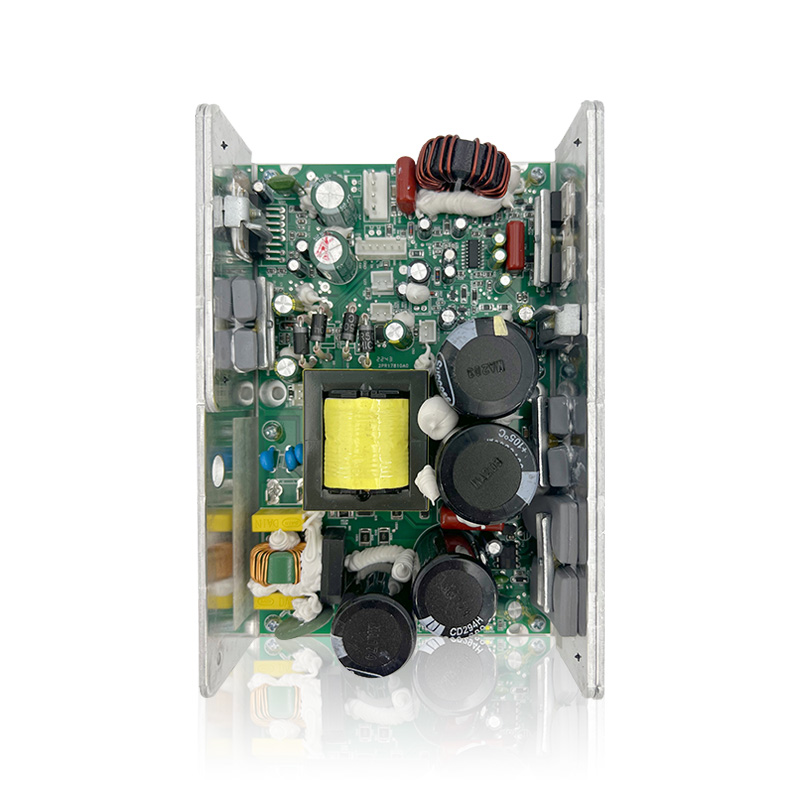
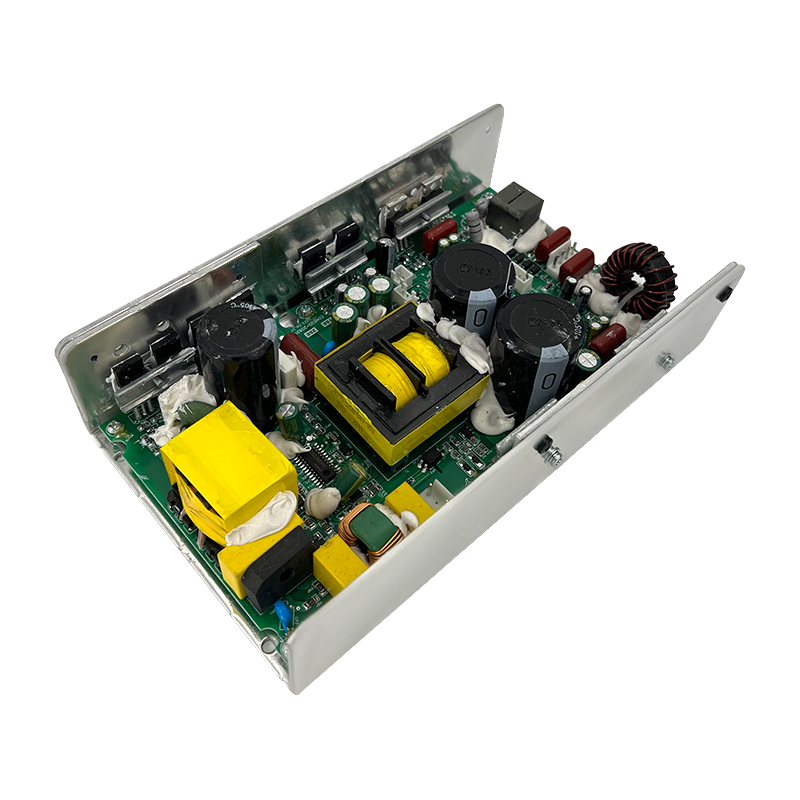 EON520: LP400W+HP100W PFC+LLC Resonance Wide Voltage Class D Power Amplifier Module● High Efficiency Switching Power Supply with PFC+LLC Resonance: 800W ● Self-adaptive Wide Voltage Input: 100V-240V ● Mid and Low-Frequency Power Amplifier: CLASS D 40...View Product →
Modules that combine both approaches — a PFC plus LLC resonant design rated LP 400 W / HP 100 W with wide-voltage input, for example — exist specifically to hold output quality steady when the mains supply moves.
DSP and the Signal Chain in Front of the Amplifier
By the time a powered speaker reaches the listener, the sound is the product of the DSP and the amplifier together, not the amplifier alone. That is why DSP modules built on the ADAU1701 chip are so common in active speakers: crossover, EQ, limiting and preset switching all live in a single device.
Three DSP behaviours translate directly into perceived Class D sound quality:
- Limiting. A properly set limiter keeps the amplifier out of hard clipping, which reduces bass distortion at high volume compared with a module relying on the amplifier's own protection.
- Protection logic. Speaker and thermal protection that ramps output down instead of cutting it abruptly avoids the audible dropouts that make a product feel unreliable.
- Presets matched to the cabinet. Preset EQ modes are only useful when they were tuned for the specific driver and enclosure, not copied from a reference design.
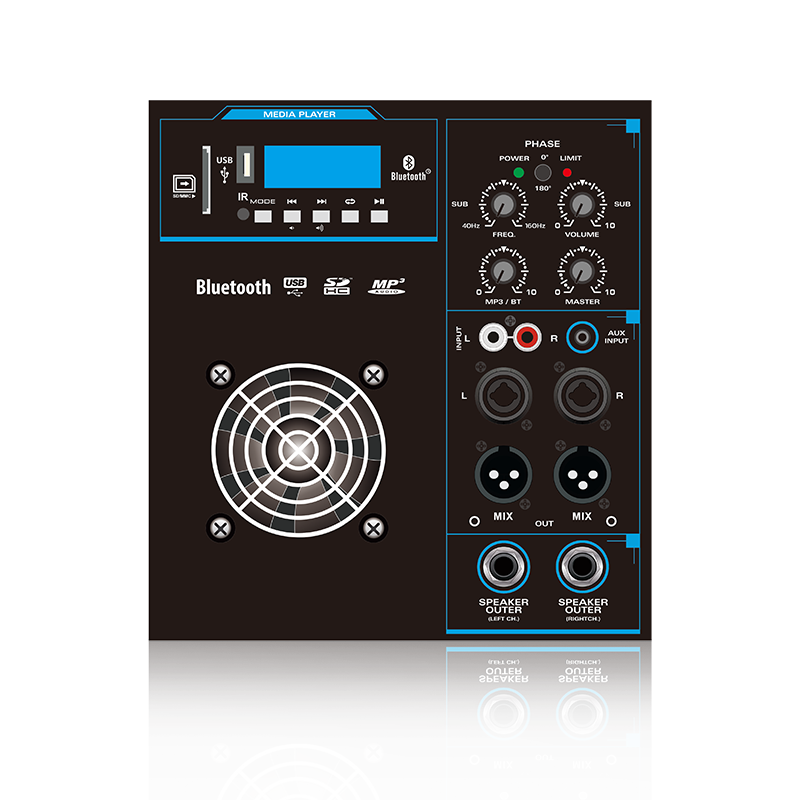
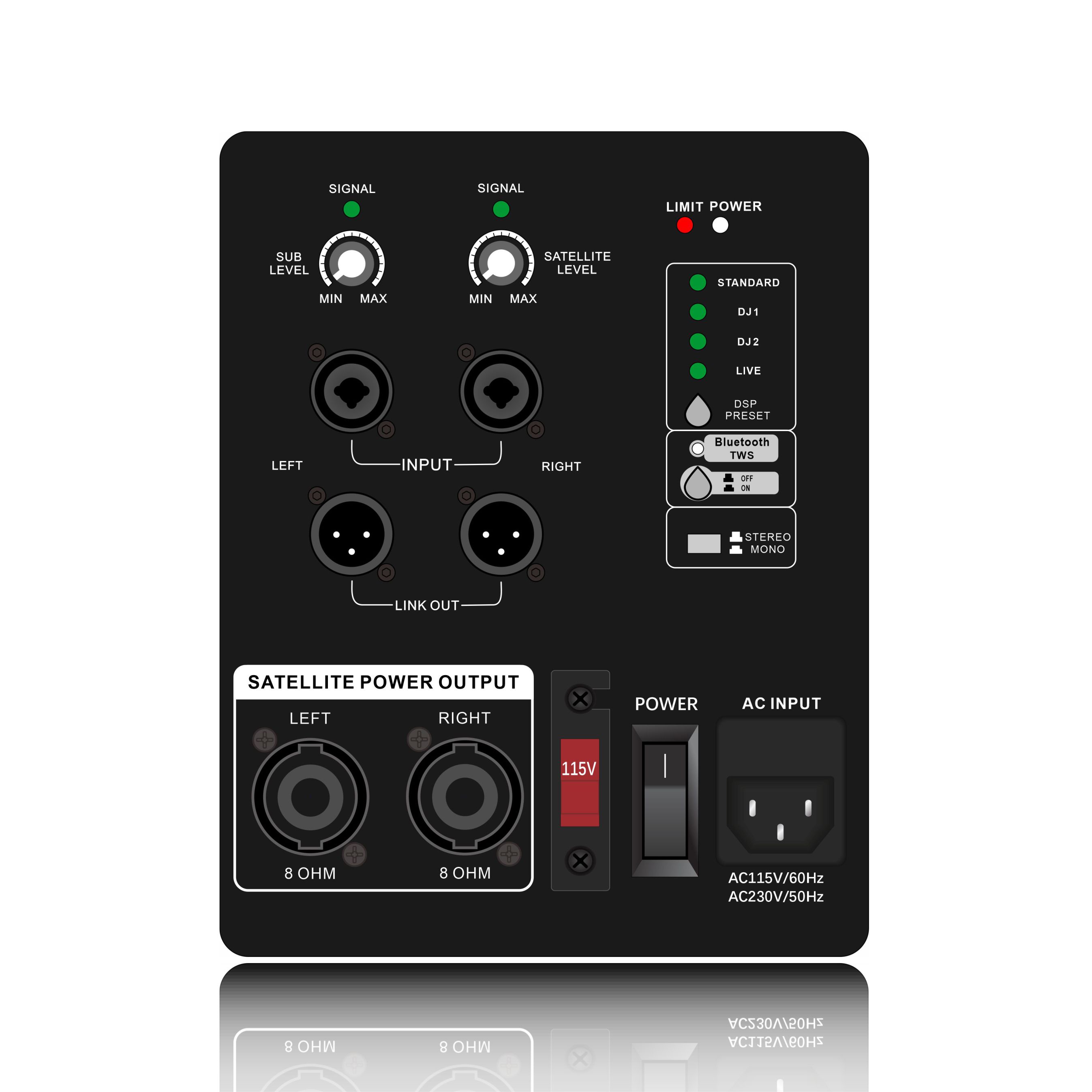 DSP1903: 4 Customized Preset EQ Modes 2.1CH Linear Array Speaker ADAU1701 Based DSP Functi● Designed based on ADAU1701 sound audio system. Use sigma studio DSP software to configure signal processing parameters. ● Selectable four customized preset modes whi...View Product →
A multi-channel DSP front end offering several customised preset EQ modes is a typical example: the amplifier stage stays identical, but the tonal behaviour of the finished speaker changes completely.
Thermal Design and Board Layout
Class D generates far less heat than Class AB, but it still generates heat. A module that enters thermal rollback after twenty minutes will sound soft and compressed no matter how good its bench measurements look.
What to verify:
- Heatsink area and airflow path matched to the real enclosure.
- Protection thresholds set with enough margin that normal programme material never triggers them.
- Burn-in data from long-duration full-load testing, not just a short bench run.
This is also the part of the evaluation that cannot be done from a datasheet. A supplier running its own SMT lines, assembly lines and an audio testing room can produce burn-in logs and impedance-load test results; a trading company usually cannot. The manufacturing setup behind the module is worth an on-site visit before committing to a production run.
Class D, Class AB and Class H Side by Side
The choice is rarely about which class sounds best in isolation. It is about which one fits the product's thermal envelope, battery budget, weight target and price point.
| Amplifier class | Typical full-power efficiency | Distortion behaviour in modern designs | Heat and physical size | Typical module applications |
|---|---|---|---|---|
| Class A | 20–30% | Very low crossover distortion, warm tonality | Very high heat, large heatsinks | Small audiophile amplifiers |
| Class AB | 50–70% | Low and well understood, easy to tune | Moderate to high heat | Home audio, smaller powered speakers |
| Class H | 65–80% | Clean at high output thanks to rail tracking | Moderate heat, linear transformer required | High-power subwoofers, installed sound |
| Class D | 80–95% | Transparent when filtering, supply and feedback are done well | Low heat, compact footprint | Portable, battery, line array and subwoofer modules |
Typical Full-Power Efficiency by Amplifier Class
Indicative ranges; real numbers depend on topology, load and output level.
The efficiency gap is not a marketing figure — it is the reason a battery-powered speaker can run for a full evening, and the reason a line array cabinet can carry more channels in a smaller box. If you want a deeper walkthrough of how these trade-offs play out in real products, this comparison of Class D and Class AB efficiency and sound quality covers the same ground from a design perspective.
Specifications Worth Writing Into a Purchase Agreement
Module catalogue pages tend to list power, impedance and a handful of features. If sound quality is a contractual requirement, ask for these instead:
- THD+N at rated power and at 1 W. The 1 W figure is the one that exposes idle noise floor and crossover behaviour.
- Frequency response measured at the speaker terminals, not at the line input, because the output filter and the load interact.
- Output impedance or damping factor across 20 Hz–20 kHz. This is what separates a module with tight bass from one that sounds loose.
- Power supply topology and switching frequency. PFC present or not, LLC resonant or hard-switched.
- Protection thresholds and recovery behaviour. Ask for actual trigger points, not simply confirmation that protection exists.
- Thermal test data at full load over at least one hour.
Suppliers who design and build their own modules can usually answer these questions with test data. Suppliers who resell cannot, and that difference shows up in the field long after the sample has been approved.
Where Class D Modules Make the Most Sense
Class D stopped being a compromise in every application where efficiency and size matter more than absolute thermal headroom, and that list keeps growing.
- Portable and battery-powered speakers. Efficiency is the entire design constraint. A Class AB module would need a substantially larger battery pack for the same play time.
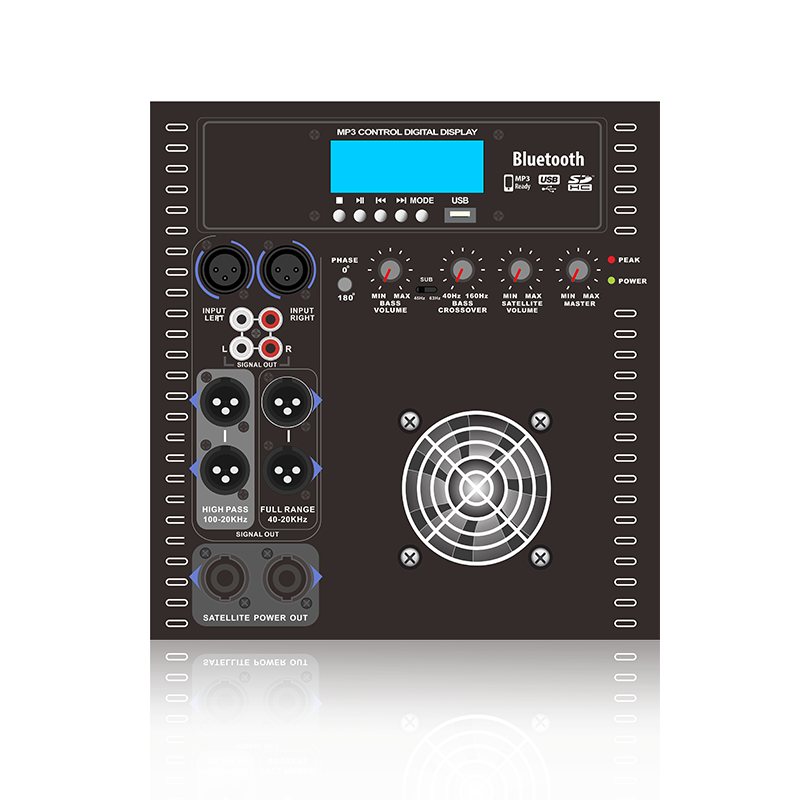
- Active line array systems. Multi-channel modules with LLC resonant supplies fit the 2.1 and 2.2 channel configurations these systems use, and low heat output lets designers pack more channels into a smaller cabinet.
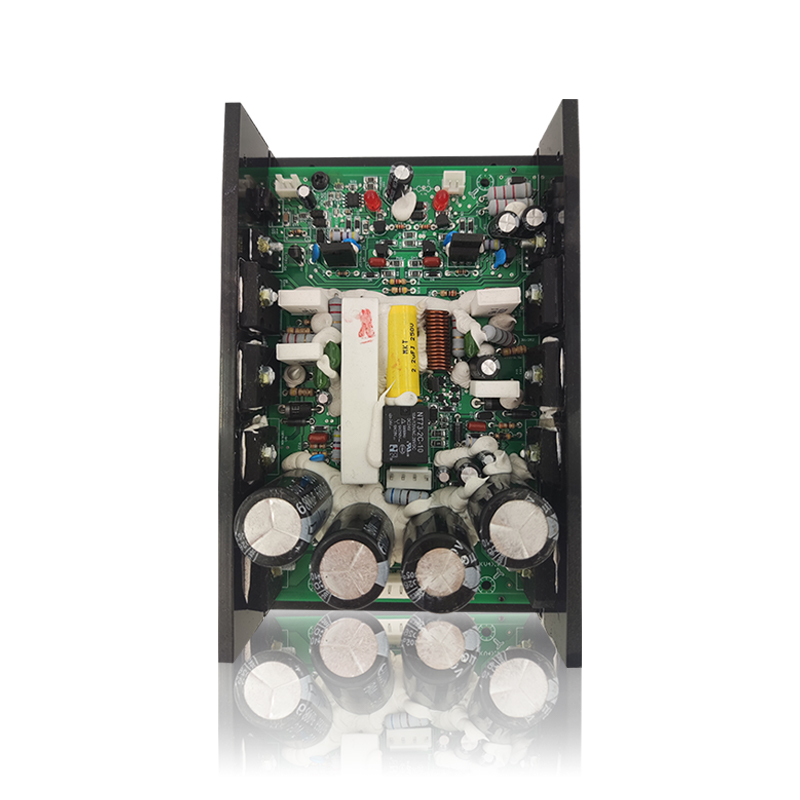
- Powered subwoofers. BTL Class D output stages deliver high power into low-impedance loads without the heatsink mass a linear design would require. A dedicated subwoofer module rated LP 1500 W into 8 ohms illustrates what that looks like in production hardware.
- Column speakers and installed sound. Low heat means the amplifier can be sealed inside the enclosure with no additional ventilation.
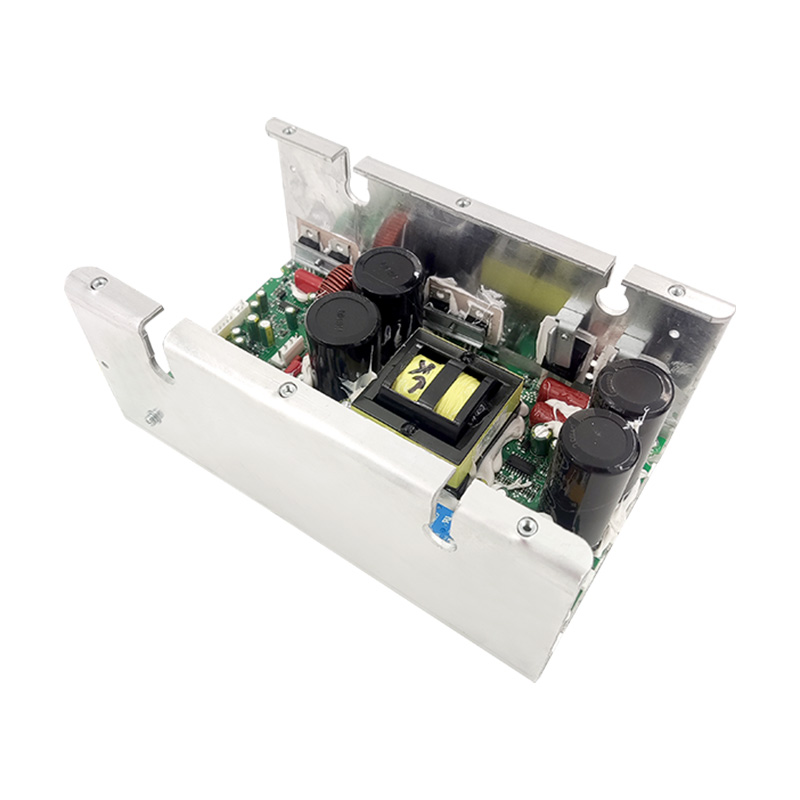 EON521+1500:LP 1500W/8ohm Pro Audio BTL Subwoofer Power Amplifier Module●LLC Resonant High Efficiency and High Reliability Switching Power Supply: 1800W ●BTL Power Amplifier: CLASS D 1500W-8 Ohm ●U-shaped Aluminum Radiator, Stable Power Ou...View Product →
Signal and Power Path Inside a Class D Powered Speaker Module
A Practical Evaluation Checklist for a Production Project
Before freezing a Class D module into a production bill of materials, run it through the same sequence every time:
- Confirm rated power at the actual load impedance of your speaker, not the impedance used in the headline specification.
- Measure frequency response at the speaker terminals with the real load connected.
- Run a one-hour full-power burn-in and log heatsink temperature alongside any protection activity.
- Play programme material with heavy low-frequency content at high level and listen specifically for compression and limiter pumping.
- Check idle noise with the input shorted; this is where inexpensive modules are exposed.
- Verify behaviour at the low end of the mains voltage range if the product ships to markets with unstable supply.
- Confirm that preset EQ modes and protection thresholds can be customised for your cabinet. Customisation is a normal part of the module business, not an exception, and a supplier who will not adjust a preset is unlikely to support the product after launch.
Frequently Asked Questions
Q1. Is Class D amplifier sound quality actually worse than Class AB?
No. A well-designed Class D amplifier module is transparent enough to be hard to distinguish from a comparable Class AB module. Perceived quality depends far more on switching frequency, output filter design, supply topology and DSP tuning than on the amplifier class itself.
Q2. What switching frequency should a Class D amplifier module have?
Professional modules commonly switch between 300 kHz and 1 MHz. Higher frequencies push the output filter corner further above the audio band and improve treble behaviour, at the cost of higher switching loss and stricter EMI layout requirements.
Q3. Does a Class D module need a DSP to sound good?
Not strictly, but in a powered speaker the DSP shapes the final result through crossover, EQ and limiting. A properly configured limiter alone prevents hard clipping and noticeably reduces bass distortion at high volume.
Q4. Why does a Class D amplifier lose bass control at high volume?
Usually it is the power supply, not the amplifier stage. Rail sag under heavy load reduces output headroom and effective damping. An LLC resonant supply with adequate bulk capacitance holds the rail far more stably than a basic hard-switched supply.
Q5. Can Class D amplifier modules drive both 4-ohm and 8-ohm speakers?
Many can, but rated power differs between the two. Always confirm power ratings at the impedance your cabinet actually presents, and check that protection thresholds were set for that load rather than copied from another model.
Q6. How should sound quality be tested before mass production?
Measure THD+N at 1 W and at rated power, take frequency response at the speaker terminals with the real load, run at least one hour of full-power burn-in, and listen for limiter pumping on bass-heavy material.