English
 Español
 中文简体
中文简体
Home / News / Industry News / How Does a Class H Loudspeaker Amplifier Work Compared to Class AB (VS Guide)?
Quick Answer
A Class H loudspeaker amplifier works by dynamically tracking the audio signal and switching the power supply rail voltage up only when the signal demands it — rather than running at full rail voltage all the time as Class AB does. This envelope-following technique eliminates wasted headroom across the output transistors at typical listening levels, reducing heat dissipation by 30–60% and making Class H the dominant high efficiency audio power amplifier topology in professional PA systems, installed sound, and high-power consumer applications where thermal management and operating cost matter.
Content
- 1 How a Class H Amplifier Actually Works: The Rail-Tracking Mechanism
- 2 Class H vs Class AB: A Direct Technical Comparison
- 3 Efficiency Across Amplifier Classes: Where Class H Stands in the Landscape
- 4 Why Class H Became the Standard for Professional PA and Installed Sound
- 5 Visualizing Rail Switching: What the Class H Supply Rail Actually Does
- 6 Digital Class H Audio Amplifier Design: How DSP Refines the Topology Further
- 7 When to Choose Class H Over Class AB — and When Not To
- 8 About Ningbo Zhenhai Huage Electronics Co., Ltd.
- 9 Frequently Asked Questions About Class H Loudspeaker Amplifiers
How a Class H Amplifier Actually Works: The Rail-Tracking Mechanism
To understand Class H, it helps to start with what happens in a conventional Class AB amplifier. In Class AB, the power supply rails are fixed — for example, at ±80V. Whether the amplifier is outputting a quiet passage at 5W or a peak burst at 500W, the transistors always operate with the full rail voltage across them. At low signal levels, almost all of that voltage appears as a voltage drop across the output stage, where it is converted directly into heat rather than useful audio power. This is the fundamental inefficiency of Class AB at real-world listening levels, which average far below the amplifier's rated peak.
A Class H loudspeaker amplifier solves this by splitting the power supply into two or more voltage levels — typically a low rail (e.g., ±40V) and a high rail (e.g., ±80V). A comparator circuit continuously monitors the instantaneous audio signal. When the signal is within the range the low rail can deliver cleanly, only the low rail is connected to the output stage. The moment the signal exceeds a threshold — typically around 70–80% of the low rail's headroom — the amplifier switches to the high rail, boosting supply voltage in real time to accommodate the peak. After the peak passes, the system drops back to the low rail.
The result is that the voltage drop across the output transistors stays relatively small throughout most of the signal's dynamic range. Since power dissipation in the output stage equals the voltage drop multiplied by the current flowing through it, lower drop means dramatically less heat — and lower energy consumption — without any change to the audio signal itself. The listener hears no difference; the thermal and electrical benefits are entirely internal to the high efficiency audio power amplifier design.
Rail Configuration
Typically 2 supply rail levels (Class H) or continuously variable rail (Class G variant). Most professional PA power amplifier systems use 2-rail designs for reliability and simplicity.
Switching Mechanism
Analog comparator or DSP-controlled gate switching. Transition must be fast (microseconds) and glitch-free to prevent audible artifacts at the crossover point between rail levels.
Efficiency Gain
Real-world efficiency of 70–85% with music program material, compared to 40–55% for Class AB at the same output power. Benefit is greatest at moderate signal levels — which is where most amplifiers spend the majority of their operating time.
Class H vs Class AB: A Direct Technical Comparison
Both topologies use linear output stages and can achieve very low distortion when well designed. The differences lie in power supply architecture, thermal behavior, and real-world efficiency — factors that become decisive in high-power professional and installed-sound applications.
| Parameter | Class AB | Class H |
|---|---|---|
| Power Supply Rails | Fixed single rail | 2+ dynamic rails |
| Efficiency at 1/8 Power (typical music) | ~40–50% | ~70–85% |
| Efficiency at Full Rated Power | ~60–70% | ~70–80% |
| Heat Dissipation (relative) | 100% (baseline) | 40–70% of Class AB |
| Heatsink / Cooling Requirement | Large, often fan-forced | Smaller, often convection-only at moderate power |
| Circuit Complexity | Lower | Moderate (rail-switching logic required) |
| THD+N (well-designed) | <0.05% | <0.05–0.1% (switching artifact must be managed) |
| Power Factor / Mains Draw | Higher at moderate loads | Lower — energy saving audio amplifier technology advantage |
| Best Application | Studio monitoring, low-power hi-fi, cost-sensitive designs | Pro PA, installed sound, high-power touring, live events |
Efficiency Across Amplifier Classes: Where Class H Stands in the Landscape
Efficiency ratings reported in amplifier datasheets are always measured at full rated power — a condition that rarely reflects real-world use. Music and speech program material has a crest factor of 10–20 dB, meaning average power is typically 6–20 times below the amplifier's peak capability. The Class H advantage is most pronounced in this real-world operating window, which is why it became the standard for professional PA power amplifier systems deployed in venues where amplifiers run for hours at a stretch.
Real-World Efficiency at 1/8 Rated Power — Music Program Material (%)
Class D (switching)
88–92%
Class H (this article)
70–85%
Class G (multi-rail linear)
65–78%
Class AB (standard)
40–52%
Class A
15–25%
Efficiency at 1/8 rated power with music program. Class D leads in raw efficiency; Class H offers the best linear-topology efficiency with superior audio fidelity versus Class D in demanding transient conditions.
Class D amplifiers claim higher peak efficiency figures, but at high power levels with demanding transient loads — common in live touring and subwoofer applications — the Class H high power sound amplifier module maintains lower output impedance and better load-invariant behavior, qualities that many professional audio engineers and system integrators still prefer for critical monitoring and main PA applications.
Why Class H Became the Standard for Professional PA and Installed Sound
Professional audio environments place demands on amplifiers that consumer applications never approach. Understanding why Class H displaced Class AB as the default topology in professional PA power amplifier systems requires looking at the operational realities of live events, permanent installation, and broadcast facilities.
Thermal Management in Dense Rack Configurations
A touring rack might pack eight to twelve amplifiers into a single equipment case. At full-day festival loads, a Class AB rack generating 100W of heat per amplifier slot requires aggressive forced-air cooling, adds noise, and creates thermal stress on neighboring equipment. The same rack loaded with Class H amplifiers generating 40–60W per slot runs cooler, quieter, and with a significantly extended component service life. For permanent installations in ceiling voids or equipment rooms, reduced heat output also lowers HVAC load — a meaningful factor in large-scale building acoustic systems.
Mains Circuit Loading and Generator Sizing
Outdoor events and temporary installations often run from hired generators. Generator sizing is directly driven by total amplifier power draw. An energy saving audio amplifier technology like Class H can reduce the total generator specification by 25–40% compared to an equivalent Class AB rig at real-world signal levels, with direct cost and logistics benefits. For permanent installations, reduced power draw also lowers utility operating costs across the system's service life.
Audio Fidelity Under Real-World Transient Loads
A common concern about Class H is whether the rail-switching transition introduces audible artifacts. In well-engineered designs, the answer is no. The switching event occurs at the output stage, not in the audio signal path, and the transition time — typically under 5 microseconds in a properly designed digital Class H audio amplifier design — is orders of magnitude below the threshold of human hearing. THD+N figures below 0.05% are routinely achieved in modern Class H designs, meeting or exceeding what most well-implemented Class AB amplifiers deliver at similar power levels.
High Power Density Without Proportional Size Increase
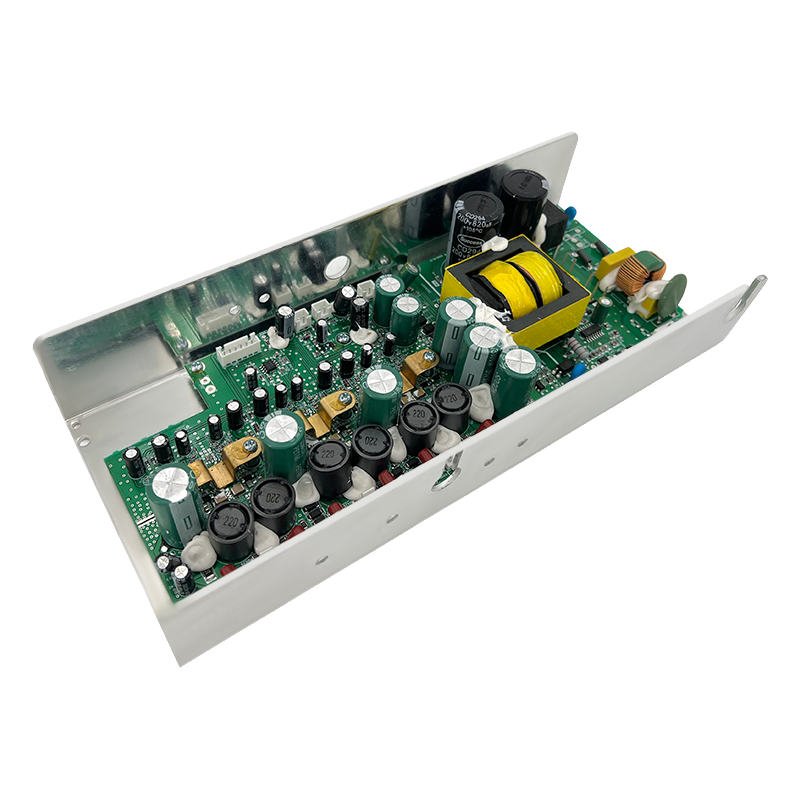
Because the output transistors operate with lower average dissipation, a high power sound amplifier module using Class H topology can deliver more output power from the same heatsink volume than a Class AB design. This allows manufacturers to build 2U rack units delivering 2×1000W or 4×500W — power densities that would require impractical cooling in Class AB. The combination of high output and compact form factor is directly why Class H became the architecture of choice for portable touring systems.
Visualizing Rail Switching: What the Class H Supply Rail Actually Does
The diagram below illustrates the relationship between the audio signal envelope (the waveform the amplifier is amplifying) and the Class H supply rail voltage. The rail tracks just ahead of the signal, maintaining a minimal but sufficient headroom margin at all times. The shaded area between the signal and the rail represents the voltage drop across the output transistors — and therefore the heat generated. In Class AB, this shaded area would be constant and large throughout; in Class H, it stays narrow across the full dynamic range.
Class H Rail Tracking vs Audio Signal Envelope (Conceptual)
The narrow band between the rail and signal envelope represents transistor dissipation — Class H keeps it minimal regardless of signal level.
Digital Class H Audio Amplifier Design: How DSP Refines the Topology Further
Modern digital Class H audio amplifier design integrates DSP-controlled rail switching that is faster, more precise, and more adaptive than purely analog comparator circuits. Rather than responding to the instantaneous signal level, a DSP-enabled rail controller can look ahead by several milliseconds using predictive algorithms — switching the rail to the higher level in anticipation of an incoming transient rather than reacting after it begins.
This predictive switching eliminates one of the original weaknesses of Class H: clipping artifacts that could occur if the rail switch was too slow to catch a fast-rising transient. With DSP lookahead, the amplifier can accommodate rise times found in percussive instruments — kick drum attacks, snare transients, brass stabs — without ever running the output stage into clipping from insufficient rail voltage.
DSP control also enables adaptive threshold setting — the crossover point between low and high rails can be adjusted in real time based on load impedance, temperature, and signal statistics. This means the amplifier can optimize its own efficiency curve depending on whether it is driving a 4Ω subwoofer at high continuous levels or a 16Ω distributed line system at moderate average output.
Predictive Rail Switching
DSP reads signal content 2–5 ms ahead, switching rails before transients arrive. Eliminates clipping from slow rail transitions and allows tighter headroom margins — improving efficiency without sacrificing headroom.
Adaptive Threshold Control
Rail crossover threshold adapts to load conditions, operating temperature, and signal statistics in real time. The amplifier self-optimizes across different program material types without manual adjustment.
Integrated Protection and Monitoring
DSP-based designs integrate thermal monitoring, clip detection, impedance sensing, and remote network control into the same processing core — reducing external component count and enabling comprehensive system diagnostics in installed-sound applications.
When to Choose Class H Over Class AB — and When Not To
Class H is the right choice for the majority of professional and high-power applications, but there are scenarios where Class AB remains a valid or even preferred option. The following guide helps engineers and system designers make the right selection.
| Use Case | Recommended Topology | Primary Reason |
|---|---|---|
| Live touring — main PA (500W+ per channel) | Class H | Generator efficiency, thermal density, weight |
| Permanent installed sound (ceilings, stadiums) | Class H | Long operating hours, HVAC load reduction |
| Subwoofer amplification (sustained high power) | Class H or Class D | Continuous high average power demands efficiency |
| Studio monitor amplifier (<200W) | Class AB | Simpler design, no switching artifacts at low power |
| Hi-fi home amplifier (<100W) | Class AB | Low cost, adequate efficiency at domestic power levels |
| Battery-powered portable PA | Class D | Highest efficiency for battery life extension |
About Ningbo Zhenhai Huage Electronics Co., Ltd.
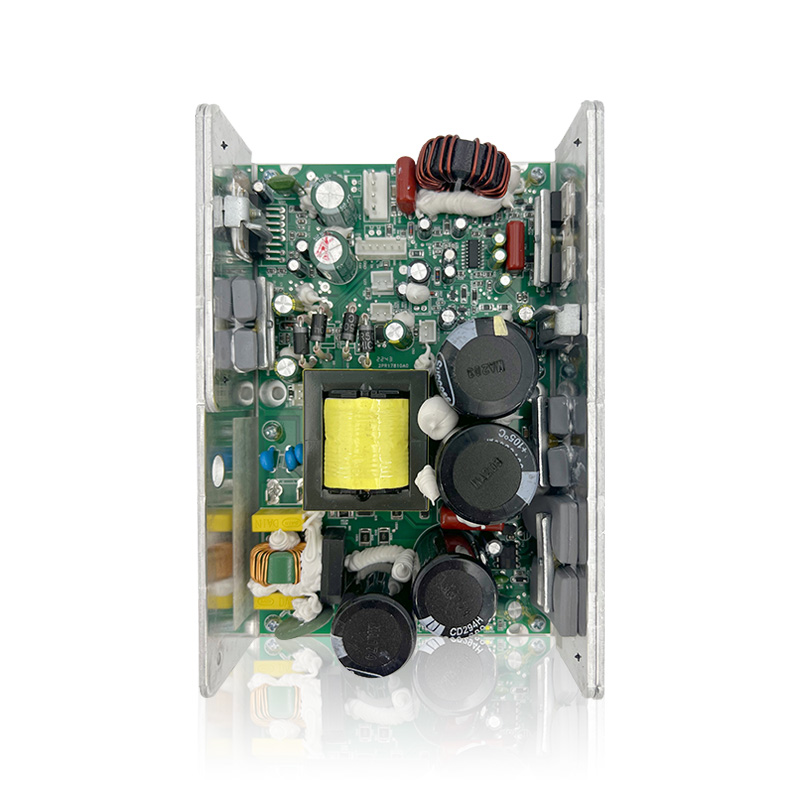
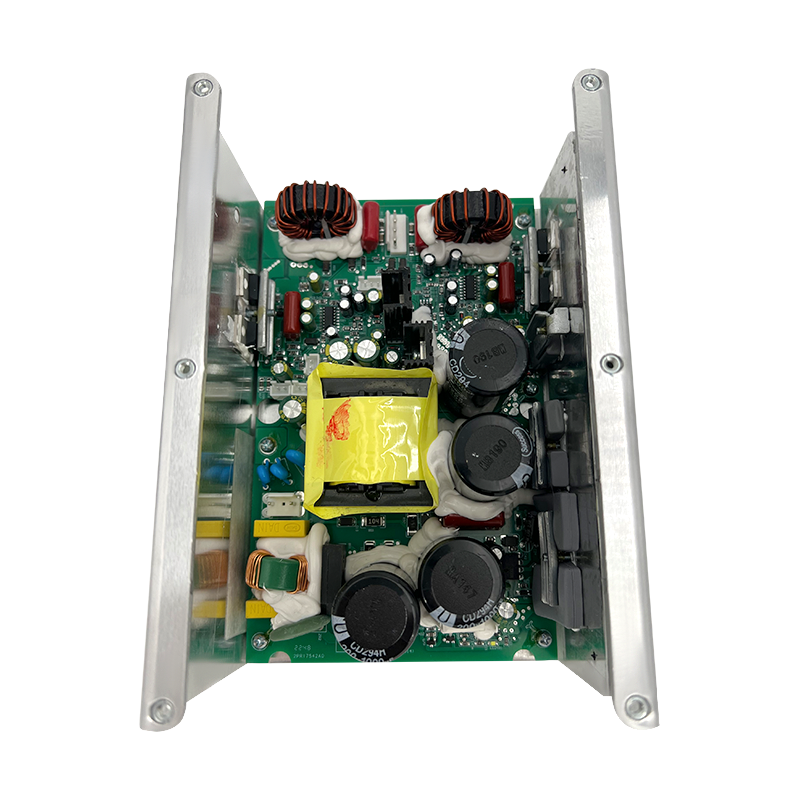
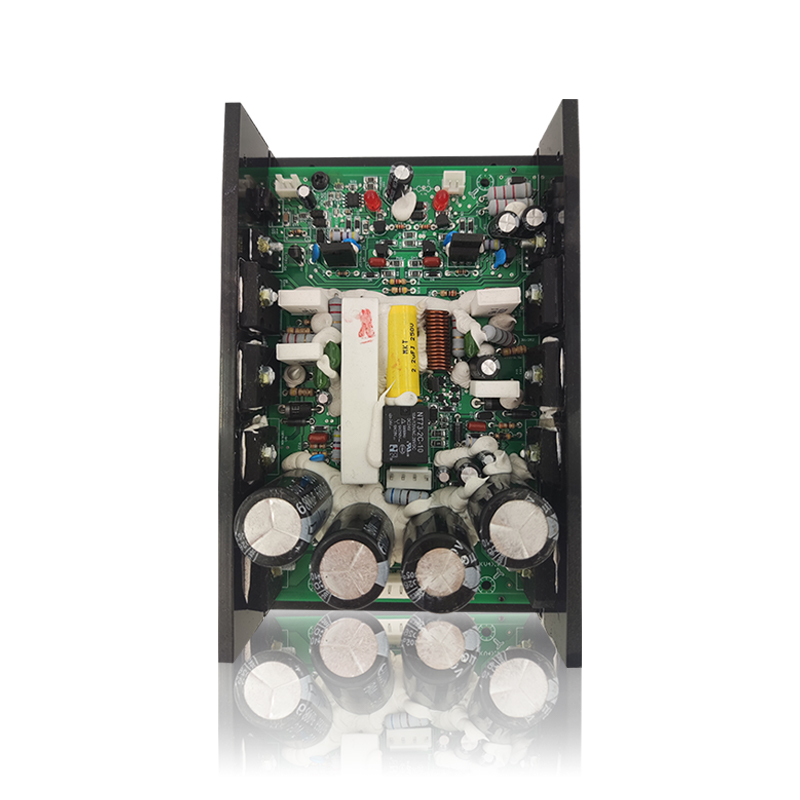
Ningbo Zhenhai Huage Electronics Co., Ltd. is a professional audio enterprise integrating research and development, production, and sales under one roof. As a dedicated Class H loudspeaker amplifier manufacturer and factory, the company has focused for many years on the production of sound mixers, active power amplifiers, microphones, and related electronic components and equipment — building deep expertise across the full audio signal chain.
Specializing in custom Class H loudspeaker amplifiers and associated products, Huage Electronics has established long-term, stable cooperative relationships with companies both in China and internationally. The company has provided OEM services for numerous well-known audio brands over an extended period, consistently adhering to a core business philosophy of delivering good products, good service, and good reputation in every engagement.
With professional design, production, and testing teams in place, Huage Electronics has the capability to customize high efficiency audio power amplifier products according to specific customer requirements — whether that means power output configuration, form factor, DSP feature sets, or OEM branding. Customers from all industries and application backgrounds are welcome to visit, review the facility, and discuss business opportunities directly with the engineering and commercial team.